

Security Handling In Front End Development




Try Before you Buy Download Free Sample Product
 Impress Your
Audience
 100%
Editable
 Save Hours
of Time


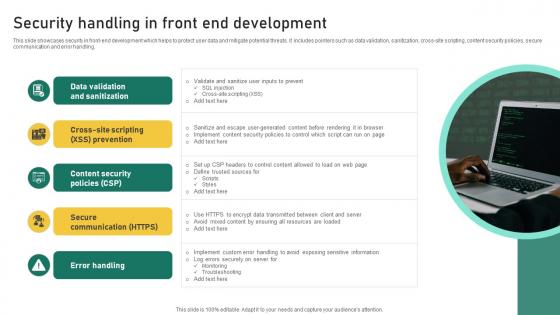
This slide showcases security in front-end development which helps to protect user data and mitigate potential threats. It includes pointers such as data validation, sanitization, cross-site scripting, content security policies, secure communication and error handling.
People who downloaded this PowerPoint presentation also viewed the following :
Security Handling In Front End Development with all 9 slides:
Use our Security Handling In Front End Development to effectively help you save your valuable time. They are readymade to fit into any presentation structure.









FAQs for Security Handling In
The primary security vulnerabilities affecting front-end applications include Cross-Site Scripting (XSS), Cross-Site Request Forgery (CSRF), insecure data storage, authentication bypasses, and dependency vulnerabilities. These security gaps present both challenges and opportunities for organizations, with many financial services and e-commerce companies finding that addressing these vulnerabilities strategically enhances customer trust, streamlines compliance processes, and ultimately delivers competitive advantage.
Developers can effectively mitigate XSS attacks through input validation, output encoding, Content Security Policy implementation, sanitization libraries, and secure coding practices. These approaches work by filtering malicious scripts, encoding user data before display, and restricting code execution, with many organizations finding that combining multiple techniques significantly enhances application security while maintaining optimal user experiences.
Content Security Policy (CSP) acts as a critical defense mechanism that prevents cross-site scripting (XSS) attacks, code injection vulnerabilities, and unauthorized resource loading by controlling which scripts, styles, and content sources browsers can execute. Through carefully configured CSP headers, web applications significantly reduce attack surfaces, enhance user data protection, and maintain regulatory compliance, with many financial institutions and e-commerce platforms finding that strategic CSP implementation delivers both robust security and improved customer trust.
Input validation prevents common security threats by filtering malicious data, sanitizing user inputs, and blocking unauthorized code execution before it reaches application systems. Through client-side and server-side validation techniques, developers can eliminate SQL injection attacks, cross-site scripting vulnerabilities, and data manipulation attempts, while ensuring data integrity and user authentication, ultimately delivering secure user experiences and protecting sensitive business information.
Best practices for handling user authentication in front-end development include secure token storage, implementing proper session management, using HTTPS exclusively, validating inputs rigorously, and employing multi-factor authentication protocols. These security measures streamline user verification while minimizing vulnerabilities, with many e-commerce platforms and financial institutions finding that robust authentication frameworks ultimately enhance customer trust and reduce fraud-related losses.
Developers securely manage API keys through environment variables, server-side proxy APIs, token-based authentication, secure storage mechanisms, and runtime key rotation strategies. These approaches enable applications to authenticate services while minimizing exposure risks, with many financial services and e-commerce platforms finding that server-side intermediaries ultimately deliver enhanced security and regulatory compliance.
CSRF prevention techniques include CSRF tokens, SameSite cookie attributes, origin header validation, double-submit cookies, and custom request headers. These security measures work by verifying request authenticity, restricting cross-origin submissions, and validating user intent, with many financial services and e-commerce platforms finding that implementing multiple layers ultimately delivers robust protection against unauthorized transactions.
Third-party libraries and frameworks introduce potential vulnerabilities through outdated dependencies, malicious code, and supply chain attacks, requiring careful evaluation and ongoing maintenance. Organizations can ensure safety by implementing automated dependency scanning, regular updates, code audits, and using package-lock files, with many development teams finding that combining security tools like Snyk or WhiteSource with strict vetting processes ultimately delivers more secure applications while maintaining development efficiency.
Secure cookie attributes prevent session hijacking, data theft, and unauthorized access by controlling how cookies transmit and store sensitive information. Through HttpOnly, Secure, and SameSite flags, developers ensure cookies only travel over encrypted connections, remain inaccessible to malicious scripts, and resist cross-site attacks, ultimately delivering robust authentication systems and protecting user data across web applications.
Developers can protect against clickjacking through X-Frame-Options headers, Content Security Policy frame-ancestors directives, frame-busting scripts, and SameSite cookie attributes. These security measures work by preventing malicious sites from embedding applications in hidden iframes, with many financial services and e-commerce platforms finding that layered defenses significantly reduce fraud attempts while maintaining seamless user experiences.
Front-end security methods include code obfuscation, minification, integrity checks, content security policies, and runtime application self-protection (RASP). While complete protection remains challenging since client-side code is inherently accessible, these approaches significantly raise barriers for attackers, with many financial services and e-commerce platforms finding that layered security measures effectively deter casual tampering and reduce vulnerability exposure.
Regular security auditing and testing are crucial for front-end codebases, helping identify vulnerabilities in dependencies, authentication flows, data handling, and user input validation before they reach production. These assessments streamline threat detection through automated scanning, penetration testing, and code reviews, with many organizations finding that consistent auditing ultimately delivers enhanced user trust, regulatory compliance, and competitive advantage in an increasingly security-conscious market.
Modern JavaScript frameworks present both challenges and opportunities for security, including client-side vulnerabilities, dependency risks, XSS protection mechanisms, and CSP implementation complexities. While frameworks like React and Angular deliver built-in security features, enhanced authentication systems, and automated sanitization, organizations increasingly find that proper configuration, regular updates, and security-first development practices ultimately determine application resilience against evolving threats.
Developers implement secure coding practices with user-generated content through input validation, output encoding, content sanitization, XSS prevention filters, and strict content security policies. These approaches streamline security by automatically filtering malicious scripts, encoding special characters, and validating data types, with many web applications finding that comprehensive sanitization libraries ultimately deliver safer user experiences while maintaining functionality.
User education plays a crucial role in frontend security by helping users recognize phishing attempts, understand password best practices, identify suspicious URLs, and respond appropriately to security warnings. Well-informed users serve as an additional security layer, with many organizations finding that comprehensive security awareness training significantly reduces successful social engineering attacks, ultimately strengthening overall application security and minimizing human-error vulnerabilities.
-
SlideTeam has helped me take my presentation to the next level. Everyone at the office is impressed! I’ll be using their designs for a long-long time.
-
Slideteam offers pocket-friendly products. As a college student this is a really necessary thing to look at while paying for something.