

Security Information And Event Management Deployment Complete Deck Ppt Sample





Try Before you Buy Download Free Sample Product
 Impress Your
 Audience
 100%
100% Editable
 Save Hours
 of Time


This Security Information and Event Management Deployment PowerPoint presentation briefly describes the challenges faced by companies without SIEM, such as cyber-attacks, regulatory compliance failures, and insider threats. In this Security Event Management SEM PowerPoint Presentation, we elaborate on how SIEM can overcome business challenges and improve security posture by assessing business needs. It enlists the various solutions provided by SIEM and a timeline for implementing those solutions. In addition, this Security Information Management SIM PPT contains the various deployment approaches of SIEM solutions, how to select the right deployment strategy, and different tools to manage and monitor SIEM. The Security Information and Event Management Deployment PPT presentation also demonstrates the implementation steps of SIEM, covering architecture design, log collection and management, SIEM configuration, and management. It also covers the incident response framework. Furthermore, this Security Event Management SEM template showcases the team formation for SIEM implementation and the roles and responsibilities of each team member. It also outlines the process of building an on-premises security operations center. Moreover, this Security Information Management SIM deck comprises a training schedule, deployment challenges, solutions, a SIEM costing model, dashboards for incident monitoring and security alerts, and IDS event tracking. Lastly, this Security Information and Event Management Deployment PowerPoint Presentation represents the impact of SIEM implementation on business, post-implementation steps, and a few case studies related to it. Download our 100 percent editable and customizable template, which is also compatible with Google Slides.
People who downloaded this PowerPoint presentation also viewed the following :
Content of this Powerpoint Presentation
Slide 1: This slide introduces Security Information and Event Management Deployment.
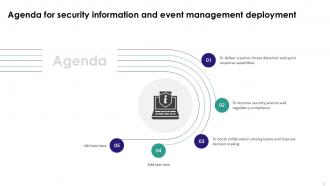
Slide 2: This slide states Agenda of the presentation.
Slide 3: This slide shows Table of Content for the presentation.
Slide 4: This slide highlights title for topics that are to be covered next in the template.
Slide 5: This slide outlines the various problems the company faces with its existing security infrastructure, such as cyber attacks, regulatory compliance failures, and insider threats.
Slide 6: This slide outlines the impact of challenges the company experienced in the previous year, such as cyber-attacks, regulatory compliance failures, and insider threats.
Slide 7: This slide highlights title for topics that are to be covered next in the template.
Slide 8: This slide outlines how security information and event management will overcome business challenges through regulatory compliance, event correlation, and incident monitoring and response.
Slide 9: This slide highlights title for topics that are to be covered next in the template.
Slide 10: This slide outlines the timeline for effective security information and event management implementation in the company, including the various steps to be performed at the interval of each week.
Slide 11: This slide highlights title for topics that are to be covered next in the template.
Slide 12: This slide represents the regulatory compliance requirements of a business for GDPR, PCI DSS, and HIPAA regulatory standards.
Slide 13: This slide outlines the security requirements of a business for implementing security information and event management solution including real-time monitoring, user activity monitoring, etc.
Slide 14: This slide showcases the objectives of security information and event management deployment, including security monitoring, advanced threat detection, threat hunting, compliance reporting and auditing, and forensics and incident response.
Slide 15: This slide highlights title for topics that are to be covered next in the template.
Slide 16: This slide outlines the two deployment strategies for security information and event management, covering on-premises, and cloud SIEM self managed.
Slide 17: This slide represents the other two approaches of security information and event management, including self-hosted hybrid managed, and SIEM as a Service.
Slide 18: This slide represents the various deployment methods for security information and event management, such as on-premise, cloud-based, hybrid, SIEM as a service and managed services.
Slide 19: This slide represents the comparative analysis of the various SIEM tools based on the features they offer, benefits, and costs.
Slide 20: This slide highlights title for topics that are to be covered next in the template.
Slide 21: This slide showcases the architecture design of in-house security information and event management solution deployment and the main components include threat and vulnerability management processes, visualization, alerting, analytics, etc.
Slide 22: This slide highlights the security information and event management process in an organization, including information gathering, normalization, data aggregation, data evaluation, etc.
Slide 23: This slide highlights title for topics that are to be covered next in the template.
Slide 24: This slide outlines the declaration of logging sources for SIEM deployment, including security events, network logs, application and devices, and IT infrastructure.
Slide 25: This slide outlines the methods used for log collection from different log sources such as core windows infrastructure, database platforms, endpoint security solutions, firewalls, etc.
Slide 26: This slide represents the log management process for SIEM implementation in the company and how data will be collected from users, endpoints, applications, data sources, firewalls, etc.
Slide 27: This slide represents the log flow funnel of SIEM solution, including its various phases such as data capturing, filtration, indexing, analyzing, correlating, and thresholding.
Slide 28: This slide outlines the steps of the operational process of a security information and event management system, including data collection, data management, and log retention.
Slide 29: This slide highlights title for topics that are to be covered next in the template.
Slide 30: This slide outlines the 5 steps for detection rule setting for SIEM implementation, including scoping, rule design, rule testing, deployment to production, and tuning.
Slide 31: This slide outlines the primary steps for creating event correlation rules for security information and event management deployment in an organization.
Slide 32: This slide represents the event correlation and analytics process of SIEM implementation, including outcomes such as early threat detection, regular compliance reports, lower costs, etc.
Slide 33: This slide represents the various incident types that triggered alerts and SIEM alert types, such as too many unsuccessful login attempts, virus or malware detection, abnormal network traffic, etc.
Slide 34: This slide highlights title for topics that are to be covered next in the template.
Slide 35: This slide highlights the different parameters for effective management of SIEM solutions, including the number of repeated or outdated rules, the reduction in false negatives/positives, etc.
Slide 36: This slide represents the metrics used to assess the performance of security information and event management implementation in different categories, such as threat detection, compliance monitoring, and user activity tracking.
Slide 37: This slide highlights title for topics that are to be covered next in the template.
Slide 38: This slide outlines the main steps of incident response framework for handling data breaches in an organization, including early detection, analysis, prioritization, and notification.
Slide 39: This slide showcases the incident response framework for handling data breaches in an organization, including containment and forensics, recovery, incident review, etc.
Slide 40: This slide highlights title for topics that are to be covered next in the template.
Slide 41: This slide represents the team building for deploying security information and event management in the organization, including SIEM integration engineer, enterprise security manager, etc.
Slide 42: This slide represents the roles and responsibilities involved in deploying SIEM infrastructure in the organization, including integration engineer, security manager, log manager, etc.
Slide 43: This slide highlights title for topics that are to be covered next in the template.
Slide 44: This slide represents the various models for security operations center building for SIEM deployment, covering reactive, distributed, multifunctional, fusion, command, and virtual.
Slide 45: This slide showcases the various roles associated with security operations center, including alert analyst, incident responder, subject matter expert or hunter, manager, etc.
Slide 46: This slide highlights the focus areas of security operations center, covering control and digital forensics, network and system administration, and monitoring and risk management.
Slide 47: This slide outlines the incident response plan of security operations center staff, including steps such as event collection, prioritization & investigation, containment & recovery, remediation & mitigation, and assessment & audit.
Slide 48: This slide outlines the various metrics to measure the performance of security operations center, including metrics, such as MTTD, MTTR, total cases per month, analysts productivity, etc.
Slide 49: This slide highlights title for topics that are to be covered next in the template.
Slide 50: This slide showcases the training program for successful SIEM implementation in the company, covering components such as duration, objectives, mode of training, participants, etc.
Slide 51: This slide highlights title for topics that are to be covered next in the template.
Slide 52: This slide represents the various challenges associated with SIEM implementation in an organization, including configuration complexity, hidden costs, resource restrictions, integration issues, and data onboarding challenges.
Slide 53: This slide describes the possible solutions to overcome the SIEM deployment challenges, such as prioritizing integration, scalability planning, defining clear objectives, making data retention policies, and investing in staff training.
Slide 54: This slide highlights title for topics that are to be covered next in the template.
Slide 55: This slide outlines the budget allocation for security information and event management implementation in the company, including estimated cost, actual cost, and expense categories.
Slide 56: This slide outlines the budget allocation for security information and event management implementation in the company, including the cost for each phase of SIEM implementation.
Slide 57: This slide highlights title for topics that are to be covered next in the template.
Slide 58: This slide showcases the incident monitoring and security alerts dashboard for SIEM implementation, covering components such as all events, successful login attempts, login failures, etc.
Slide 59: This slide showcases the Intrusion Detection System event tracking dashboard, which covers components such as internal IDS events, unique IDS events, inbound IDS incidents, etc.
Slide 60: This slide highlights title for topics that are to be covered next in the template.
Slide 61: This slide highlights the impact of security information and event management implementation on business by showing improvement in the number of cyber attacks.
Slide 62: This slide outlines the benefits of implementing security information and event management in organization.
Slide 63: This slide highlights title for topics that are to be covered next in the template.
Slide 64: This slide outlines the security information and event management maturity hierarchy, including different levels such as threat hunting, behavioral alarming, threat feeds, rule-based alarming, etc.
Slide 65: This slide outlines the tuning steps of SIEM solution, including adjusting detection rules, conducting regular audits, updating SIEM software and signature, monitoring SIEM performance, etc.
Slide 66: This slide highlights title for topics that are to be covered next in the template.
Slide 67: This slide highlights the case study associated with implementing security information and event management in a government organization, including the client's background, industry type, technology used, problem, solution and outcome.
Slide 68: This slide represents the case study for implementing security information and event management in a Saudi Arabia based healthcare organization, including the challenge, solution, and outcome.
Slide 69: This slide represents the case study for implementing security information and event management in an energy service provider organization, including the problem, solution, and outcome.
Slide 70: This slide contains all the icons used in this presentation.
Slide 71: This slide is titled as Additional Slides for moving forward.
Slide 72: This slide presents Bar chart with two products comparison.
Slide 73: This is a Timeline slide. Show data related to time intervals here.
Slide 74: This slide depicts Venn diagram with text boxes.
Slide 75: This is a Financial slide. Show your finance related stuff here.
Slide 76: This slide contains Puzzle with related icons and text.
Slide 77: This is Our Goal slide. State your firm's goals here.
Slide 78: This is an Idea Generation slide to state a new idea or highlight information, specifications etc.
Slide 79: This slide provides 30 60 90 Days Plan with text boxes.
Slide 80: This slide shows Post It Notes. Post your important notes here.
Slide 81: This is a Thank You slide with address, contact numbers and email address.
Security Information And Event Management Deployment Complete Deck Ppt Sample with all 89 slides:
Use our Security Information And Event Management Deployment Complete Deck Ppt Sample to effectively help you save your valuable time. They are readymade to fit into any presentation structure.











-
Best Representation of topics, really appreciable.
-
The PPT layout is great and it has an effective design that helps in presenting corporate presentations. It's easy to edit and the stunning visuals make it an absolute steal!