

Security System Evaluation Checklist To Enhance Effectiveness




Try Before you Buy Download Free Sample Product
 Impress Your
Audience
 100%
Editable
 Save Hours
of Time


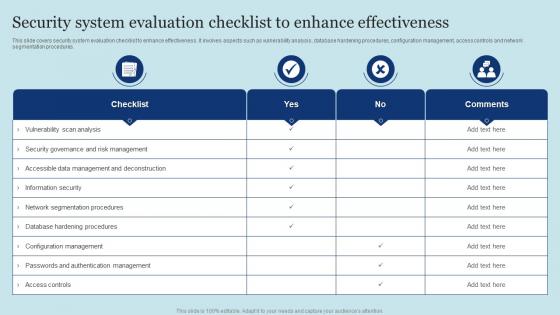
This slide covers security system evaluation checklist to enhance effectiveness. It involves aspects such as vulnerability analysis, database hardening procedures, configuration management, access controls and network segmentation procedures.
People who downloaded this PowerPoint presentation also viewed the following :
Security System Evaluation Checklist To Enhance Effectiveness with all 6 slides:
Use our Security System Evaluation Checklist To Enhance Effectiveness to effectively help you save your valuable time. They are readymade to fit into any presentation structure.






FAQs for Security System Evaluation Checklist
Key components include threat assessment capabilities, access control systems, surveillance infrastructure, incident response protocols, and compliance frameworks. These elements work together by identifying vulnerabilities, controlling facility access, and monitoring activities in real-time, with many organizations finding that comprehensive evaluations ultimately deliver enhanced protection and operational efficiency.
Organizations can determine security effectiveness through comprehensive assessments including vulnerability testing, penetration testing, compliance audits, incident response evaluations, and security metrics analysis. Through regular testing and monitoring, companies in banking, healthcare, and retail can identify gaps, measure response times, and benchmark against industry standards, ultimately ensuring robust protection while minimizing operational disruptions and potential financial losses.
Security system success metrics include threat detection rates, response times, false positive frequencies, incident resolution speeds, and compliance adherence levels. These measurements enable organizations to assess operational efficiency, minimize security gaps, and optimize resource allocation, with many institutions finding that comprehensive metric tracking ultimately delivers enhanced protection, reduced costs, and improved regulatory compliance across their security infrastructure.
Emerging technologies like AI and IoT revolutionize traditional security evaluations by introducing predictive analytics, real-time threat detection, automated response systems, and interconnected device monitoring capabilities. These technologies enable security teams to identify vulnerabilities faster, analyze behavioral patterns more comprehensively, and streamline incident response protocols, with many organizations finding that AI-driven assessments deliver significantly enhanced accuracy and operational efficiency.
Employee training serves as a critical component in security system evaluation, determining how effectively personnel can operate controls, respond to alerts, identify vulnerabilities, and follow protocols. Comprehensive training programs enhance system performance by reducing human error, improving incident response times, and ensuring consistent security practices, with many organizations finding that well-trained staff significantly amplifies their security infrastructure's protective capabilities.
Organizations identify potential vulnerabilities through comprehensive penetration testing, vulnerability scanning, access control audits, network traffic analysis, and social engineering assessments. These methodologies enable systematic examination of technical weaknesses, human factors, and procedural gaps, with many financial institutions and healthcare systems finding that regular evaluations ultimately deliver enhanced threat detection and significantly reduced security risks.
**INPUT**: What are the best practices for conducting a security risk assessment prior to evaluation? **OUTPUT**: Best practices include comprehensive asset inventory, threat modeling, vulnerability scanning, regulatory compliance review, and stakeholder interviews across all organizational levels. These methodologies streamline evaluation processes by identifying critical security gaps, prioritizing resource allocation, and establishing baseline metrics, with many organizations finding that thorough pre-assessment ultimately delivers more targeted security investments and measurable risk reduction.
Businesses should perform comprehensive security system evaluations quarterly, with continuous monitoring and annual third-party assessments to address evolving threats, regulatory changes, and technological updates. This strategic approach enables organizations to identify vulnerabilities, optimize resource allocation, and maintain competitive advantage, with many financial services and healthcare institutions finding that regular evaluations significantly reduce breach risks while enhancing operational efficiency.
Organizations should evaluate third-party security solutions based on compliance certifications, integration capabilities, scalability options, incident response times, and cost-effectiveness. Financial institutions and healthcare providers increasingly prioritize solutions offering real-time threat detection, seamless API integration, and 24/7 monitoring support, ultimately delivering enhanced protection while reducing internal resource demands.
Regulatory compliance requirements significantly shape security system evaluation by mandating specific technical standards, audit capabilities, data protection measures, and reporting functionalities that systems must demonstrate. Organizations in healthcare, finance, and government find that compliance frameworks like HIPAA, SOX, and GDPR drive evaluation criteria toward solutions offering comprehensive logging, encryption, and access controls, ultimately ensuring both security effectiveness and regulatory adherence.
Common pitfalls when evaluating security systems include focusing solely on upfront costs rather than total ownership expenses, neglecting scalability requirements, overlooking integration capabilities with existing infrastructure, and inadequate assessment of vendor support quality. Many organizations find that rushing evaluation timelines, ignoring user training needs, and underestimating implementation complexity ultimately compromises security effectiveness and increases long-term operational costs.
Businesses can integrate physical and cyber security evaluations through unified risk assessments, cross-domain incident response protocols, shared threat intelligence platforms, and coordinated compliance frameworks. This strategic combination enables organizations to identify interconnected vulnerabilities, streamline security operations, and enhance overall protection, with many enterprises finding that integrated approaches deliver significantly improved threat detection and cost-effective resource allocation.
Recommended tools include vulnerability scanners like Nessus and OpenVAS, penetration testing frameworks such as Metasploit, network analyzers like Wireshark, and compliance assessment platforms including Rapid7 and Qualys. These technologies streamline evaluations by automating threat detection, identifying system weaknesses, and generating comprehensive reports, with many organizations finding that integrated platforms deliver faster assessments and enhanced security postures.
User feedback is significant in security system evaluation because it reveals real-world usability issues, operational effectiveness, and implementation challenges that technical testing might miss. Through employee surveys and stakeholder input, organizations identify system gaps, enhance user adoption rates, and optimize security protocols, with many institutions finding that user insights drive more practical, effective security solutions that balance protection with operational efficiency.
Incident response capability significantly influences security system assessment by evaluating detection speed, containment effectiveness, recovery protocols, and communication frameworks during security breaches. Organizations across sectors like banking, healthcare, and retail find that robust incident response capabilities minimize damage, reduce downtime, and ensure regulatory compliance, ultimately delivering faster threat resolution and enhanced operational resilience.
-
Their professional templates are very impressive, even my manager was curious about the source. I am very grateful.
-
Visually stunning presentation, love the content.