

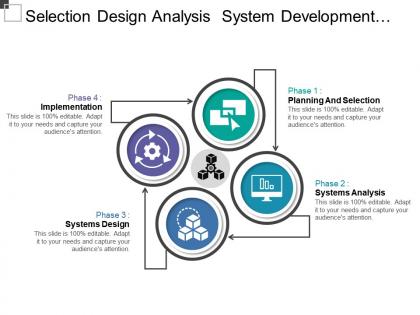
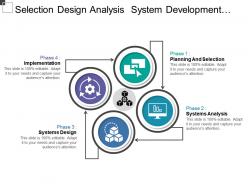
Selection design analysis system development life cycle with arrows and icons




Try Before you Buy Download Free Sample Product
 Impress Your
 Audience
 100%
100% Editable
 Save Hours
 of Time


Advise inventive folks with our Selection Design Analysis System Development Life Cycle With Arrows And Icons. Guide them on how to display ingenuity.
People who downloaded this PowerPoint presentation also viewed the following :
Selection design analysis system development life cycle with arrows and icons with all 5 slides:
Acquire financial foresight with our Selection Design Analysis System Development Life Cycle With Arrows And Icons. Get a glimpse of the economy of the future.
FAQs for Selection design analysis system development life cycle with
The key phases of Selection Design Analysis in SDLC include requirements gathering, alternative solution evaluation, feasibility assessment, design specification creation, and stakeholder validation. These phases streamline decision-making by comparing multiple design approaches, evaluating technical constraints, and assessing resource requirements, with many organizations finding that systematic selection analysis ultimately delivers more robust solutions and reduces costly redesign cycles.
Selection Design Analysis significantly influences software project effectiveness by ensuring optimal technology choices, architectural decisions, and resource allocation align with project requirements and business objectives. Through systematic evaluation of design alternatives, development teams minimize technical debt, reduce implementation risks, and accelerate delivery timelines, while enhancing system scalability and maintainability, ultimately delivering superior software solutions that meet stakeholder expectations.
**INPUT**: What methodologies are commonly used during the Selection Design Analysis phase? **OUTPUT**: Selection Design Analysis methodologies include feasibility studies, cost-benefit analysis, risk assessment frameworks, stakeholder impact evaluation, and technical compatibility reviews. These approaches streamline decision-making by comparing multiple design alternatives, evaluating resource requirements, and assessing implementation timelines, with many organizations finding that systematic methodology application ultimately delivers more strategic technology selections and minimizes project risks.
Stakeholders can be effectively involved through structured workshops, requirement gathering sessions, design reviews, and collaborative prototyping activities that capture their needs and expectations. By establishing clear communication channels, regular feedback loops, and cross-functional teams, organizations streamline decision-making processes while ensuring all perspectives are integrated, ultimately delivering solutions that meet business objectives and user requirements.
Software solution selection criteria include functionality alignment, scalability requirements, integration capabilities, cost-effectiveness, vendor reliability, and security compliance. These factors enable organizations to evaluate solutions systematically by assessing technical specifications, implementation timelines, and long-term maintenance costs, with many enterprises finding that comprehensive criteria frameworks ultimately deliver better ROI and reduced project risks.
Risk assessment drives Selection Design Analysis by evaluating potential technical, operational, and business risks associated with each design alternative, ensuring solutions align with organizational risk tolerance and compliance requirements. Through systematic risk analysis, organizations identify vulnerabilities early, compare risk-benefit ratios across options, and select designs that minimize exposure while maximizing strategic value, ultimately delivering more resilient and sustainable solutions.
User experience serves as a critical evaluation criterion in Selection Design Analysis, influencing interface design, usability requirements, accessibility standards, and user workflow optimization. Through comprehensive UX assessment, development teams evaluate how different design alternatives impact user satisfaction, task completion rates, and overall system adoption, with many organizations finding that prioritizing user-centered design principles during selection phases ultimately delivers reduced training costs, higher user engagement, and improved business outcomes.
Prototyping aids Selection Design Analysis by enabling early user feedback, visualizing design concepts, and identifying usability issues before full development begins. Through interactive mockups and wireframes, development teams can test multiple design alternatives, validate user requirements, and reduce costly changes later in the SDLC, ultimately streamlining the selection process and enhancing final product quality.
Common pitfalls include insufficient stakeholder consultation, inadequate requirement documentation, overlooking scalability considerations, rushing timeline constraints, and neglecting integration complexities. These challenges can derail selection processes by creating misaligned expectations, incomplete technical assessments, and poor vendor evaluations, with many organizations finding that thorough upfront analysis ultimately delivers better system outcomes and reduced implementation risks.
Selection Design Analysis interfaces with requirements gathering by validating functional specifications, identifying technical constraints, and evaluating feasibility of proposed solutions against business objectives. Through systematic analysis, development teams streamline requirement prioritization, enhance solution architecture planning, and minimize scope creep, while ensuring stakeholder expectations align with technical capabilities, ultimately delivering more accurate project timelines and resource allocation.
Tools and technologies for Selection Design Analysis in SDLC include requirements management platforms, design modeling software, decision matrices, prototyping tools, and stakeholder collaboration systems. These technologies streamline evaluation processes by automating comparisons, visualizing design alternatives, and tracking decision rationale, with many development teams finding that integrated toolsets significantly reduce analysis time while enhancing design quality and stakeholder alignment.
Feedback loops during Selection Design Analysis can be established through regular stakeholder reviews, prototype testing sessions, design walkthroughs, and iterative validation checkpoints throughout the process. These mechanisms enable continuous refinement by gathering input from end-users, technical teams, and business stakeholders, ultimately ensuring the selected design meets functional requirements while minimizing costly revisions later in development.
Selection Design Analysis success metrics include user acceptance rates, system performance benchmarks, cost-benefit ratios, implementation timeline adherence, and stakeholder satisfaction scores. These evaluation criteria enable organizations to measure design effectiveness, resource optimization, and strategic alignment, with many enterprises finding that comprehensive metric frameworks ultimately deliver improved decision-making processes and competitive advantage.
Selection Design Analysis adapts to agile methodologies by incorporating iterative evaluation cycles, continuous stakeholder feedback, and flexible design criteria that evolve with each sprint. Through rapid prototyping and incremental assessment phases, development teams can streamline decision-making processes, enhance cross-functional collaboration, and deliver more responsive solutions, ultimately enabling faster time-to-market and improved product alignment with user needs.
Selection Design Analysis significantly impacts project timelines and budgets by enabling early identification of optimal solutions, reducing costly redesigns, and streamlining development phases through informed decision-making. This systematic evaluation helps organizations avoid expensive pivots mid-project, accelerate implementation cycles, and allocate resources more effectively, with many software development teams finding that thorough upfront analysis ultimately delivers faster time-to-market and reduced overall project costs.
-
Graphics are very appealing to eyes.
-
Unique and attractive product design.