

Selective Deposition Lamination Sdl 3d Printing Process 3d Printing In Manufacturing





Try Before you Buy Download Free Sample Product
 Impress Your
Audience
 100%
Editable
 Save Hours
of Time


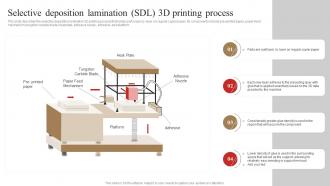
This slide describes the selective deposition lamination 3D printing process that builds parts layer by layer on regular copier paper. Its components include pre-printed paper, paper-feed mechanism, tungsten carbide blade, heat plate, adhesive nozzle, adhesive, and platform.
People who downloaded this PowerPoint presentation also viewed the following :
Selective Deposition Lamination Sdl 3d Printing Process 3d Printing In Manufacturing with all 6 slides:
Use our Selective Deposition Lamination Sdl 3d Printing Process 3d Printing In Manufacturing to effectively help you save your valuable time. They are readymade to fit into any presentation structure.





FAQs for Selective Deposition Lamination Sdl 3d Printing Process 3d
SDL offers superior material efficiency, reduced waste generation, enhanced design flexibility, faster prototyping capabilities, and lower tooling costs compared to traditional manufacturing. This additive approach enables complex geometries, multi-material integration, and on-demand production, with aerospace and automotive industries finding that SDL delivers significant cost reductions while accelerating product development cycles.
SDL integrates with existing 3D printing technologies by combining additive manufacturing with precision material deposition, selective layer control, and automated post-processing workflows. This strategic combination enables manufacturers to produce complex geometries with multiple materials simultaneously, reduce production time by eliminating assembly steps, and achieve superior surface finishes, with aerospace and medical device companies finding that SDL significantly enhances their prototyping and small-batch production capabilities.
SDL processes most commonly utilize thermoplastic polymers like PLA, ABS, and PEEK, metal powders including aluminum and titanium, ceramics such as alumina, and composite materials combining polymers with carbon fibers. These material choices significantly impact mechanical strength, thermal resistance, and surface finish quality, with aerospace and automotive manufacturers finding that strategic material selection enables enhanced performance characteristics, reduced weight, and improved durability in complex geometries.
SDL presents both challenges and opportunities for mass production, offering faster build speeds and material efficiency that can scale effectively, while also excelling in custom applications requiring complex geometries and multi-material components. Many manufacturers find that SDL's versatility enables both high-volume production of standardized parts and specialized custom work, ultimately delivering operational flexibility and competitive advantage in an increasingly diverse manufacturing landscape.
SDL typically achieves layer thicknesses ranging from 0.1 to 0.3 millimeters, with thinner layers delivering enhanced surface finish and dimensional accuracy. These precise layer controls enable manufacturers across aerospace, automotive, and medical device sectors to produce components with superior resolution and reduced post-processing requirements, ultimately streamlining production workflows while maintaining competitive quality standards.
Aerospace, automotive, medical device manufacturing, and electronics industries are increasingly adopting SDL to address challenges like complex geometries, material waste, and precision requirements in multi-material components. This technology enables manufacturers to reduce material costs by up to 40%, streamline production of intricate parts, and achieve superior surface finishes, with many organizations finding that SDL delivers faster prototyping cycles and enhanced design flexibility compared to traditional manufacturing methods.
SDL significantly enhances manufacturing sustainability by minimizing material waste through precise layer-by-layer deposition, reducing energy consumption compared to traditional subtractive methods, and enabling local production that cuts transportation emissions. This additive approach allows manufacturers in aerospace, automotive, and electronics sectors to optimize resource utilization while reducing their environmental footprint, ultimately delivering cost savings and competitive advantage in an increasingly eco-conscious marketplace.
Primary SDL design considerations include layer adhesion requirements, material thermal compatibility, support structure minimization, surface finish specifications, and dimensional tolerance planning. Engineers must balance these factors with processing parameters like temperature profiles and deposition speeds, while considering post-processing requirements, ultimately ensuring optimal part performance and manufacturing efficiency across diverse applications.
SDL integrates seamlessly with CAD software through direct file compatibility, automated toolpath generation, and real-time design optimization algorithms that streamline the transition from digital models to physical prototypes. This integration enables engineers and designers to modify geometries instantly, preview layer-by-layer deposition sequences, and optimize material usage, ultimately delivering faster iteration cycles and reduced development costs across manufacturing workflows.
SDL builds typically require support removal, surface finishing through sanding or machining, adhesive curing in controlled environments, and quality inspection processes. These post-processing steps can extend turnaround time by 24-48 hours, though many manufacturers find that automated finishing systems and optimized curing cycles significantly streamline operations while delivering superior part quality and dimensional accuracy.
SDL eliminates material waste by building components layer-by-layer using only necessary materials, unlike subtractive processes that remove excess material through cutting or machining. This additive approach enables manufacturers in aerospace, automotive, and medical device sectors to achieve up to 90% material utilization rates, ultimately delivering significant cost savings and enhanced sustainability.
SDL technology presents both higher initial investment costs compared to basic FDM printers and competitive pricing against advanced metal AM systems like SLM or EBJ. While SDL equipment requires significant upfront capital, many manufacturers find that its multi-material capabilities, reduced post-processing requirements, and enhanced part quality ultimately deliver lower per-part costs and faster ROI, especially for complex prototyping applications.
Emerging SDL advancements include enhanced multi-material capabilities, improved resolution precision, faster layer processing speeds, advanced metal alloy compatibility, and integrated quality monitoring systems. These innovations enable manufacturers across aerospace, medical device, and automotive sectors to produce increasingly complex geometries with superior material properties, ultimately delivering reduced production costs and expanded design possibilities while maintaining stringent quality standards.
SDL delivers faster setup, more precise material placement, and reduced waste through automated selective deposition, while traditional lamination requires manual alignment and full-sheet processing. Users experience streamlined workflows with SDL's digital controls and immediate placement verification, whereas conventional methods involve multiple manual steps, extensive trimming, and repositioning adjustments, ultimately enabling faster project completion and enhanced accuracy in professional printing environments.
Future research areas for improving SDL performance include multi-material processing capabilities, enhanced layer adhesion mechanisms, real-time quality monitoring systems, and advanced thermal management techniques. These developments enable manufacturers in aerospace, automotive, and medical device sectors to achieve higher precision, faster production cycles, and improved material properties, ultimately delivering greater design flexibility and cost-effective manufacturing solutions for complex geometries.
-
The PPT layout is great and it has an effective design that helps in presenting corporate presentations. It's easy to edit and the stunning visuals make it an absolute steal!
-
Informative and engaging! I really like the design and quality of the slides.