

Self Driving And Parking Vehicles Using Artificial Intelligence Training Ppt




Try Before you Buy Download Free Sample Product
 Impress Your
 Audience
 100%
100% Editable
 Save Hours
 of Time


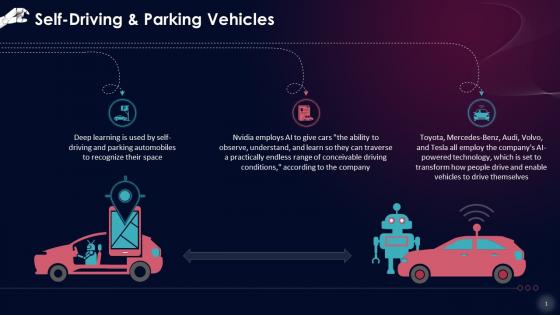
This slide provides information about self-driving and parking vehicles and the Artificial Intelligence technology backing these.
People who downloaded this PowerPoint presentation also viewed the following :
Self Driving And Parking Vehicles Using Artificial Intelligence Training Ppt with all 17 slides:
Use our Self Driving And Parking Vehicles Using Artificial Intelligence Training Ppt to effectively help you save your valuable time. They are readymade to fit into any presentation structure.














FAQs for Self Driving And Parking Vehicles Using Artificial
Key technologies driving autonomous vehicle development include LiDAR sensors, computer vision systems, artificial intelligence algorithms, GPS navigation, and vehicle-to-vehicle communication networks. These technologies work together by enabling real-time environment mapping, predictive decision-making, and seamless connectivity, with automotive manufacturers and logistics companies finding that this strategic combination ultimately delivers safer transportation and enhanced operational efficiency.
Regulations and policies significantly influence autonomous vehicle adoption by establishing safety standards, testing protocols, liability frameworks, and operational guidelines that manufacturers must meet. While comprehensive policies can accelerate deployment by providing clear compliance pathways, inconsistent regulations across jurisdictions create challenges, with many automotive companies finding that harmonized standards ultimately deliver faster market entry and greater consumer confidence.
Autonomous driving safety concerns include sensor limitations in adverse weather, cybersecurity vulnerabilities, unpredictable human driver interactions, ethical decision-making algorithms, and system failure protocols. While these challenges present legitimate considerations, many automotive manufacturers and tech companies are addressing them through advanced redundancy systems, enhanced machine learning, and rigorous testing protocols, ultimately delivering safer transportation solutions.
Ethical considerations shape autonomous vehicle programming through moral decision algorithms, liability frameworks, and safety prioritization protocols that determine responses in unavoidable accident scenarios. These systems balance pedestrian protection, passenger safety, and property damage while addressing cultural values and legal requirements, with automakers increasingly incorporating diverse ethical perspectives to ensure socially acceptable and legally compliant autonomous behavior.
Public perceptions significantly influence autonomous vehicle acceptance through trust in safety systems, comfort with technology integration, and willingness to relinquish driving control. These perceptions shape regulatory policies, insurance frameworks, and market adoption rates, with many transportation authorities finding that transparent communication about testing results, safety protocols, and gradual implementation builds consumer confidence and accelerates widespread acceptance.
Data privacy in autonomous vehicles can be managed through encryption protocols, anonymization techniques, decentralized data processing, consent management systems, and selective data retention policies. These approaches enable manufacturers to minimize personal information exposure while maintaining vehicle safety and performance, with many automotive companies finding that transparent privacy frameworks ultimately enhance consumer trust and regulatory compliance.
Autonomous vehicles require significant urban infrastructure changes, including smart traffic systems, dedicated lanes, updated parking facilities, enhanced connectivity networks, and redesigned intersections. These modifications enable cities to optimize traffic flow, reduce congestion, and repurpose parking spaces for housing or commercial use, with many metropolitan areas finding that strategic infrastructure investment ultimately delivers improved mobility and enhanced urban efficiency.
AI integration enhances autonomous vehicles by enabling real-time data processing, predictive decision-making, and adaptive learning from traffic patterns. Through machine learning algorithms, these vehicles analyze sensor data, recognize objects, and optimize routes dynamically, while continuously improving performance through experience, ultimately delivering safer transportation and reduced operational costs.
Autonomous vehicles present both significant environmental benefits and implementation challenges, including reduced emissions through optimized routing and electric integration, decreased traffic congestion, improved fuel efficiency, and potential for shared mobility models. While manufacturing batteries and infrastructure development create initial environmental costs, many transportation agencies find that strategic deployment ultimately delivers cleaner air quality and reduced carbon footprints across urban environments.
Manufacturers approach autonomous vehicle development through diverse strategies, with Tesla emphasizing camera-based vision systems, Waymo leveraging comprehensive LiDAR mapping, and traditional automakers like GM and Ford pursuing gradual automation levels. These varying approaches reflect different philosophies on sensor integration, data collection, and safety validation, with many companies finding that strategic partnerships with tech firms accelerate development while reducing costs.
Autonomous vehicles will significantly transform transportation jobs by eliminating some driving positions while creating new roles in vehicle monitoring, maintenance, fleet management, and remote operation oversight. While truck drivers, taxi operators, and delivery personnel face displacement challenges, the technology simultaneously generates employment opportunities in AI supervision, logistics coordination, and specialized technical support, with many transportation companies finding that strategic workforce retraining delivers competitive advantage.
Autonomous vehicles interact with traditional traffic systems through advanced sensor fusion, real-time communication protocols, and adaptive AI algorithms that monitor human driving patterns, traffic signals, and road conditions. These vehicles seamlessly integrate by predicting human driver behaviors, maintaining safe following distances, and adjusting to traffic flow dynamics, with many transportation authorities finding that mixed-traffic environments ultimately enhance overall road safety and efficiency.
Sensor advancements for autonomous vehicles include higher-resolution LiDAR systems, advanced radar with improved object detection, enhanced computer vision cameras, ultrasonic sensors for close-range monitoring, and integrated sensor fusion platforms. These technologies streamline navigation accuracy, obstacle recognition, and real-time decision-making, with automotive manufacturers finding that enhanced sensor integration delivers safer autonomous operations, reduced accident rates, and ultimately competitive advantage in transportation markets.
Weather conditions significantly impact autonomous driving systems through reduced sensor accuracy, compromised camera visibility, and altered road surface detection capabilities. Rain, snow, fog, and ice challenge LiDAR precision, camera clarity, and radar interpretation, while advanced systems increasingly incorporate weather-adaptive algorithms, redundant sensor arrays, and real-time environmental mapping to maintain safety standards and operational reliability.
Current autonomous vehicle pilot projects reveal that gradual deployment in controlled environments, robust safety protocols, and extensive public-private partnerships are essential for success. Projects in cities like Singapore, Phoenix, and Stockholm demonstrate that focusing on specific routes, weather conditions, and use cases, while continuously collecting data and engaging communities, ultimately delivers valuable insights for scaling autonomous transportation solutions across diverse urban environments.
-
“Ample and amazing variety of templates available, really helpful for making professional PPT for day to day workings.”
-
This design is not only aesthetically pleasing but it has many uses making the cost worthwhile. The graphics look stunning, and you can edit them as per your needs.