

SEO Marketing KPI Dashboard Snapshot To Track Performance




Try Before you Buy Download Free Sample Product
 Impress Your
 Audience
 100%
100% Editable
 Save Hours
 of Time


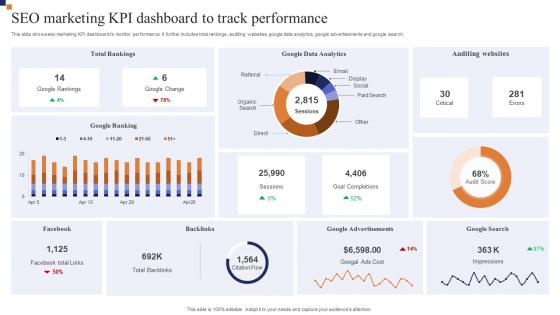
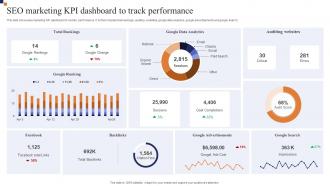
This slide covers SEO marketing KPI dashboard snapshot to track performance and improve effectiveness. It involves data such as sessions from organic, organic sessions by source, organic conversion, pages per sessions from organic.
People who downloaded this PowerPoint presentation also viewed the following :
SEO Marketing KPI Dashboard Snapshot To Track Performance with all 7 slides:
Use our SEO Marketing KPI Dashboard Snapshot To Track Performance to effectively help you save your valuable time. They are readymade to fit into any presentation structure.





FAQs for SEO Marketing KPI Dashboard Snapshot
Essential SEO KPIs include organic traffic growth, keyword rankings, click-through rates, conversion rates, bounce rates, page load speeds, and backlink quality metrics. These metrics enable marketing teams to track search visibility, user engagement, and revenue impact across campaigns, with many organizations finding that comprehensive dashboard monitoring streamlines optimization efforts and delivers measurable competitive advantages.
An SEO KPI dashboard helps track content marketing effectiveness by monitoring organic traffic growth, keyword rankings, conversion rates, engagement metrics, and backlink acquisition across all content pieces. These comprehensive analytics enable marketing teams to identify high-performing content types, optimize underperforming assets, and allocate resources strategically, ultimately delivering improved search visibility and measurable ROI for content investments.
SEO marketing KPI dashboards can be created using Google Analytics, SEMrush, Ahrefs, Google Data Studio, and Tableau, combined with tools like Moz and Search Console. These platforms streamline performance tracking by consolidating organic traffic metrics, keyword rankings, and conversion data, with many marketing teams finding that integrated dashboards enhance strategic decision-making and competitive advantage.
SEO marketing KPI dashboards should be updated daily for technical metrics like rankings and traffic, weekly for content performance analysis, and monthly for comprehensive strategic reviews. This multi-tiered approach enables organizations to respond quickly to algorithm changes, track campaign effectiveness, and make data-driven optimizations, ultimately delivering improved search visibility and competitive advantage.
Backlink impact metrics include referring domains count, domain authority scores, anchor text diversity ratios, backlink growth velocity, and organic traffic attribution from referral sources. These indicators enable SEO teams to measure link-building ROI by tracking ranking improvements, referral traffic increases, and domain credibility enhancement, with many digital marketing agencies finding that comprehensive backlink analytics ultimately deliver measurable organic visibility gains.
User engagement metrics integrate into SEO KPI dashboards through tracking bounce rates, time on page, pages per session, click-through rates, and social sharing data alongside traditional ranking metrics. This strategic combination enables marketers to correlate search visibility with actual user behavior, ultimately delivering deeper insights into content effectiveness and conversion potential across different traffic sources.
Organic traffic serves as a fundamental SEO KPI because it directly measures search engine visibility, user intent alignment, and content relevance without paid advertising costs. This metric enables marketers to track authentic audience engagement, assess keyword strategy effectiveness, and demonstrate sustainable growth, with many organizations finding that consistent organic traffic increases correlate strongly with long-term revenue growth and competitive market positioning.
Keyword optimization success is measured through organic traffic growth, keyword ranking improvements, click-through rates, and conversion metrics displayed in SEO dashboards. These dashboards track position changes for target keywords, search visibility scores, and revenue attribution from organic search, with many digital marketing teams finding that combining ranking data with conversion tracking ultimately delivers clearer ROI insights and strategic optimization opportunities.
Conversion rate serves as the critical bridge between SEO traffic and business outcomes, measuring how effectively organic visitors complete desired actions like purchases, sign-ups, or downloads. This metric enables marketers to evaluate ROI beyond rankings, with e-commerce and SaaS companies finding that optimizing for conversions, rather than just traffic volume, ultimately delivers higher revenue and sustainable growth.
Local SEO performance can be monitored through an SEO KPI dashboard by tracking local search rankings, Google My Business insights, citation consistency, online reviews, and local traffic metrics. These dashboards enable businesses to analyze location-specific keyword performance, monitor competitor positioning in local markets, and measure conversion rates from local searches, ultimately delivering enhanced visibility and customer acquisition in targeted geographic areas.
Visualizing data in an SEO marketing KPI dashboard delivers enhanced decision-making speed, improved trend identification, streamlined performance tracking, and increased team alignment across complex metrics. Through interactive charts and real-time analytics, marketing teams can quickly identify ranking opportunities, monitor conversion patterns, and optimize resource allocation, ultimately enabling faster strategic pivots and measurably improved campaign ROI.
An SEO KPI dashboard enables marketers to establish specific, measurable goals like increasing organic traffic by 25%, improving keyword rankings, and boosting conversion rates through centralized performance tracking. These dashboards streamline goal-setting by visualizing key metrics such as click-through rates, bounce rates, and revenue attribution, with many marketing teams finding that real-time data accessibility accelerates strategy adjustments and ultimately delivers improved ROI.
Click-through rates reveal search result effectiveness, keyword relevance, meta description performance, title tag optimization, and user intent alignment within SEO dashboards. These metrics enable marketers to identify high-performing content, refine underperforming listings, and optimize SERP presentations, with many organizations finding that strategic CTR improvements significantly enhance organic traffic quality and conversion potential.
A dashboard identifies underperforming pages through metrics like low organic traffic, high bounce rates, poor conversion rates, declining search rankings, and minimal time on page. These analytics enable marketers to prioritize optimization efforts by highlighting pages with the greatest improvement potential, ultimately streamlining SEO workflows and delivering enhanced search visibility and user engagement.
SEO marketing KPI dashboard design should prioritize clear metric visualization, logical grouping by funnel stage, real-time data integration, and mobile responsiveness for accessibility. These dashboards streamline performance tracking by combining organic traffic, keyword rankings, conversion rates, and ROI metrics, with many marketing teams finding that automated reporting and customizable views ultimately enhance strategic decision-making and campaign optimization.
-
The PPT layout is great and it has an effective design that helps in presenting corporate presentations. It's easy to edit and the stunning visuals make it an absolute steal!
-
It makes easy work of my work presentations. I’ve never had to be nervous about my presentations for meetings.