

Series b investment pitch deck ppt template





Try Before you Buy Download Free Sample Product
 Impress Your
Audience
 100%
Editable
 Save Hours
of Time


Series B investment for a start-up is significant and takes things to the next level. Such funding is used to grow the firm and get prepared for success on a larger scale. Investors seek series B rounds as a profitable investment as these firms either give stable returns or are ready for the development stage. Here is a professionally designed pitch deck on Series B Investment that will grow your business and meet levels of demand. The pitch deck showcases the series B funding process, including a summary to potential investors with details about its mission statement, consistent growth of profits and revenues, the value proposition of the round. It caters to information on the customer value, impressive performance, growth cohorts, team development, and the unique capital competency of investors funds to raise capital for series B funding. The pitch deck caters to slide about the potential positioning of the investors, the unique positioning of the product rendered in rounds, future initiatives of the firm, raising capital for series B funding. Get access to the markets best pitch deck on Series B Investment and talk to our expert team for all your queries. Book a free demo now! Download this 100 percent editable template and customize it with our research analysts based on your needs.
People who downloaded this PowerPoint presentation also viewed the following :
Content of this Powerpoint Presentation
Slide 1: This slide introduces Series B Investment Pitch Deck. State Your Company Name and begin.
Slide 2: This slide shows Table of Content for the presentation.
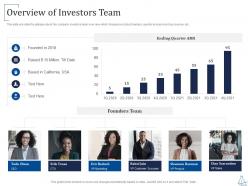
Slide 3: This slide provides the glimpse about the company investors team overview.
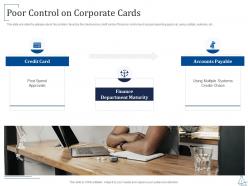
Slide 4: This slide presents problem faced by the clients since credit cards offers poor control.
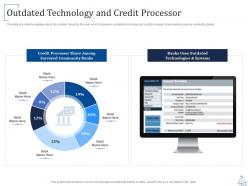
Slide 5: This slide displays problem faced by the user which focuses on outdated technology and credit processor shared among various community banks.
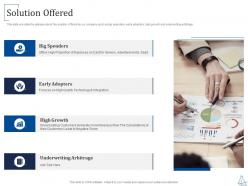
Slide 6: This slide represents solution offered by our company such as big spenders, early adopters, high growth and underwriting arbitrage.
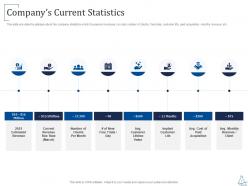
Slide 7: This slide shows company statistics which focuses on revenues, run rate, number of clients, etc.
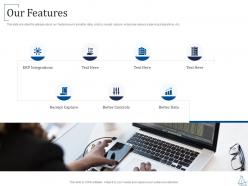
Slide 8: This slide displays features such as better data, control, receipt capture, enterprise resource planning integrations, etc.
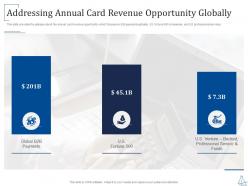
Slide 9: This slide represents the glimpse about the annual card revenue opportunity.
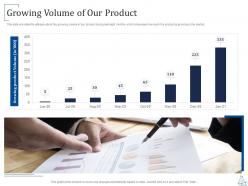
Slide 10: This slide shows growing volume of our product during last eight months.
Slide 11: This slide presents our product positioning in the market which focuses on exclusive marketers, technology lead, proven record, etc.
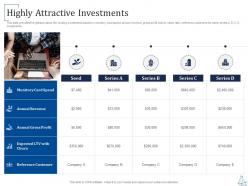
Slide 12: This slide displays funding investments based on monitory card spend, annual revenue, gross profit, etc.
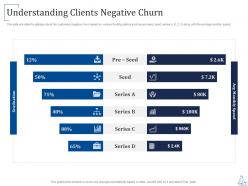
Slide 13: This slide represents customers negative churn based on various funding options.
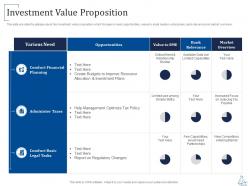
Slide 14: This slide provides the glimpse about the investment value proposition.
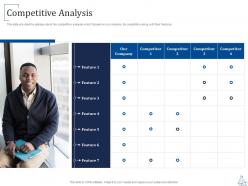
Slide 15: This slide presents the glimpse about the competitive analysis which focuses on our company, its competitors along with their features.
Slide 16: This slide displays client testimonials wherein customers share their experience of using our products.
Slide 17: This slide shows Icons for Series B Investment Pitch Deck.
Slide 18: This slide is titled as Additional Slides for moving forward.
Slide 19: This is Our Mission slide with related imagery and text.
Slide 20: This is About Us slide to show company specifications etc.
Slide 21: This is Our Team slide with names and designation.
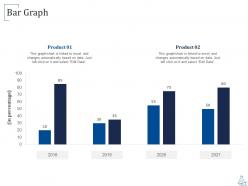
Slide 22: This slide displays Bar Graph with two products comparison.
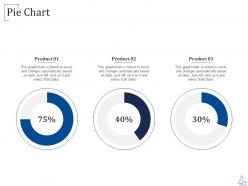
Slide 23: This slide shows Pie Chart with data in percentage.
Slide 24: This is an Idea Generation slide to state a new idea or highlight information, specifications etc.
Slide 25: This slide shows Post It Notes. Post your important notes here.
Slide 26: This is a Quotes slide to convey message, beliefs etc.
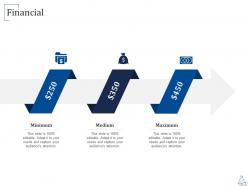
Slide 27: This is a Financial slide. Show your finance related stuff here.
Slide 28: This slide shows Venn diagram with text boxes.
Slide 29: This is a Thank You slide with address, contact numbers and email address.
Series b investment pitch deck ppt template with all 29 slides:
Use our Series B Investment Pitch Deck Ppt Template to effectively help you save your valuable time. They are readymade to fit into any presentation structure.








FAQs for Series b investment pitch
For Series B, you'll want the usual suspects: problem/solution, market size, business model, competition, team, financials, and your funding ask. But honestly, the traction slide is where you'll live or die - they want real revenue growth and solid user metrics, not just potential. Include your go-to-market strategy and unit economics too since they're really focused on whether you can actually scale. Keep it tight, maybe 12-15 slides max. Oh, and start prepping that appendix with detailed financials now because they always dig deeper in follow-ups.
Dude, you gotta nail those month-over-month numbers - that's what actually matters. Skip the vanity metrics because investors can spot fake stuff instantly. Focus on recurring revenue, customer acquisition costs, retention rates. The magic number? Net revenue retention above 100%. That shows you're not just keeping customers but growing them. Also grab some solid testimonials from brands people recognize - that carries serious weight. Don't just throw numbers at them though. Explain WHY you're growing and prove it'll keep happening. Honestly, your traction slide should be doing most of the heavy lifting in that pitch.
Start with your revenue stuff - ARR growth and monthly trends. That's what they really care about at Series B. Your unit economics need to be solid too, so show off that CAC and LTV ratio if it's looking good. Gross margins are way more important now than they were before. Churn rates tell the whole story honestly - if people aren't sticking around, that's a red flag. Net revenue retention is another big one. I'd probably lead with whatever metric makes you look best and just be ready to explain any weird dips or spikes. They're basically checking if you can actually scale without burning cash forever.
By Series B, investors have totally different priorities than seed guys. They're obsessed with your unit economics and whether you can actually scale without burning cash. Your deck should be heavy on the numbers - CAC, retention curves, cohort data, expansion revenue. Skip the lengthy vision stuff (honestly, they already get what you're building). What they really want is proof you've cracked the code on sustainable growth. Make your financials super detailed because they'll tear apart every assumption. Oh, and show a clear path to profitability - that's basically non-negotiable at this stage.
Start with clean charts showing revenue growth and user metrics - that's what Series B folks actually care about. Don't clutter your slides because squinting at tiny text during a pitch is the worst (trust me on this one). Real product screenshots beat mockups every time, and throw in some customer logos for credibility. Honestly, skip the fancy animations - they just distract from your story. Each section needs a clear "so what" moment that connects back to why they should invest. Oh, and make sure your data tells the traction story super clearly.
Start with hard numbers that show you're crushing competitors - actual CAC, retention rates, market share gains. Data beats claims every day. Too many founders just rattle off features instead of showing real outcomes, which honestly drives me nuts. Your competitive advantage needs to get stronger over time - think network effects, proprietary datasets, or high switching costs. The whole "we're 10x faster" thing? Skip it unless you can prove exactly why competitors can't copy you. Generic speed claims are everywhere. What matters is whether you'll still dominate in three years when everyone else catches up.
Honestly, just tell a story that flows naturally - problem, solution, how it's working out. Since Series A, show how you've actually changed based on what customers told you. Those before/after customer stories are gold - like "Company X was drowning in this mess, now they're crushing it with our product." Don't save all your numbers for one boring slide, sprinkle them throughout. And here's the thing - admit where you screwed up or had to pivot. Investors aren't stupid, they know startups are messy. Makes you look real. Wrap up by painting where this funding takes you next. Make them think "damn, I don't want to miss this."
Dude, Series B investors are ruthless about the money breakdown. Split everything into clear buckets - hiring (actual headcount numbers), product dev, marketing, ops costs. They want 18-24 month projections with percentages for each category. Honestly, the "keep the lights on" approach will tank your pitch instantly. Connect each dollar to specific milestones you'll hit. Oh and double-check your burn rate matches what you're showing here. I've seen founders get absolutely grilled when those numbers don't line up during Q&A. They'll spot inconsistencies from a mile away.
Don't make the mistake I see everyone do - treating Series B like it's just Series A round two. Investors want proof now, not more vision stuff. Your unit economics need to actually work, and you better have a real path to profitability mapped out. Those hockey stick projections? Yeah, nobody's buying that anymore. Show them repeatable sales processes instead of just pointing to your early wins. Burn rate has to make sense too - I can't stress this enough. Scale efficiently rather than just throwing money at growth. Basically prove your business model actually works with real numbers.
Look, investors don't care about fancy titles - they want proof you've actually done this stuff before. Start with hard numbers from your team's previous gigs. Revenue growth, successful launches, whatever shows you deliver. Then connect those wins directly to the challenges you're tackling now. International expansion? Better have someone who's crushed that already. Honestly, most pitch decks waste way too much space on generic bios. Keep yours tight - two slides tops. The key is showing why this exact group of people gives you an edge competitors can't match. It's all about that track record.
Look, Series B investors are writing way bigger checks, so they need to see you can become a billion-dollar company. TAM numbers? Yeah, everyone fudges those - honestly don't stress too much about hitting some magic number. What actually matters is proving your specific slice of the market is growing fast. Use real data to show that trajectory, not just some analyst's wishful thinking. You're past the product-market fit stage now. Focus on demonstrating how you'll grab serious market share as things scale up.
Definitely be honest about your biggest risks, but don't just dump a list of doom on them. Pick 3-4 real threats and show how you're tackling each one. Regulatory stuff, competition, losing key people - whatever actually worries you. The thing is, investors can smell BS from a mile away, so they'd rather see you think critically than pretend you're bulletproof. Frame each risk with your game plan already mapped out. Put this slide near the end though - you'll want to get them excited about the opportunity first before diving into potential problems.
Dude, you absolutely need customer feedback in that deck. Series B investors are way more skeptical than A round - they want proof you're not just building random stuff nobody wants. Get your best customer quotes and usage numbers front and center in the traction section. Show retention data, feedback scores, testimonials - basically anything proving people actually love your product and keep paying for it. I'd honestly lead with your strongest customer stories, then sprinkle feedback throughout to back up those growth projections. Makes the whole pitch feel way more legit when real customers are basically selling it for you.
For your Series B deck, focus on proving your unit economics actually get better as you scale - show how customer acquisition costs drop and margins improve with size. Map out your growth plan: new markets, products, whatever makes sense. Here's the thing investors really want to see: repeatable systems that won't completely fall apart when you're 10x bigger. Include hard numbers on how margins expand with scale. Oh, and be super clear about how their cash translates to accelerated growth, not just keeping the lights on. You want them thinking exponential returns, not linear stuff.
Finding good Series B decks is honestly pretty tough since companies get way more secretive by then. You can check out Airbnb's 2009 deck for storytelling basics (even though it's earlier stage). Buffer shared some of their pitch stuff which is cool. Mixpanel's deck shows how to nail the growth story. For newer examples, look at how Canva and Notion talk about expansion in their public materials - not pitch decks exactly, but you'll get the idea. The key thing they all do? Show real product-market fit with actual numbers and map out how they'll hit profitability. Your best shot is probably joining founder Slack groups where people sometimes drop anonymized versions of their real decks.
-
Excellent products for quick understanding.
-
Very unique and reliable designs.
-
Innovative and Colorful designs.
-
Use of different colors is good. It's simple and attractive.
-
Very unique and reliable designs.