

Server Management Powerpoint PPT Template Bundles




Try Before you Buy Download Free Sample Product
 Impress Your
 Audience
 100%
100% Editable
 Save Hours
 of Time


Our Server Management Powerpoint PPT Template Bundles are topically designed to provide an attractive backdrop to any subject. Use them to look like a presentation pro.
People who downloaded this PowerPoint presentation also viewed the following :
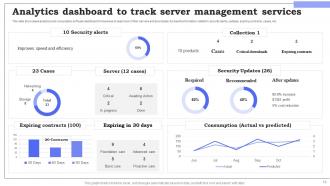
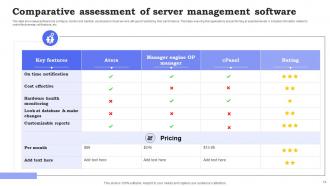
Server Management Powerpoint PPT Template Bundles with all 23 slides:
Use our Server Management Powerpoint PPT Template Bundles to effectively help you save your valuable time. They are readymade to fit into any presentation structure.








FAQs for Server Management Powerpoint
Dedicated servers offer complete physical control with direct hardware access, customizable configurations, and isolated performance, while cloud servers provide virtual flexibility, automated scaling, and shared infrastructure management. Through cloud platforms, organizations streamline deployment, reduce maintenance overhead, and enable rapid resource allocation, whereas dedicated servers deliver predictable performance and enhanced security for mission-critical applications requiring consistent computational power.
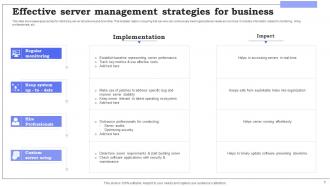
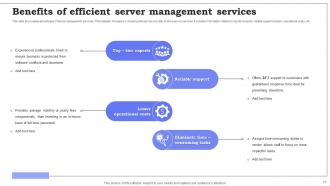
Automation tools simplify server management by streamlining deployment, monitoring system performance, and handling routine maintenance tasks without manual intervention. These solutions enable IT teams to automate software updates, resource allocation, and security patches across multiple servers simultaneously, ultimately reducing operational overhead while enhancing system reliability and freeing up technical staff for strategic initiatives.
High availability strategies include load balancing, redundancy, failover clustering, regular health monitoring, and automated backup systems. These approaches work together by distributing traffic across multiple servers, eliminating single points of failure, and enabling seamless service continuity, with many organizations finding that strategic redundancy ultimately delivers 99.9% uptime and enhanced customer experiences.
Server software updates should be performed monthly for non-critical patches and immediately for security vulnerabilities, with many organizations implementing automated update schedules during maintenance windows. These updates enhance system security, improve performance, and ensure compliance requirements are met, while regular patching significantly reduces cybersecurity risks and operational downtime, ultimately delivering better reliability and competitive advantage.
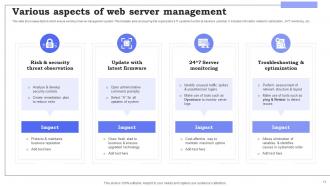
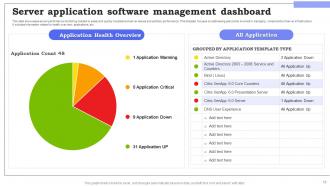
Server performance monitoring best practices include implementing real-time resource tracking, automated alert systems, comprehensive logging, regular performance baselines, and proactive capacity planning. These monitoring approaches streamline IT operations by identifying bottlenecks early, minimizing downtime, and optimizing resource allocation, with many organizations finding that strategic monitoring ultimately delivers enhanced system reliability and reduced operational costs.
A robust backup strategy protects against data loss by implementing automated regular backups, maintaining multiple backup copies across different locations, and establishing clear recovery procedures with defined timelines. These comprehensive measures enable organizations to quickly restore critical systems after hardware failures, cyberattacks, or natural disasters, ultimately minimizing downtime and ensuring business continuity.
Essential server security measures include robust firewalls, intrusion detection systems, regular security patches, access control protocols, and encrypted data transmission. These technologies work together by monitoring network traffic, preventing unauthorized access, and maintaining system integrity, with many financial institutions and healthcare organizations finding that layered security approaches significantly reduce breach risks while ensuring operational continuity.
Load balancers enhance server management by distributing incoming traffic across multiple servers, preventing overload, and automatically routing requests away from failed systems. This strategic distribution enables organizations to maintain consistent performance during peak usage, minimize downtime through redundancy, and scale resources efficiently, ultimately delivering faster response times and improved user experiences while reducing operational costs.
VPS hosting offers small businesses dedicated resources, enhanced security, greater customization, scalable infrastructure, and improved performance compared to shared hosting. While requiring more technical knowledge, many small businesses find that VPS delivers cost-effective server control, faster website loading times, and better customer experiences, ultimately providing competitive advantages as they scale their digital operations.
Server management practices directly influence application performance through resource allocation, monitoring protocols, automated scaling, and proactive maintenance strategies. Effective server management enables faster response times, minimizes downtime, and optimizes resource utilization, with many organizations finding that robust monitoring and automated failover systems significantly enhance user satisfaction while reducing operational costs in increasingly competitive digital environments.
Containerization revolutionizes modern server management by enabling lightweight virtualization, consistent deployment environments, simplified scaling, and improved resource utilization across diverse infrastructure platforms. Through technologies like Docker and Kubernetes, organizations streamline application deployment, enhance system reliability, and reduce operational overhead, with many enterprises finding that containerized environments deliver faster deployment cycles and significantly lower infrastructure costs.
Server location directly impacts latency by determining physical distance data must travel, with closer servers reducing response times significantly. Strategic server placement across multiple geographic regions enables organizations to deliver faster web services, enhance user experiences, and maintain competitive advantage, with many companies finding that distributed server networks reduce latency by 40-60%.
Managing hybrid server environments presents challenges including complex network configurations, security inconsistencies across platforms, integration difficulties between on-premises and cloud systems, monitoring fragmentation, and compliance management complexities. These challenges require strategic orchestration tools, unified security frameworks, and comprehensive monitoring solutions, with many organizations finding that proper automation and centralized management platforms ultimately deliver operational efficiency and reduced administrative overhead.
Server logs enable troubleshooting and performance optimization by tracking system events, identifying error patterns, monitoring resource usage, and analyzing application behavior over time. Through automated log analysis tools, IT teams can quickly pinpoint bottlenecks, detect security threats, and optimize server configurations, ultimately delivering faster response times and improved system reliability across enterprise environments.
**INPUT**: What are the considerations when scaling server resources to meet increasing demand? **OUTPUT**: Scaling server resources requires evaluating performance metrics, cost implications, infrastructure capacity, security requirements, and monitoring capabilities. Organizations must balance vertical scaling through upgraded hardware with horizontal scaling across multiple servers, while considering load distribution patterns, data backup strategies, and network bandwidth limitations, ultimately delivering enhanced operational efficiency and seamless user experiences.
-
The team is highly dedicated and professional. They deliver their work on time and with perfection.
-
I’ve been your client for a few years now. Couldn’t be more than happy after using your templates. Thank you!