

Seven Step Merchant Onboarding And Underwriting Process





Try Before you Buy Download Free Sample Product
 Impress Your
Audience
 100%
Editable
 Save Hours
of Time


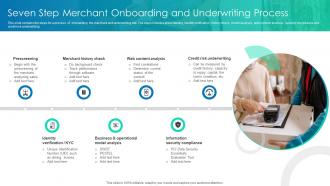
This slide contains the steps for a process of onboarding the merchant and underwriting risk. The steps includes prescreening, identity verification, history check, model analysis, web content analysis, security compliance and credit risk underwriting.
People who downloaded this PowerPoint presentation also viewed the following :
Seven Step Merchant Onboarding And Underwriting Process with all 6 slides:
Use our Seven Step Merchant Onboarding And Underwriting Process to effectively help you save your valuable time. They are readymade to fit into any presentation structure.





FAQs for Seven Step Merchant Onboarding
Essential merchant onboarding steps include business verification, documentation collection, risk assessment, compliance checks, system integration setup, and account activation. These processes streamline operations by automating identity verification, accelerating approval workflows, and ensuring regulatory compliance, with many financial institutions finding that comprehensive onboarding platforms reduce processing time while enhancing security and delivering superior merchant experiences.
Technology streamlines merchant onboarding through automated document verification, digital identity checks, AI-powered risk assessment, and integrated compliance monitoring systems. These solutions accelerate approval processes by eliminating manual paperwork, reducing verification time from weeks to hours, and enabling real-time status tracking, ultimately delivering faster market entry and enhanced operational efficiency for financial institutions.
Merchants commonly face lengthy documentation requirements, complex compliance verification, unclear fee structures, integration difficulties with existing systems, and poor communication during status updates. These challenges can be addressed through streamlined digital documentation, automated KYC processes, transparent pricing models, and dedicated support channels, with many financial institutions finding that proactive communication and user-friendly platforms significantly reduce onboarding time while enhancing merchant satisfaction.
Data validation is crucial during merchant onboarding, ensuring accurate business information, regulatory compliance, risk assessment, and seamless payment processing integration. Through automated validation systems, financial institutions streamline verification processes, reduce onboarding time, and minimize fraudulent applications, while enhancing customer experiences and operational efficiency, ultimately delivering faster merchant approval cycles and stronger risk management capabilities.
Compliance ensures new merchants meet regulatory requirements, risk standards, and industry protocols through identity verification, financial assessment, and documentation review. These safeguards protect payment processors and financial institutions by minimizing fraud exposure, ensuring AML adherence, and maintaining operational integrity, with many organizations finding that robust compliance frameworks ultimately accelerate legitimate merchant approvals while reducing costly security breaches.
Merchants can effectively integrate with payment processing systems through API documentation review, sandbox testing environments, technical support consultations, compliance requirement assessments, and phased implementation strategies. These approaches streamline integration by ensuring proper configuration, reducing technical errors, and maintaining security standards, with many financial institutions finding that comprehensive onboarding support ultimately delivers faster deployment and enhanced transaction processing capabilities.
Best practices for user-friendly merchant onboarding include streamlined digital applications, clear progress indicators, minimal documentation requirements, automated verification processes, and responsive customer support throughout the journey. These approaches enhance merchant satisfaction by reducing time-to-activation, eliminating friction points, and providing transparent communication, with many financial institutions finding that intuitive onboarding significantly improves merchant retention and accelerates revenue generation.
Analytics improves merchant onboarding by identifying bottlenecks, predicting approval likelihood, and personalizing documentation requirements based on merchant profiles and risk assessments. Through predictive modeling and real-time tracking, financial institutions streamline application workflows, reduce processing times, and enhance approval rates, while minimizing manual reviews, ultimately delivering faster onboarding experiences and operational efficiency.
Faster onboarding significantly improves merchant retention and satisfaction by reducing abandonment rates, accelerating time-to-revenue, and demonstrating operational efficiency from the initial interaction. Streamlined processes enable merchants to start processing transactions within hours rather than weeks, with many payment providers finding that reducing onboarding time by 50% increases merchant lifetime value and builds stronger long-term partnerships.
Personalization enhances merchant onboarding by tailoring application flows based on business size, industry requirements, and transaction volumes, while delivering customized documentation requests and relevant feature recommendations. Through adaptive interfaces and sector-specific guidance, financial institutions streamline approval processes, reduce abandonment rates, and accelerate time-to-market, with many payment providers finding significantly improved merchant satisfaction and faster revenue generation.
Training resources should include comprehensive platform tutorials, payment processing guides, compliance documentation, troubleshooting manuals, and dedicated support channels. These materials streamline merchant adoption by reducing setup confusion, accelerating transaction processing, and ensuring regulatory adherence, with many financial institutions finding that structured training programs significantly decrease support tickets while improving merchant satisfaction and retention rates.
Different industries impose unique merchant onboarding requirements through regulatory compliance, risk profiles, and operational needs, with financial services requiring extensive KYC documentation, healthcare demanding HIPAA compliance, and retail focusing on payment processing capabilities. These sector-specific requirements ultimately streamline operations by ensuring merchants meet industry standards, reduce compliance risks, and deliver appropriate customer experiences within their specialized markets.
Poor merchant onboarding consequences include increased customer churn, delayed revenue generation, higher support costs, damaged brand reputation, and reduced merchant lifetime value. These challenges ultimately impact business growth by creating friction in payment processing, increasing operational overhead, and hindering competitive advantage, with many payment providers finding that streamlined onboarding processes significantly enhance merchant retention and accelerate time-to-revenue.
A well-structured onboarding process enhances fraud prevention by implementing comprehensive identity verification, risk assessment protocols, document authentication, and continuous monitoring systems from the initial merchant application. Through rigorous KYC procedures and automated screening technologies, financial institutions can identify suspicious entities early, reduce fraudulent transactions, and maintain regulatory compliance, while legitimate merchants experience faster approval processes and enhanced security protection.
Companies should track time-to-activation, completion rates, drop-off points, merchant satisfaction scores, and time-to-first-transaction to evaluate onboarding success. These metrics enable organizations to identify bottlenecks, streamline documentation processes, and enhance user experiences, with many financial services finding that reduced onboarding time directly correlates with higher merchant retention and faster revenue generation.
-
I am extremely pleased with these PPT slides that we used for our event. They were easy to modify and came out great in all aspects!
-
Informative and engaging! I really like the design and quality of the slides.