

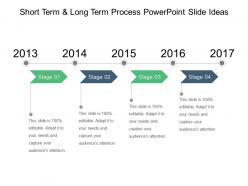
Short term and long term process powerpoint slide ideas





Try Before you Buy Download Free Sample Product
 Impress Your
 Audience
 100%
100% Editable
 Save Hours
 of Time


Our Short Term And Long Term Process Powerpoint Slide Ideas will comply with your wants. They are designed for total satisfaction.
People who downloaded this PowerPoint presentation also viewed the following :
Short term and long term process powerpoint slide ideas with all 5 slides:
Exercise effective control via our Short Term And Long Term Process Powerpoint Slide Ideas. Demonstrate ability to handle events.


FAQs for Short term and long term process
Effective process management includes process mapping, performance metrics, continuous improvement protocols, stakeholder alignment, and resource optimization frameworks. These components work together by establishing clear workflows, measuring operational efficiency, and enabling systematic refinements, with many organizations finding that this strategic combination delivers reduced costs, faster service delivery, and enhanced competitive advantage.
Organizations can identify and map existing processes through stakeholder interviews, process observation, workflow documentation, system analysis, and cross-functional workshops. These methods enable comprehensive visibility into current operations, with many companies finding that detailed process mapping reveals inefficiencies, redundancies, and automation opportunities, ultimately delivering streamlined workflows and enhanced operational efficiency.
Process visualization enhances understanding by transforming complex workflows into clear, visual representations that identify bottlenecks, redundancies, and improvement opportunities across departments. Through flowcharts, process maps, and digital dashboards, organizations in manufacturing, healthcare, and financial services streamline operations, reduce training time, and accelerate decision-making, ultimately delivering greater operational efficiency and enhanced team collaboration.
Businesses leverage technology through automation platforms, AI-powered analytics, cloud-based workflow systems, and real-time monitoring tools to streamline process management. These technologies enhance operational efficiency by eliminating manual bottlenecks, providing data-driven insights, and enabling seamless collaboration, with many organizations finding significantly reduced costs and faster service delivery across departments.
Common challenges during process management initiatives include resistance to change, inadequate stakeholder buy-in, insufficient resource allocation, poor communication, and lack of clear metrics for success. These obstacles often emerge when organizations attempt to streamline operations across departments, with many companies finding that addressing cultural barriers and establishing robust training programs ultimately delivers smoother transitions and sustainable process improvements.
Lean focuses on eliminating waste and streamlining workflow efficiency, while Six Sigma emphasizes reducing defects and variability through statistical analysis. These methodologies complement each other strategically, with manufacturing and healthcare organizations often combining both approaches to achieve operational excellence, enhance quality control, and deliver measurable cost reductions while maintaining competitive advantage.
Essential metrics for measuring process management success include cycle time, throughput rates, error rates, cost per process, customer satisfaction scores, and resource utilization percentages. These metrics enable organizations to identify bottlenecks, optimize workflows, and demonstrate ROI, with many companies finding that combining operational and customer-focused measurements delivers comprehensive insights for continuous improvement and competitive advantage.
Employee feedback can be integrated into process improvement through regular surveys, suggestion systems, cross-functional teams, performance metrics analysis, and structured review sessions. These approaches enable organizations to identify bottlenecks, streamline workflows, and enhance operational efficiency, with many companies finding that employee insights ultimately deliver faster implementation and higher adoption rates.
Cross-departmental collaboration in process management breaks down silos, ensures seamless workflow integration, and enables comprehensive process optimization across organizational boundaries. It facilitates shared accountability, reduces redundancies, and accelerates decision-making, with many organizations finding that collaborative approaches deliver faster project completion, improved resource allocation, and enhanced operational efficiency in increasingly complex business environments.
Process management enhances customer satisfaction by streamlining service delivery, reducing response times, and ensuring consistent quality across all touchpoints. Through standardized workflows and continuous optimization, organizations like banks accelerate loan approvals, while retail companies minimize checkout delays, ultimately delivering faster services, fewer errors, and more predictable customer experiences that build trust and loyalty.
Best practices for process documentation include standardized templates, clear step-by-step workflows, defined roles and responsibilities, visual elements like flowcharts, and regular update schedules. These approaches streamline operations by reducing training time, minimizing errors, and ensuring compliance, with many organizations finding that consistent documentation ultimately delivers improved efficiency and scalable knowledge transfer across teams.
Organizations cultivate continuous improvement cultures by establishing regular process review cycles, empowering employees to suggest optimizations, implementing feedback mechanisms, and celebrating incremental wins. This approach enables systematic identification of inefficiencies, promotes cross-departmental collaboration, and drives innovation, with many companies finding that engaged teams deliver measurable productivity gains and enhanced operational excellence.
**INPUT**: What are the biggest trends influencing process management in the digital age? **OUTPUT**: Key trends influencing process management include artificial intelligence automation, cloud-based workflow platforms, real-time analytics integration, robotic process automation, and IoT-enabled monitoring systems. These technologies streamline operations by eliminating manual bottlenecks, enhancing decision-making transparency, and enabling predictive maintenance, with many organizations finding that strategic digital integration ultimately delivers faster service delivery and significant competitive advantage. **Word count: 58 words**
Risk management integrates into process management frameworks through risk assessment matrices, control point identification, mitigation protocols, continuous monitoring systems, and compliance tracking mechanisms. These strategic combinations enable organizations to proactively identify vulnerabilities, streamline operational resilience, and maintain regulatory compliance, with many financial services and healthcare institutions finding that integrated approaches significantly reduce operational disruptions while enhancing overall process efficiency.
Process management supports sustainability initiatives by optimizing resource utilization, reducing waste streams, enhancing energy efficiency, and streamlining operational workflows to minimize environmental impact. Through systematic process analysis and redesign, organizations across manufacturing, logistics, and service sectors achieve significant cost reductions while meeting environmental compliance standards, ultimately delivering competitive advantage in an increasingly sustainability-focused marketplace.
-
Appreciate the research and its presentable format.
-
Illustrative design with editable content. Exceptional value for money. Highly pleased with the product.