


SIEM Cyber Security Analytics Solution




Try Before you Buy Download Free Sample Product
 Impress Your
Audience
 100%
Editable
 Save Hours
of Time


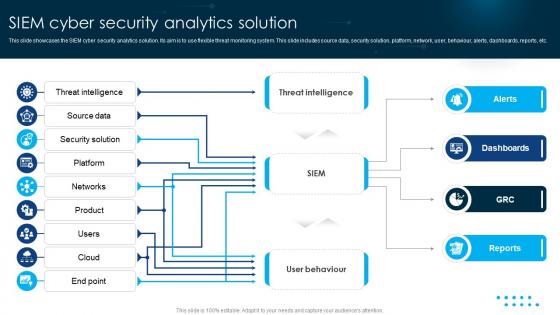
This slide showcases the SIEM cyber security analytics solution. Its aim is to use flexible threat monitoring system. This slide includes source data, security solution, platform, network, user, behaviour, alerts, dashboards, reports, etc.
People who downloaded this PowerPoint presentation also viewed the following :
SIEM Cyber Security Analytics Solution with all 9 slides:
Use our SIEM Cyber Security Analytics Solution to effectively help you save your valuable time. They are readymade to fit into any presentation structure.









FAQs for SIEM Cyber
The primary function of a SIEM system is to collect, analyze, and correlate security data from across an organization's IT infrastructure in real-time to detect threats, manage incidents, and ensure compliance. Through centralized monitoring and advanced analytics, organizations can identify suspicious activities, automate threat responses, and streamline security operations, ultimately delivering enhanced protection and faster incident resolution.
SIEM differs from traditional log management by providing real-time security analysis, automated threat detection, and comprehensive incident response capabilities, rather than just storing and retrieving log data. While traditional solutions focus on compliance and basic monitoring, SIEM platforms correlate events across multiple sources, identify security patterns, and enable proactive threat hunting, ultimately delivering faster incident response and enhanced organizational security posture.
Key SIEM architecture components include data collectors, log management systems, correlation engines, threat intelligence feeds, dashboards, and automated response mechanisms. These technologies streamline security operations by aggregating massive data volumes, identifying suspicious patterns, and enabling rapid incident response, with many financial institutions and healthcare organizations finding that integrated SIEM architectures deliver enhanced threat visibility and operational efficiency.
SIEM enhances incident response capabilities by providing real-time threat detection, automated alert prioritization, and centralized log analysis from across enterprise networks. Through advanced correlation engines and machine learning algorithms, security teams can reduce response times, minimize false positives, and streamline investigation workflows, ultimately delivering faster threat containment and improved security posture.
Machine learning enhances modern SIEM implementations by enabling automated threat detection, reducing false positives, identifying behavioral anomalies, and accelerating incident response times. These AI-driven capabilities help security teams in banking, healthcare, and retail environments detect sophisticated attacks more accurately while streamlining operations, ultimately delivering faster threat resolution and improved security posture.
Correlation rules in SIEM systems enhance threat detection by analyzing patterns across multiple data sources, identifying anomalies that indicate potential security incidents, and reducing false positives through contextual analysis. These automated rules enable security teams to detect sophisticated attacks like advanced persistent threats, coordinate multi-stage breaches, and insider threats, ultimately delivering faster incident response and more accurate threat identification.
Common SIEM deployment challenges include complex integration with existing systems, overwhelming alert volumes, skilled personnel shortages, high implementation costs, and data quality inconsistencies. Organizations often struggle with fine-tuning detection rules and managing false positives, while many find that inadequate planning and insufficient training ultimately hinder their security operations effectiveness and ROI.
A SIEM manages and analyzes data by collecting logs from firewalls, servers, applications, and network devices, then normalizing and correlating this information in real-time. Through centralized dashboards and automated rules, organizations streamline threat detection, accelerate incident response, and enhance security visibility, ultimately delivering faster threat identification and improved operational efficiency.
Organizations should evaluate SIEM effectiveness through metrics including mean detection time, false positive rates, incident response times, threat coverage percentage, and security analyst productivity. These measurements enable security teams to optimize alert accuracy, streamline investigation workflows, and enhance overall threat visibility, with many enterprises finding that balanced dashboards ultimately deliver faster incident resolution and improved security posture.
SIEM solutions enhance regulatory compliance by automatically collecting audit trails, generating detailed compliance reports, and monitoring policy violations in real-time. Through centralized logging and automated documentation, organizations streamline audit processes, reduce manual oversight burdens, and maintain continuous compliance postures, with many financial services and healthcare institutions finding that comprehensive activity tracking significantly accelerates regulatory assessments while minimizing compliance risks.
SIEM tuning best practices include baseline establishment, correlation rule refinement, whitelist creation, threat intelligence integration, and continuous threshold adjustment. These approaches streamline security operations by filtering legitimate activities, prioritizing genuine threats, and reducing alert fatigue, with many organizations finding that proper tuning delivers faster incident response and enhanced analyst productivity.
Cloud-based SIEM solutions offer greater scalability, reduced infrastructure costs, and faster deployment compared to on-premises options, while on-premises systems provide enhanced data control and compliance capabilities. Many financial institutions and healthcare organizations find that cloud SIEM delivers automatic updates and broader threat intelligence, ultimately enabling faster incident response and lower operational overhead.
High data volumes can significantly impact SIEM performance through slower query responses, increased storage costs, and potential alert fatigue from processing massive event streams. However, modern SIEM solutions address these challenges through advanced analytics, cloud scalability, and intelligent filtering, with many organizations finding that strategic data prioritization and automated threat detection ultimately enhance security efficiency while managing operational costs.
Organizations integrate threat intelligence feeds with their SIEM through automated APIs, real-time data ingestion protocols, and standardized formats like STIX/TAXII. These integrations enhance security monitoring by enriching alerts with contextual threat data, correlating incidents with known attack patterns, and enabling proactive threat hunting, ultimately delivering faster incident response and significantly improved detection capabilities.
Emerging SIEM trends include cloud-native architectures, AI-driven threat detection, automated incident response, extended detection and response (XDR) integration, and zero-trust security frameworks. These advancements streamline threat identification, reduce false positives, and enhance response times, with many organizations finding that modern SIEM platforms deliver significantly improved security postures and operational efficiency.
-
Wonderful ideas and visuals. I'm really pleased with the templates, which are unique and up to date.
-
Incredibly beautiful designs that will help you get noticed! These eye-catching templates are perfect for corporate presentations that can be altered to fit any occasion or taste.