

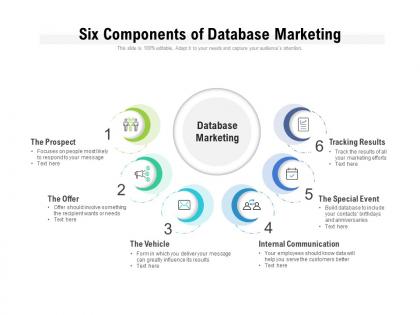
Six components of database marketing




Try Before you Buy Download Free Sample Product
 Impress Your
 Audience
 100%
100% Editable
 Save Hours
 of Time


Our Six Components Of Database Marketing are a handy tool. Drill your thoughts in to the heads of your team.
People who downloaded this PowerPoint presentation also viewed the following :
Six components of database marketing with all 2 slides:
Our Six Components Of Database Marketing are a useful tool. Engrave your ideas in the minds of your listeners.

FAQs for Six components
Key components of a successful database marketing strategy include customer segmentation, data quality management, personalized content creation, automated campaign workflows, and performance analytics. These elements work together by enabling targeted messaging, improving customer experiences, and maximizing campaign ROI, with many organizations finding that strategic data integration ultimately delivers higher conversion rates and stronger customer loyalty.
Businesses can effectively segment customer databases using demographic data, purchase history, behavioral patterns, engagement levels, and geographic location. Through advanced analytics and CRM integration, companies in retail, financial services, and healthcare deliver personalized campaigns, increase conversion rates, and enhance customer lifetime value, ultimately achieving higher ROI and stronger customer relationships.
Data analytics transforms database marketing by enabling precise customer segmentation, predictive modeling, behavioral analysis, personalization algorithms, and performance optimization across campaigns. Through advanced analytics tools, businesses identify high-value prospects, predict purchase patterns, and deliver targeted messaging that resonates with specific audience segments, ultimately increasing conversion rates and customer lifetime value while reducing acquisition costs.
CRM systems enhance database marketing by centralizing customer data, automating personalized campaigns, and tracking interactions across multiple touchpoints. Through advanced analytics and segmentation capabilities, organizations can deliver targeted messaging, optimize timing for communications, and measure campaign effectiveness, with many retail and financial services companies finding significantly improved conversion rates and customer lifetime value.
Companies must navigate data protection regulations like GDPR and CCPA, obtain explicit consent for data collection, ensure secure storage and processing, and provide transparent privacy policies detailing data usage. These compliance requirements, while complex, ultimately enhance customer trust and brand reputation, with many organizations finding that strong data governance practices create competitive advantages in increasingly privacy-conscious markets.
Businesses ensure database accuracy through regular data audits, validation protocols, automated cleansing tools, standardized entry procedures, and duplicate removal systems. These quality measures enable more precise customer targeting, improved campaign performance, and enhanced decision-making capabilities, with many retail and financial services organizations finding that consistent data maintenance ultimately delivers higher conversion rates and operational efficiency.
Integrating social media insights into database marketing enhances customer segmentation, improves targeting precision, increases engagement rates, and delivers more personalized campaigns. Through social listening and behavioral analysis, businesses streamline content creation, accelerate customer acquisition, and minimize marketing waste, with many retail and financial services organizations finding that this strategic combination ultimately delivers higher conversion rates and stronger customer relationships.
Personalization enhances database marketing effectiveness by enabling targeted messaging, relevant product recommendations, and customized timing based on individual customer data and behavioral patterns. Through segmentation and dynamic content, businesses like e-commerce retailers and financial services companies deliver higher engagement rates, improved conversion rates, and stronger customer loyalty, ultimately reducing marketing costs while maximizing campaign ROI.
Companies should track conversion rates, customer lifetime value, email open and click-through rates, segmentation effectiveness, and return on investment across campaigns. These metrics enable businesses to optimize targeting strategies, enhance customer engagement, and improve resource allocation, with many organizations finding that comprehensive tracking ultimately delivers higher revenue per customer and stronger competitive positioning in their markets.
Automation tools streamline database marketing processes by segmenting audiences, personalizing campaigns, and scheduling communications across multiple channels automatically. These technologies enable marketers to trigger targeted messages based on customer behavior, track engagement metrics in real-time, and optimize campaign performance continuously, ultimately delivering higher conversion rates and improved customer experiences.
Common database marketing pitfalls include poor data quality, lack of segmentation, over-communication, ignoring privacy regulations, and insufficient personalization. While these challenges can undermine campaign effectiveness, businesses that prioritize data hygiene, strategic segmentation, and compliance find that addressing these issues ultimately delivers higher engagement rates, better customer relationships, and improved ROI across their marketing initiatives.
Companies leverage customer feedback to refine database marketing strategies by analyzing survey responses, social media interactions, purchase behavior patterns, and direct communication insights to identify preferences and pain points. This feedback enables businesses to enhance segmentation accuracy, personalize messaging more effectively, and optimize campaign timing, with many retailers and service providers finding that feedback-driven refinements significantly improve engagement rates and customer lifetime value.
Mobile marketing significantly enhances database marketing effectiveness by providing real-time behavioral data, location-based insights, personalized push notifications, and seamless cross-channel integration. Through mobile apps and responsive campaigns, businesses collect richer customer profiles while delivering targeted messages instantly, with retailers and financial services finding that mobile-enabled database strategies increase engagement rates and conversion optimization substantially.
Emerging database marketing trends include AI-powered personalization, real-time customer journey mapping, predictive analytics for behavior forecasting, cross-channel data integration, and privacy-first marketing approaches. These technologies enhance targeting precision, streamline campaign optimization, and deliver personalized experiences at scale, with many retail and financial services organizations finding that strategic data integration ultimately drives higher conversion rates and customer lifetime value.
Businesses maintain customer engagement through database marketing by segmenting audiences based on behavior and preferences, personalizing content across multiple touchpoints, and implementing automated lifecycle campaigns that deliver relevant messaging at optimal intervals. This strategic approach enables companies to build stronger relationships while reducing churn, with many retailers and financial services finding that consistent, data-driven engagement increases customer lifetime value significantly.
No Reviews