

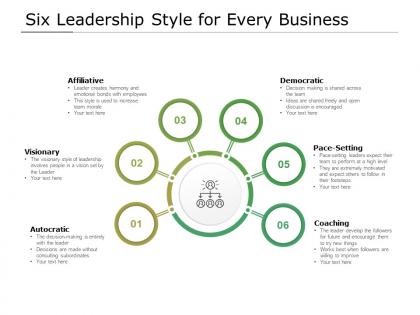
Six leadership style for every business




Try Before you Buy Download Free Sample Product
 Impress Your
Audience
 100%
Editable
 Save Hours
of Time


Beat the bell with our Six Leadership Style For Every Business. Get far ahead of any deadline.
People who downloaded this PowerPoint presentation also viewed the following :
Six leadership style for every business with all 5 slides:
Get far ahead of deadlines with our Six Leadership Style For Every Business. You will always beat the bell.




FAQs for Six leadership style
Transformational leaders exhibit visionary thinking, inspirational communication, intellectual stimulation, and individualized consideration for team members. These leaders revolutionize organizations by challenging conventional processes, fostering innovation, and empowering employees to exceed expectations, with many companies finding that transformational leadership significantly enhances employee engagement, accelerates organizational change, and ultimately delivers sustained competitive advantage.
Democratic leadership enhances team collaboration by encouraging open communication, shared input, and collective problem-solving, creating stronger buy-in and diverse perspectives in decision-making processes. Through inclusive discussions and consensus-building, teams experience improved engagement, faster implementation of decisions, and enhanced innovation, with many organizations finding that this approach ultimately delivers higher employee satisfaction and more sustainable business outcomes.
Situational leadership adapts by adjusting leadership approaches based on individual team member competence, commitment levels, and task requirements, utilizing directing, coaching, supporting, and delegating styles as needed. Through flexible communication methods and tailored guidance levels, leaders enhance team performance, accelerate skill development, and boost engagement, ultimately delivering improved productivity and stronger organizational outcomes.
Autocratic leadership delivers rapid decision-making, clear accountability, and consistent direction, while presenting challenges including reduced employee engagement, limited innovation, and potential talent retention issues. This approach proves effective in crisis management, manufacturing environments, and military operations, with many organizations finding that strategic combination with collaborative elements enhances overall operational efficiency and team satisfaction.
Servant leadership fosters positive organizational culture by prioritizing employee development, encouraging open communication, and building trust through authentic relationships. This approach creates environments where team members feel valued and empowered, ultimately delivering higher engagement, reduced turnover, and enhanced collaboration, with many organizations finding that servant leaders drive sustainable performance improvements.
Emotional intelligence enables leaders to understand and manage their own emotions while effectively reading and responding to others' feelings, enhancing communication, empathy, and decision-making across all leadership styles. Leaders with high emotional intelligence build stronger team relationships, navigate conflicts more successfully, and adapt their approach to different situations, ultimately delivering improved employee engagement and organizational performance.
Strategic leadership contributes to long-term organizational success by establishing clear vision, aligning resources with market opportunities, and fostering adaptive organizational capabilities. Through forward-thinking decision-making, strategic leaders enable companies to anticipate industry shifts, build competitive advantages, and cultivate innovation cultures, with many organizations finding that this approach ultimately delivers sustained growth and market resilience.
Transactional leadership focuses on structured exchanges, clear expectations, rewards for performance, and maintaining status quo operations, while transformational leadership emphasizes inspiring vision, intellectual stimulation, individualized consideration, and driving organizational change. Many companies find that transactional approaches work well for operational efficiency and short-term goals, whereas transformational styles enable innovation, employee engagement, and long-term competitive advantage, ultimately delivering sustained growth.
Laissez-faire leadership proves most effective with highly skilled, self-motivated teams, creative professionals requiring autonomy, experienced specialists in research environments, and during innovation-focused projects where micromanagement stifles creativity. This hands-off approach enables maximum flexibility and independent decision-making, with many organizations finding that seasoned teams deliver superior results when given strategic freedom and minimal oversight.
Leaders can balance assertiveness and empathy by setting clear expectations while actively listening to team concerns, making decisive decisions that consider employee wellbeing, and communicating transparently about both challenges and support available. This strategic combination enables stronger team performance, higher employee engagement, and improved organizational outcomes, with many successful leaders finding that empathetic assertiveness ultimately delivers both results and retention.
Leaders can develop a coaching style through active listening, asking open-ended questions, providing constructive feedback, setting clear expectations, and empowering team members to find solutions independently. These techniques enhance employee engagement, accelerate professional development, and build stronger team capabilities, with many organizations finding that coaching-oriented leaders ultimately deliver improved performance and higher retention rates.
Cultural differences significantly influence leadership effectiveness by shaping expectations around hierarchy, communication patterns, decision-making processes, and relationship dynamics. For example, transformational leadership thrives in individualistic cultures like the US, while paternalistic approaches resonate in collectivist Asian markets, with successful global organizations adapting their leadership frameworks to local cultural values, ultimately enhancing employee engagement and operational performance.
Charismatic leaders significantly enhance team motivation by inspiring through compelling vision, emotional connection, and persuasive communication, often resulting in increased engagement, loyalty, and willingness to exceed expectations. Through their magnetic presence and storytelling ability, organizations find that charismatic leadership drives higher performance levels, accelerates change adoption, and fosters innovation, ultimately delivering competitive advantage and stronger business outcomes.
Leaders can assess their leadership style through 360-degree feedback, self-reflection questionnaires, behavioral assessments, and seeking input from team members, peers, and supervisors. These evaluation methods enable leaders to identify strengths, uncover blind spots, and recognize areas for development, with many organizations finding that regular self-assessment ultimately enhances decision-making effectiveness and team engagement.
Transformational and situational leadership styles prove most effective in crisis management, combining clear vision with adaptable decision-making, decisive communication, and empathetic team support. These approaches enable leaders to navigate uncertainty while maintaining team cohesion, with many organizations finding that hybrid styles incorporating democratic input and autocratic execution deliver faster crisis resolution and stronger organizational resilience.
No Reviews