

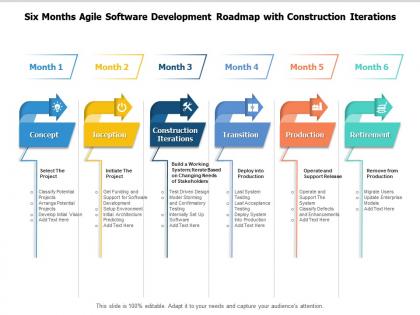
Six months agile software development roadmap with construction iterations




Try Before you Buy Download Free Sample Product
 Impress Your
 Audience
 100%
100% Editable
 Save Hours
 of Time


Utilize our pre build Six Months Agile Software Development Roadmap With Construction Iterations to present your plan of action in the most effective way. Reduce the paperwork and showcase how different activities are linked to each other by incorporating this attention grabbing PowerPoint theme. This completely editable roadmap PPT layout is suitable to fit all your needs and to have a structured outline of the entire process flow using color coding. Provide guidelines to your teammates about the progression process by employing our PPT theme. Team members can easily be designated into teams by accessing the work milestones to be accomplished within the timeframe. You can easily modify the PowerPoint slide according to real time situations. Download our stunning Six Months Agile Software Development Roadmap With Construction Iterations, and you are good to go to prove your expertise in strategic planning.
People who downloaded this PowerPoint presentation also viewed the following :
Six months agile software development roadmap with construction iterations with all 2 slides:
Use our Six Months Agile Software Development Roadmap With Construction Iterations to effectively help you save your valuable time. They are readymade to fit into any presentation structure.
FAQs for Six months agile software development roadmap
Agile development roadmaps include strategic planning, release planning, sprint planning, execution and review, and continuous improvement phases. These phases streamline project delivery by establishing clear objectives, prioritizing features based on user value, and maintaining flexibility through iterative cycles, with many software teams finding that this approach enhances collaboration, reduces time-to-market, and ultimately delivers higher-quality products that better meet evolving customer needs.
Agile principles influence roadmap prioritization by emphasizing customer value, continuous feedback, and iterative delivery, ensuring highest-priority features are developed first. Through user stories, sprint planning, and regular stakeholder collaboration, development teams can rapidly adjust priorities based on market feedback, changing requirements, and business outcomes, ultimately delivering more relevant products faster.
Essential metrics for tracking Agile development roadmap progress include velocity, sprint burndown rates, cycle time, defect density, and customer satisfaction scores. These metrics enhance project visibility by measuring team productivity, identifying bottlenecks, and ensuring quality delivery, with many development teams finding that strategic combination of these measurements ultimately delivers faster releases and improved stakeholder confidence.
Teams ensure stakeholder alignment through regular sprint reviews, continuous feedback loops, transparent communication channels, shared project dashboards, and collaborative planning sessions. These practices streamline decision-making by maintaining visibility into progress, addressing concerns proactively, and adapting priorities based on stakeholder input, ultimately delivering solutions that meet business objectives while minimizing costly revisions.
Agile development roadmaps adapt to changing market conditions through flexible sprint planning, iterative feedback loops, regular stakeholder reviews, and dynamic priority reassessment based on customer insights. These adaptive mechanisms enable organizations to pivot quickly when market demands shift, with many technology companies and financial services firms finding that continuous roadmap refinement delivers faster time-to-market and enhanced competitive positioning.
User stories serve as foundational building blocks that translate customer needs into actionable development priorities, helping teams sequence features based on business value, technical dependencies, and user impact. They enable product managers and development teams to create flexible roadmaps that adapt to changing requirements while maintaining clear stakeholder communication, with many organizations finding that story-driven roadmaps deliver more customer-centric products and faster market responsiveness.
Team collaboration during Agile roadmap execution is enhanced through daily stand-ups, sprint planning sessions, retrospectives, cross-functional pairing, and shared digital workspaces that maintain transparency. These practices streamline communication by eliminating silos, accelerating decision-making, and ensuring alignment across development cycles, with many organizations finding that consistent collaboration rituals ultimately deliver faster product iterations and higher team productivity.
Popular Agile roadmap tools include Jira, Azure DevOps, Aha!, ProductPlan, and Roadmunk, each offering sprint planning, backlog management, and stakeholder visualization capabilities. These platforms streamline development cycles by enabling real-time collaboration, automated progress tracking, and seamless integration with existing workflows, with many development teams finding that centralized roadmap management significantly enhances delivery speed and cross-functional alignment.
Agile frameworks like Scrum and Kanban integrate into roadmap planning by breaking long-term goals into iterative sprints, enabling continuous feedback loops, and maintaining flexible prioritization based on evolving requirements. These methodologies streamline development cycles through regular retrospectives, cross-functional collaboration, and adaptive planning, with many software teams finding that this approach delivers faster time-to-market and enhanced product quality.
Common pitfalls include overcommitting to rigid timelines, neglecting stakeholder feedback loops, creating overly detailed long-term plans, and failing to account for technical debt or dependencies. These roadmapping challenges can derail project momentum by reducing flexibility, creating unrealistic expectations, and limiting the team's ability to respond to changing requirements, with many organizations finding that maintaining adaptable, outcome-focused roadmaps delivers better stakeholder alignment and project success.
Feedback loops can be effectively integrated into Agile roadmaps through regular sprint retrospectives, stakeholder reviews, user testing sessions, and continuous deployment monitoring that captures real-time performance data. These mechanisms enable development teams to identify bottlenecks, adjust priorities, and refine features based on actual user behavior, ultimately delivering faster iterations and enhanced product-market fit.
Effective strategies include using visual roadmaps with clear timelines, translating technical jargon into business outcomes, conducting regular stakeholder demos, and focusing on customer value delivery rather than technical implementation details. These approaches enable organizations to maintain stakeholder alignment, secure continued buy-in, and demonstrate tangible progress, with many companies finding that visual storytelling and outcome-focused communication significantly enhance cross-functional collaboration and strategic understanding.
Risk management integrates into Agile development roadmaps through regular risk assessments during sprint planning, continuous monitoring throughout iterations, and adaptive mitigation strategies that evolve with project needs. Teams incorporate risk registers into daily standups and retrospectives, enabling early identification of technical debt, resource constraints, and scope changes, ultimately delivering more predictable outcomes and enhanced project resilience.
Retrospectives are crucial for roadmap refinement as they provide structured opportunities to evaluate sprint outcomes, identify process bottlenecks, and gather team insights on delivery effectiveness. These sessions enable development teams to adjust priorities, streamline workflows, and realign roadmap objectives with actual project realities, ultimately delivering more accurate timelines and enhanced product quality through continuous improvement cycles.
Organizations balance flexibility and structure in Agile roadmaps by establishing clear strategic objectives while maintaining adaptive sprint planning, implementing regular review cycles, and using scalable frameworks like SAFe or LeSS. Through iterative planning and continuous stakeholder feedback, teams can pivot quickly when priorities shift while maintaining development momentum, ultimately delivering faster time-to-market and enhanced customer satisfaction.
No Reviews