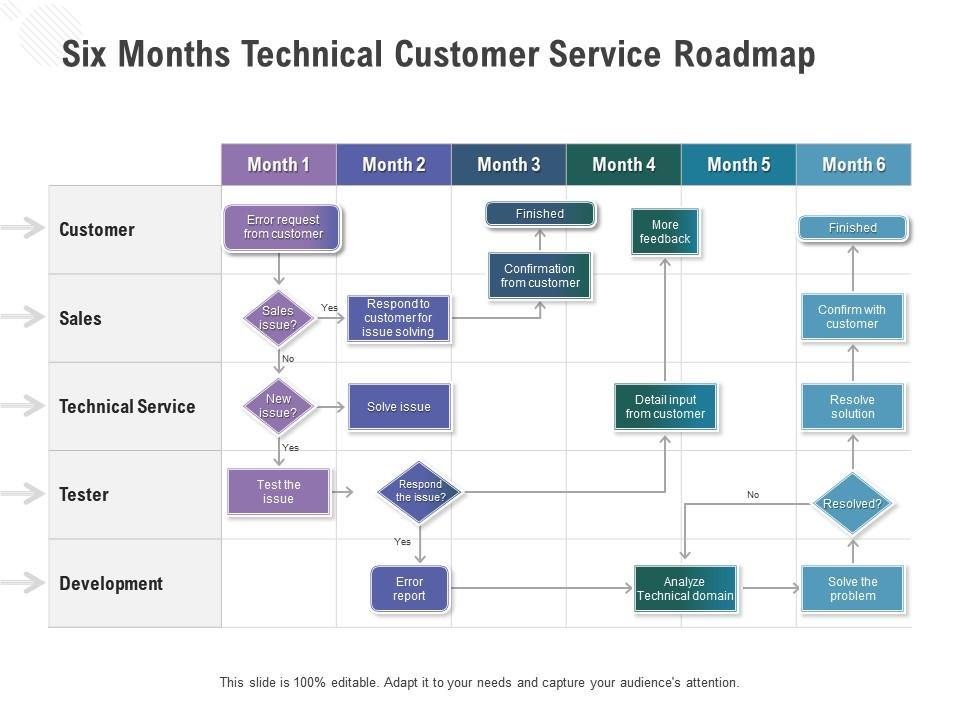
Six months technical customer service roadmap

Six months technical customer service roadmap
Slide 1 of 2
Favourites Favourites

Try Before you Buy Download Free Sample Product

Audience Impress Your
Audience
Editable 100%
Editable
Time Save Hours
of Time
The Biggest Sale is ending soon in
0
0
:
0
0
:
0
0
Presenting Six Months Technical Customer Service Roadmap PowerPoint slide. This PPT slide is available at 4,3 and 16,9 aspect ratios. You can download this PPT theme in various formats like PDF, PNG, and JPG. This PowerPoint template is completely editable and you can modify the font size, font type, and shapes as per your requirements. Our PPT layout is compatible with Google Slides.

FAQs for Six months technical

**INPUT**: What are the key components of an effective technical support roadmap? **OUTPUT**: Effective technical support roadmaps include comprehensive service level agreements, escalation procedures, knowledge management systems, performance metrics, and continuous improvement frameworks. These components streamline support operations by enhancing response times, minimizing resolution delays, and delivering consistent customer experiences, with many organizations finding that strategic roadmaps ultimately enable scalable support infrastructure and competitive service advantage. **Word count: 54 words**

Organizations ensure continuous improvement in technical support by implementing regular performance analytics, gathering customer feedback systematically, conducting team training programs, and establishing clear escalation protocols. Through data-driven insights and structured review cycles, companies streamline resolution times, enhance service quality, and reduce operational costs, with many finding that proactive monitoring ultimately delivers competitive advantage and superior customer experiences.

Customer feedback plays a pivotal role in shaping technical support roadmaps by identifying pain points, prioritizing feature requests, and revealing gaps in current service delivery. Through systematic feedback analysis, organizations streamline support processes, enhance user experiences, and develop targeted solutions that address real customer needs, ultimately delivering improved satisfaction rates and competitive advantage in increasingly demanding markets.

Businesses can integrate AI and automation into technical support through chatbots for initial inquiries, predictive analytics for issue prevention, automated ticket routing, and AI-powered knowledge bases. These technologies streamline operations by reducing response times, minimizing human workload, and enhancing customer experiences, with many organizations finding that strategic automation ultimately delivers cost savings while enabling support teams to focus on complex, high-value interactions.

Key metrics include first-call resolution rates, average response times, customer satisfaction scores, ticket volume trends, and support cost per incident. These measurements enable organizations to assess operational efficiency, resource allocation effectiveness, and service quality improvements, with many companies finding that tracking both quantitative performance data and qualitative customer feedback ultimately delivers enhanced support experiences and reduced operational costs.

Cross-departmental collaboration enhances technical support effectiveness by streamlining communication channels, leveraging diverse expertise, and accelerating issue resolution through shared knowledge bases. When support teams collaborate with engineering, product, and sales departments, organizations deliver faster response times, more accurate solutions, and proactive problem prevention, ultimately improving customer satisfaction while reducing operational costs.

Common challenges include resource allocation constraints, stakeholder alignment issues, technology integration complexities, timeline management difficulties, and staff training requirements. These obstacles can significantly impact implementation success, with many organizations finding that inadequate planning, insufficient communication between departments, and underestimating change management needs ultimately delay roadmap execution and reduce operational efficiency gains.

Technical support teams prioritize issues through severity-based classification systems, automated ticket routing, customer impact assessment, and service level agreements. These frameworks enable teams to address critical system outages before minor inquiries, implement escalation protocols for enterprise clients, and maintain response time standards, ultimately delivering faster resolution and improved customer satisfaction while optimizing resource allocation.

**INPUT**: What tools and technologies are essential for modern technical support operations? **OUTPUT**: Essential tools include helpdesk ticketing systems, live chat platforms, remote desktop software, knowledge management databases, and AI-powered chatbots for initial customer interactions. These technologies streamline operations by automating ticket routing, enabling faster issue resolution, and providing self-service options, with many organizations finding that integrated platforms ultimately deliver improved response times and enhanced customer satisfaction across all support channels. [Word count: 58 words]

Training and development can be incorporated through structured competency assessments, role-specific certification programs, cross-functional knowledge sharing sessions, and continuous learning pathways aligned with emerging technologies. These initiatives enhance team expertise, reduce resolution times, and improve customer satisfaction, with many organizations finding that systematic skill development ultimately delivers stronger technical capabilities and competitive service advantages.

Knowledge management streamlines technical support by centralizing solutions, reducing resolution times, and ensuring consistent service quality across all customer interactions. It enables support teams to quickly access proven troubleshooting methods, minimize repetitive inquiries, and maintain institutional expertise, with many organizations finding that comprehensive knowledge bases ultimately deliver faster customer resolutions and improved operational efficiency.

Customer personas inform technical support roadmap design by identifying specific pain points, preferred communication channels, technical skill levels, and support expectations across different user segments. These insights enable organizations to prioritize feature development, customize service delivery methods, and allocate resources strategically, with many companies finding that persona-driven roadmaps deliver faster resolution times and significantly improved customer satisfaction rates.

Strategies to reduce technical support response and resolution times include implementing AI-powered ticket routing, creating comprehensive self-service knowledge bases, utilizing chatbots for initial triage, establishing tiered support structures, and deploying remote diagnostic tools. These approaches streamline workflows by automating routine inquiries, prioritizing critical issues, and enabling faster problem identification, with many organizations finding that strategic automation reduces average resolution times by 40-60% while improving customer satisfaction.

A technical support roadmap aligns with business objectives by prioritizing customer retention, operational efficiency, and scalability improvements that directly impact revenue and growth targets. Through strategic integration of support metrics with business KPIs, organizations streamline resource allocation, enhance customer experiences, and reduce operational costs, ultimately delivering competitive advantage and measurable ROI across departments.

Best practices for documenting and communicating technical support roadmaps include creating visual timeline presentations, establishing regular stakeholder review cycles, maintaining detailed progress tracking systems, and developing clear milestone communication protocols. These approaches enhance transparency by providing real-time updates, standardized reporting formats, and collaborative feedback mechanisms, with many organizations finding that structured documentation ultimately delivers improved stakeholder alignment and faster project execution.

Ratings and Reviews

0% of 100
Review Form
Write a review
Most Relevant Reviews

No Reviews