

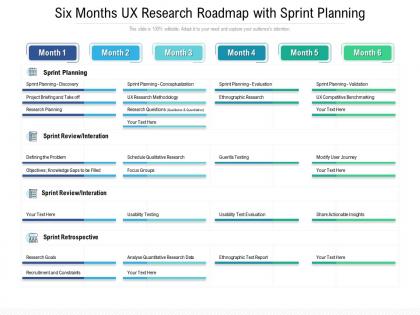
Six months ux research roadmap with sprint planning




Try Before you Buy Download Free Sample Product
 Impress Your
 Audience
 100%
100% Editable
 Save Hours
 of Time


A well thought out action plan makes execution easier and increases the possibility of success significantly. Ensure hitting all the milestones within the deadlines by introducing our fully customizable Six Months UX Research Roadmap With Sprint Planning. Streamline the work related information, budget, timeframe, key deliverable, landmarks, and major steps involved, all in one place to give an organized overview of the project by utilizing our PowerPoint theme. Minimize time lag and increase work efficiency by providing insight into the process with our comprehensively researched roadmap PowerPoint layout. Color coding helps in highlighting the process and grabs the attention of the audience. Download our handy Six Months UX Research Roadmap With Sprint Planning to identify the possible problem areas in a much shorter time and propose solutions. Have a productive brainstorming session with your workforce by utilizing our action plan visualization tool.
People who downloaded this PowerPoint presentation also viewed the following :
Six months ux research roadmap with sprint planning with all 2 slides:
Use our Six Months UX Research Roadmap With Sprint Planning to effectively help you save your valuable time. They are readymade to fit into any presentation structure.

FAQs for Six months ux research roadmap
A typical UX research roadmap includes discovery and user needs assessment, research planning and methodology selection, data collection through interviews and usability testing, analysis and insights synthesis, and implementation with stakeholder alignment. These phases streamline product development by identifying user pain points, validating design decisions, and reducing costly redesigns, with many organizations finding that structured research roadmaps ultimately deliver enhanced user experiences and stronger market positioning.
User personas can be effectively integrated into the UX research process by establishing them as foundational reference points during planning, recruiting participants that match persona profiles, and continuously validating persona assumptions through testing. These research-backed profiles guide decision-making across discovery, usability testing, and iterative design phases, with many design teams finding that persona-driven research delivers more targeted insights, reduces development costs, and ultimately creates more intuitive user experiences that drive engagement.
Qualitative UX research methods include user interviews, usability testing, ethnographic studies, and focus groups, while quantitative methods encompass surveys, A/B testing, analytics analysis, and click tracking. These approaches work strategically together, with qualitative methods revealing user motivations and pain points, and quantitative methods validating findings at scale, ultimately delivering comprehensive insights for data-driven design decisions.
Prioritizing research questions involves assessing business impact, user needs, feasibility, and timeline constraints through stakeholder alignment and strategic scoring frameworks. Organizations typically rank questions by revenue potential, user experience gaps, and implementation complexity, with many product teams finding that quarterly roadmap reviews and cross-functional collaboration ensure research directly supports key business objectives and competitive positioning.
**INPUT**: What tools are recommended for remote usability testing? **OUTPUT**: Recommended remote usability testing tools include UserTesting, Maze, Lookback, UsabilityHub, and Hotjar, each offering screen recording, user interaction tracking, and real-time feedback capabilities. These platforms streamline research processes by enabling seamless participant recruitment, automated data collection, and comprehensive analytics, with many UX teams finding that remote testing delivers faster insights and broader participant diversity than traditional in-person methods. **Word count**: 60 words
UX research findings can be effectively communicated through visual dashboards, executive summaries, user journey maps, persona documentation, and stakeholder-specific presentations tailored to different audience needs. These communication methods streamline decision-making by translating complex user insights into actionable business recommendations, with many organizations finding that structured reporting formats enhance stakeholder buy-in and ultimately accelerate product development timelines.
Competitor analysis provides critical benchmarking insights, identifies industry best practices, reveals market gaps, uncovers user expectations, and informs strategic positioning within the UX research roadmap. Through systematic evaluation of competitor interfaces and user experiences, organizations can accelerate design decisions, avoid costly missteps, and differentiate their offerings, ultimately delivering superior user experiences while maintaining competitive advantage in increasingly crowded markets.
User research should be conducted continuously throughout the product development cycle, with formal studies at key phases including discovery, design validation, usability testing, and post-launch evaluation. This iterative approach enables teams to validate assumptions early, reduce costly redesigns, and maintain user-centered focus, with many successful organizations finding that regular research touchpoints, whether weekly feedback sessions or monthly comprehensive studies, ultimately deliver better user experiences and stronger market positioning.
Effective user engagement strategies include creating comfortable environments, using interactive prototypes, implementing think-aloud protocols, offering incentives, and establishing clear communication channels. These approaches enhance participation by building rapport, encouraging honest feedback, and maintaining focus throughout sessions, with many UX teams finding that combining multiple techniques delivers richer insights and more actionable research outcomes.
UX researchers ensure diversity and inclusion by implementing stratified sampling across demographics, partnering with community organizations, offering multiple participation formats, and removing accessibility barriers. These approaches deliver more representative insights by reaching underserved populations, accommodating different abilities and schedules, and building inclusive recruitment pipelines, ultimately enhancing product usability for broader user bases.
Key metrics include task completion rates, user satisfaction scores, time-to-completion, error rates, and conversion improvements across user journeys. These measurements enable organizations to demonstrate research ROI through reduced support costs, increased customer retention, and enhanced product adoption, with many companies finding that systematic UX tracking delivers measurable competitive advantages.
Balancing user needs and business objectives requires strategic alignment through research methods like user journey mapping, competitive analysis, and stakeholder interviews that address both perspectives simultaneously. Financial services and retail organizations increasingly find that prioritizing user pain points while measuring business metrics like conversion rates and customer lifetime value creates solutions that enhance user satisfaction while driving revenue growth and competitive advantage.
Common UX research pitfalls include conducting research too late in development, relying on small or biased sample sizes, asking leading questions, and failing to involve stakeholders in findings. These missteps often result in products that miss user needs, requiring costly redesigns and delayed launches, with many organizations finding that early, systematic research ultimately delivers better user experiences and stronger market performance.
UX research helps identify and mitigate usability issues early through user interviews, prototype testing, heuristic evaluations, and behavioral analytics that reveal pain points before full development. These methodologies enable organizations to streamline design iterations, reduce costly post-launch fixes, and enhance user satisfaction, with many companies finding that early research investment delivers significantly improved conversion rates and customer retention.
Ethical UX research considerations include informed consent, data privacy protection, participant anonymity, avoiding manipulation, and ensuring inclusive representation across demographics. These principles streamline research integrity by building genuine user trust, preventing legal complications, and delivering authentic insights, with many organizations finding that ethical practices ultimately enhance credibility and competitive advantage.
No Reviews