

Six Sigma Process Improvement For Enhancing Quality Standards Complete Deck




Try Before you Buy Download Free Sample Product
 Impress Your
 Audience
 100%
100% Editable
 Save Hours
 of Time


Check out our professionally designed Six Sigma Process Improvement for Enhancing Quality Standards PowerPoint Presentation. Six Sigma improvement involves a comprehensive process aimed at identifying errors and defects across various facets of the manufacturing process to uphold overall quality standards of the output. Additionally, the DMAIC Methodology slides provide an overview of the DMAIC methodology, a widely utilized approach in Six Sigma, consisting of five essential phases Define establishing goals and scope, Measure gathering data for analysis, Analyze pinpointing root causes of issues, Improve implementing solutions, and Control ensuring sustained improvements. Lastly, the Value stream improvement templates provide a structured approach that facilitates data-driven decision-making, continuous enhancement, and the consistent upkeep of high-quality processes. Explore our expertly designed PowerPoint Presentation illustrating the Six Sigma improvement framework, ensuring the achievement of predetermined objectives without compromising quality. Lastly, it incorporates dashboards illustrating the status of defects and errors collectively. Download our fully customizable module, compatible with Google Slides, to facilitate seamless editing and adaptation to your specific requirements.
People who downloaded this PowerPoint presentation also viewed the following :
Content of this Powerpoint Presentation
Slide 1: This slide introduces Six sigma Process improvement for enhancing quality standards. State your company name and begin.
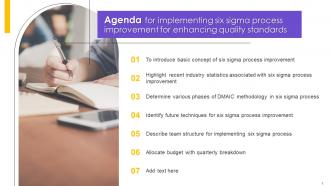
Slide 2: This is an Agenda slide. State your agendas here.
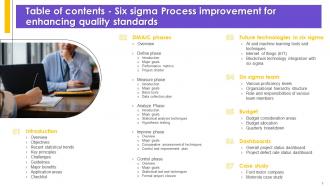
Slide 3: This slide shows Table of Content for the presentation.
Slide 4: This slide shows title for topics that are to be covered next in the template.
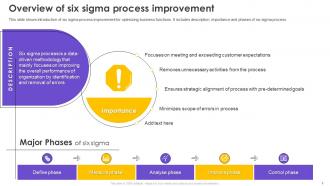
Slide 5: This slide presents an introduction of six sigma process improvement for optimizing business functions.
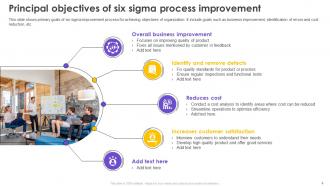
Slide 6: This slide shows primary goals of six sigma improvement process for achieving objectives of organization. It include goals such as business improvement etc.
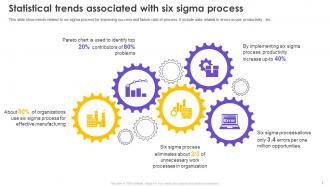
Slide 7: This slide displays trends related to six sigma process for improving success and failure ratio of process.
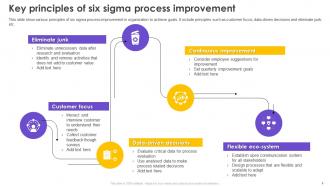
Slide 8: This slide show various principles of six sigma process improvement in organization to achieve goals.
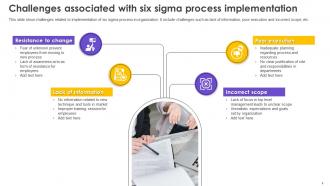
Slide 9: This slide presents challenges related to implementation of six sigma process in organization.
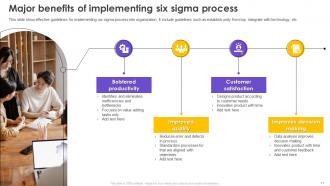
Slide 10: This slide shows an effective guidelines for implementing six sigma process into organization.
Slide 11: This slide presents effective guidelines for implementing six sigma process into organization.
Slide 12: This slide shows major application areas of six sigma process sin manufacturing to ensure overall stability.
Slide 13: This slide displays a detailed checklist for implementing six sigma process effectively in the organization.
Slide 14: This slide shows title for topics that are to be covered next in the template.
Slide 15: This slide displays a summary of all phases in six sigma process improvement for reducing defect and errors.
Slide 16: This slide shows title for topics that are to be covered next in the template.
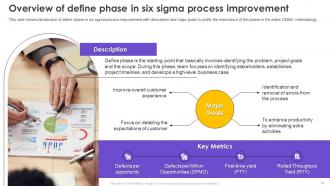
Slide 17: This slide presents introduction of define phase in six sigma process improvement with description and major goals to justify the importance of this phase.
Slide 18: This slide shows primary goals of define phase for outlining project scope and purpose. It include objectives such as describe project scope and map the current process, etc.
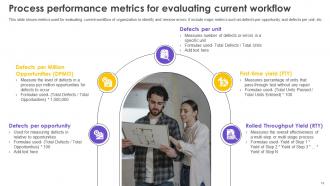
Slide 19: This slide displays metrics used for evaluating current workflow of organization to identify and remove errors.
Slide 20: This slide shows sample project charter for forecasting future scenario of business initiative. It include components such as project title etc.
Slide 21: This slide shows title for topics that are to be covered next in the template.
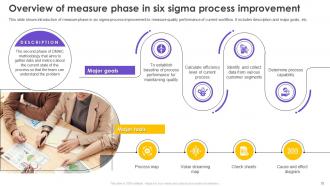
Slide 22: This slide shows introduction of measure phase in six sigma process improvement to measure quality performance of current workflow.
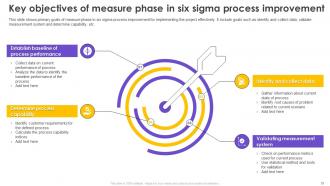
Slide 23: This slide displays primary goals of measure phase in six sigma process improvement for implementing the project effectively.
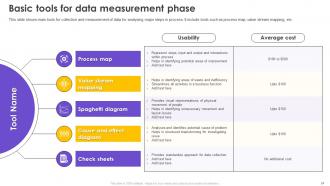
Slide 24: This slide shows main tools for collection and measurement of data for analysing major steps in process. It include tools such as process map, value stream mapping, etc.
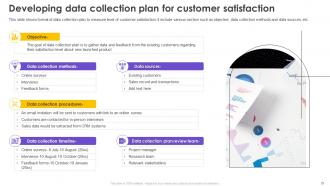
Slide 25: This slide presents format of data collection plan to measure level of customer satisfaction. It include various section such as objective, data collection methods etc.
Slide 26: This slide shows title for topics that are to be covered next in the template.
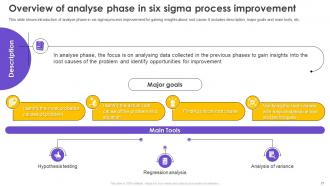
Slide 27: This slide presents introduction of analyse phase in six sigma process improvement for gaining insights about root cause.
Slide 28: This slide shows primary goals of analyse phase in six sigma process improvement for finding root cause problem.
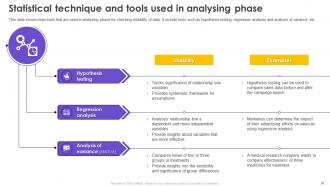
Slide 29: This slide displays main tools that are used in analysing phase for checking reliability of data.
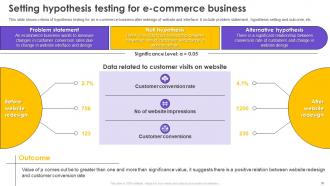
Slide 30: This slide presents the criteria of hypothesis testing for an e-commerce business after redesign of website and interface.
Slide 31: This slide shows title for topics that are to be covered next in the template.
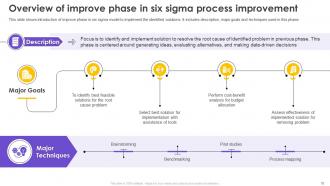
Slide 32: This slide displays an introduction of improve phase in six sigma model to implement the identified solutions.
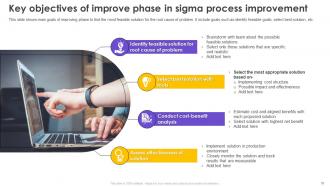
Slide 33: This slide shows main goals of improving phase to find the most feasible solution for the root cause of problem.
Slide 34: This slide presents the main goals of improving phase to find the most feasible solution for the root cause of problem.
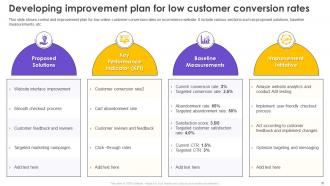
Slide 35: This slide displays the control and improvement plan for low online customer conversion rates on ecommerce website.
Slide 36: This slide shows title for topics that are to be covered next in the template.
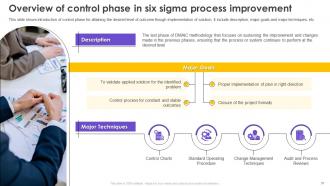
Slide 37: This slide presents an introduction of control phase for attaining the desired level of outcome though implementation of solution.
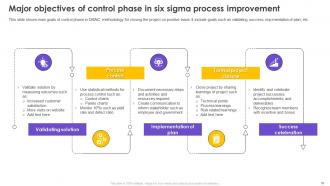
Slide 38: This slide shows main goals of control phase in DMAIC methodology for closing the project on positive basis.
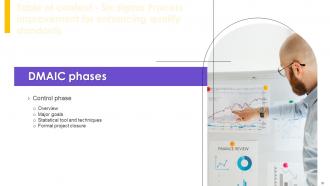
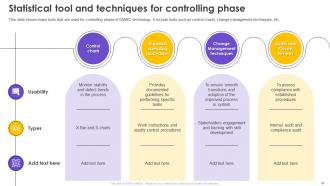
Slide 39: This slide presents the major tools that are used for controlling phase of DMAIC technology. It include tools such as control charts, change management techniques, etc.
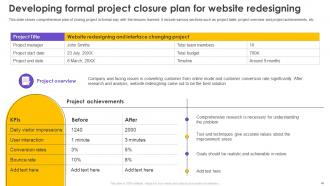
Slide 40: This slide displays comprehensive plan of closing project in formal way with the lessons learned. It include various sections such as project title etc.
Slide 41: This slide shows title for topics that are to be covered next in the template.
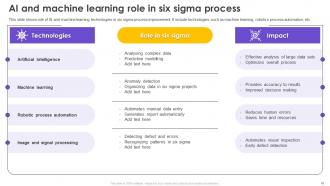
Slide 42: This slide presents role of AI and machine learning technologies in six sigma process improvement.
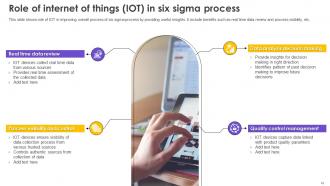
Slide 43: This slide shows role of IOT in improving overall process of six sigma process by providing useful insights.
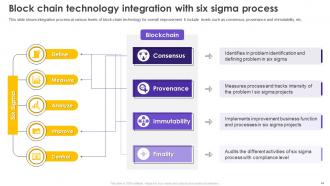
Slide 44: This slide presents integration process at various levels of block-chain technology for overall improvement.
Slide 45: This slide shows title for topics that are to be covered next in the template.
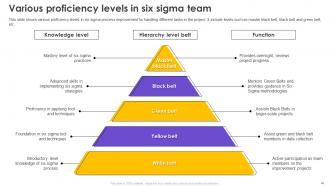
Slide 46: This slide displays various proficiency levels in six sigma process improvement for handling different tasks in the project.
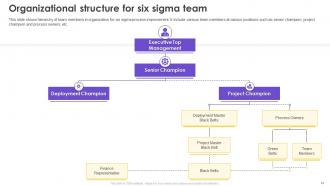
Slide 47: This slide shows hierarchy of team members in organization for six sigma process improvement. It include various team members at various positions.
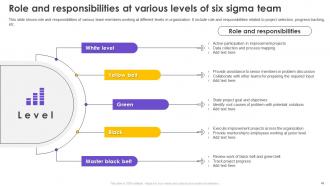
Slide 48: This slide presents role and responsibilities of various team members working at different levels in organization.
Slide 49: This slide shows title for topics that are to be covered next in the template.
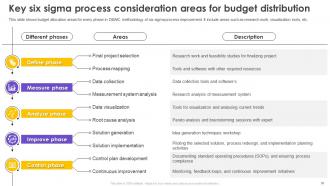
Slide 50: This slide displays budget allocation areas for every phase in DMAIC methodology of six sigma process improvement.
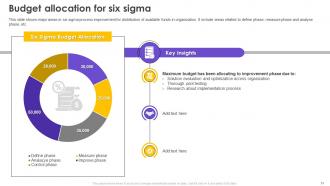
Slide 51: This slide shows major areas in six sigma process improvement for distribution of available funds in organization.
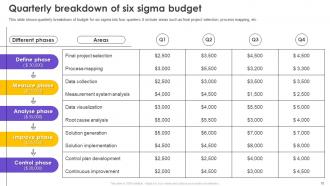
Slide 52: This slide displays an quarterly breakdown of budget for six sigma into four quarters. It include areas such as final project selection, process mapping, etc.
Slide 53: This slide shows title for topics that are to be covered next in the template.
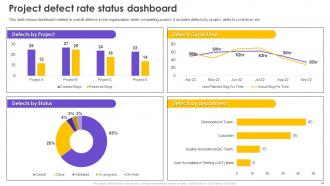
Slide 54: This slide presents dashboard related to overall defects in the organization while completing project. It includes defects by project, defects cycle time, etc.
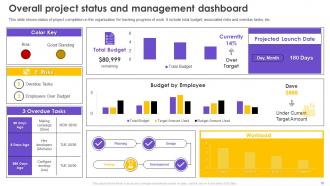
Slide 55: This slide shows status of project completion in the organization for tracking progress of work. It include total budget, associated risks and overdue tasks, etc.
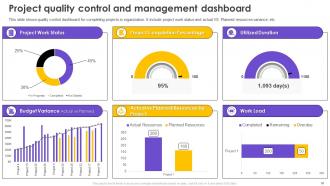
Slide 56: This slide displays an quality control dashboard for completing projects in organization. It include project work status and actual VS. Planned resources variance, etc.
Slide 57: This slide shows title for topics that are to be covered next in the template.
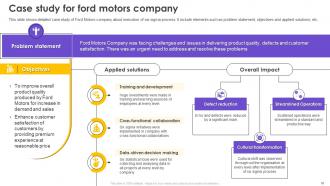
Slide 58: This slide presents detailed case study of Ford Motors company about execution of six sigma process.
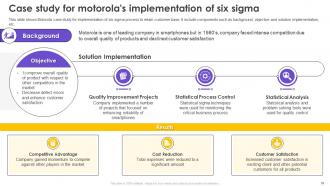
Slide 59: This slide shows Motorola case study for implementation of six sigma process to retain customer base.
Slide 60: This slide shows all the icons included in the presentation.
Slide 61: This slide is titled as Additional Slides for moving forward.
Slide 62: This is a Timeline slide. Show data related to time intervals here.
Slide 63: This is Our Target slide. State your targets here.
Slide 64: This is a financial slide. Show your finance related stuff here.
Slide 65: This slide displays Mind Map with related imagery.
Slide 66: This slide displays Lego timeline with additional textboxes and related imagery.
Slide 67: This slide displays silhouettes with additional textboxes and related imagery.
Slide 68: This slide showcases Magnifying Glass to highlight, minute details, information, specifications etc.
Slide 69: This is an Idea Generation slide to state a new idea or highlight information, specifications etc.
Slide 70: This is a Funnel slide. Showcase how the data moves through the process.
Slide 71: This is a Timeline slide. Show data related to time intervals here.
Slide 72: This is a Thank You slide with address, contact numbers and email address.
Six Sigma Process Improvement For Enhancing Quality Standards Complete Deck with all 80 slides:
Use our Six Sigma Process Improvement For Enhancing Quality Standards Complete Deck to effectively help you save your valuable time. They are readymade to fit into any presentation structure.


























FAQs for Six Sigma Process Improvement For Enhancing Quality
Six Sigma's core principles include customer focus, data-driven decision making, process improvement, defect reduction, employee engagement, and systematic problem-solving methodologies. These principles work together by eliminating waste, reducing variability, and enhancing quality control, with many organizations in manufacturing, healthcare, and financial services finding that this approach delivers significant cost savings, improved operational efficiency, and enhanced customer satisfaction.
Six Sigma differs from TQM through its data-driven methodology, statistical focus on defect reduction to 3.4 defects per million opportunities, and project-based implementation structure. While TQM emphasizes company-wide cultural transformation and continuous improvement philosophy, Six Sigma delivers measurable results through structured DMAIC processes, with organizations like Motorola and GE finding significant cost savings and operational efficiency gains.
DMAIC is Six Sigma's five-phase improvement methodology: Define project scope and customer requirements, Measure current process performance, Analyze root causes of defects, Improve processes through targeted solutions, and Control sustaining gains. This structured approach enables organizations to systematically reduce variation, eliminate waste, and enhance quality, with manufacturing, healthcare, and financial services finding significant cost reductions and operational efficiency improvements.
Primary roles include Black Belts who lead projects and mentor teams, Green Belts who support implementation within departments, Master Black Belts who train others and oversee multiple initiatives, Champions who provide executive sponsorship, and team members who execute daily improvements. These structured roles ensure accountability and expertise across manufacturing, healthcare, and financial services organizations, with many companies finding that clear role definition accelerates project completion and delivers measurable quality improvements.
Six Sigma enhances service industries by reducing process variations, improving customer satisfaction scores, and streamlining operational workflows through data-driven methodologies. Financial services use it for faster loan processing, healthcare organizations apply it to reduce patient wait times, and hospitality companies leverage it for consistent service delivery, ultimately delivering cost reductions and competitive advantage in increasingly customer-focused markets.
Six Sigma projects utilize DMAIC methodology, statistical process control, control charts, fishbone diagrams, and process mapping to identify and eliminate defects. These tools enable organizations to reduce variation, enhance operational efficiency, and improve quality outcomes, with manufacturing companies, healthcare institutions, and financial services finding that systematic application ultimately delivers significant cost savings and competitive advantage.
Six Sigma effectiveness is measured through defect reduction rates, process cycle time improvements, cost savings, and customer satisfaction scores. Organizations typically track sigma levels moving from 3-4 sigma to 6 sigma performance, while monitoring financial returns on projects, with many companies finding that successful implementations deliver 15-25% improvement in operational efficiency and measurable competitive advantage.
Common Six Sigma implementation challenges include resistance to change, inadequate leadership support, insufficient training, poor project selection, and lack of sustained commitment. Organizations often struggle with cultural transformation and resource allocation, though companies in manufacturing, healthcare, and financial services find that addressing these obstacles early through comprehensive training and executive sponsorship ultimately delivers significant operational improvements.
Six Sigma contributes to cost reduction by eliminating waste, reducing defects, and streamlining processes through data-driven analysis and systematic problem-solving methodologies. Through DMAIC frameworks, organizations minimize rework costs, optimize resource allocation, and enhance operational efficiency, with manufacturing companies and financial services finding that these improvements deliver significant savings while ultimately strengthening competitive positioning.
Data analysis serves as Six Sigma's foundation, enabling organizations to identify process variations, measure performance gaps, and validate improvement solutions through statistical methods like regression analysis, hypothesis testing, and control charts. This data-driven approach helps manufacturing, healthcare, and financial services companies reduce defects, streamline operations, and achieve measurable quality improvements, ultimately delivering enhanced customer satisfaction and competitive advantage.
Six Sigma improves customer satisfaction by reducing defects, eliminating process variations, and streamlining service delivery through data-driven methodologies. By systematically identifying and addressing quality issues, organizations in manufacturing, healthcare, and financial services deliver more consistent products and faster response times, ultimately enhancing customer experiences and building stronger loyalty.
Successful Six Sigma projects include General Electric reducing manufacturing defects by 50%, Motorola decreasing production cycle times, Bank of America streamlining loan processing, hospitals improving patient safety protocols, and Toyota enhancing supply chain efficiency. These initiatives delivered significant cost reductions, faster service delivery, and enhanced customer satisfaction, with many organizations finding that systematic process improvements ultimately drive competitive advantage and operational excellence.
Six Sigma training follows a belt-based hierarchy system, progressing from Yellow Belt basics through Green Belt project leadership to Black Belt mastery and Master Black Belt expertise. Organizations typically implement structured certification programs combining classroom instruction, statistical methodology training, and hands-on project completion, with many companies finding that certified professionals deliver measurable process improvements and operational excellence.
DPMO measures process quality by calculating defects relative to total opportunities, enabling standardized comparison across different processes and industries. This metric helps organizations benchmark performance, track improvement progress, and achieve Six Sigma's goal of 3.4 defects per million opportunities, with manufacturing and service companies finding that DPMO drives targeted process enhancements and operational excellence.
Six Sigma methodologies integrate with Agile practices through shared data-driven decision making, continuous improvement cycles, and customer-focused quality standards. This strategic combination enables organizations to maintain Agile's rapid iteration while leveraging Six Sigma's statistical rigor, with many software development teams and manufacturing companies finding that this hybrid approach delivers faster delivery times, reduced defects, and enhanced operational efficiency.
-
Nice and innovative design.
-
Thanks for all your great templates they have saved me lots of time and accelerate my presentations. Great product, keep them up!
-
The templates you provide are great! They have saved me tons of time and made my presentations come alive. Thank you for this awesome product. Keep up the good work!
-
The best collection of PPT templates!! Totally worth the money.