

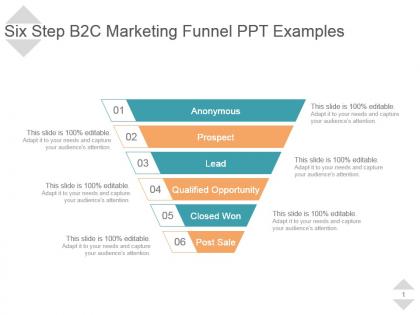
Six step b2c marketing funnel ppt examples




Try Before you Buy Download Free Sample Product
 Impress Your
Audience
 100%
Editable
 Save Hours
of Time


We understand the importance of storyboarding in creating powerful presentation designs. That is why our Six Step B2c Marketing Funnel Ppt Examples are well sort after.
People who downloaded this PowerPoint presentation also viewed the following :
Six step b2c marketing funnel ppt examples with all 5 slides:
Focus attention onto your core competence with our Six Step B2c Marketing Funnel Ppt Examples. They help direct their gaze.


FAQs for Six step b2c marketing
The key stages of a B2C marketing funnel include awareness, interest, consideration, purchase, and retention. These stages streamline customer acquisition by building brand recognition, nurturing engagement through targeted content, converting prospects with strategic offers, and fostering loyalty through personalized experiences, ultimately delivering higher conversion rates and increased customer lifetime value.
Brands effectively attract potential customers through content marketing, social media engagement, search engine optimization, influencer partnerships, and targeted advertising campaigns. These strategies work by creating valuable educational content, building brand awareness across multiple touchpoints, and leveraging data-driven targeting, with many retail and e-commerce companies finding that consistent multi-channel approaches ultimately deliver higher conversion rates and sustainable customer acquisition.
Content marketing guides consumers through each B2C funnel stage by delivering targeted messaging, educational resources, personalized recommendations, and trust-building narratives that address specific customer needs. Through strategic content placement, brands nurture prospects from awareness to conversion, with retail, e-commerce, and service companies finding that tailored content significantly enhances engagement and ultimately drives higher conversion rates.
Social media advertising enhances awareness stage visibility by leveraging targeted demographics, interest-based algorithms, and expansive reach capabilities across multiple platforms. Through strategic content placement on Facebook, Instagram, and LinkedIn, businesses achieve broader audience exposure, increased brand recognition, and cost-effective customer acquisition, ultimately delivering measurable engagement and competitive market positioning.
Effective consideration phase strategies include targeted email campaigns, educational webinars, personalized product demonstrations, retargeting ads, and comparison guides that address specific pain points. These approaches enable businesses to build trust through valuable content, showcase competitive advantages, and guide prospects toward purchase decisions, with many companies finding that multi-touchpoint nurturing significantly increases conversion rates.
Customer reviews and testimonials are crucial in moving prospects closer to purchase, serving as powerful social proof that builds trust, reduces perceived risk, and validates purchasing decisions. In today's digital marketplace, potential customers increasingly rely on peer experiences over traditional advertising, with many businesses finding that authentic testimonials significantly accelerate conversion rates and enhance credibility throughout the decision-making process.
B2C marketers should track conversion rates at each funnel stage, customer acquisition cost, lifetime value, bounce rates, and time-to-conversion metrics. These measurements enable organizations to identify bottlenecks, optimize resource allocation, and enhance customer experiences, with many retail and e-commerce businesses finding that comprehensive funnel analytics ultimately deliver improved ROI and sustainable growth.
Email marketing integrates throughout the B2C funnel by delivering targeted messaging at each stage, from awareness-building newsletters and educational content to consideration-phase product recommendations and retention-focused loyalty programs. This strategic approach enables businesses to nurture prospects systematically, automate personalized communications, and drive conversions, with many retail and e-commerce companies finding that segmented email campaigns significantly enhance customer lifetime value.
Common pitfalls at the decision stage include complicated checkout processes, limited payment options, unclear pricing, lack of trust signals, and insufficient customer support during purchase. These friction points significantly impact conversion rates, with many e-commerce businesses finding that streamlining their purchase flow, adding security badges, and providing live chat support ultimately reduces cart abandonment and enhances customer confidence.
Personalization improves B2C conversions by delivering targeted content, customized product recommendations, and tailored messaging at each funnel stage, significantly increasing engagement and purchase likelihood. Through dynamic email campaigns, personalized landing pages, and behavioral targeting, retailers and e-commerce platforms enhance customer experiences, reduce cart abandonment, and ultimately drive higher conversion rates across all touchpoints.
Abandoned cart emails significantly enhance funnel performance by recovering 10-15% of lost sales, reducing customer acquisition costs, and re-engaging hesitant buyers at critical decision points. These targeted campaigns streamline the conversion process by addressing specific concerns, offering personalized incentives, and maintaining brand visibility, with many e-commerce businesses finding that strategic cart recovery sequences ultimately deliver higher lifetime customer value and improved overall funnel efficiency.
Effective post-purchase re-engagement tactics include personalized follow-up emails, loyalty programs, exclusive offers, user-generated content campaigns, and targeted social media engagement. These strategies enhance customer lifetime value by delivering relevant recommendations, gathering feedback, and creating community connections, with many retailers finding that strategic post-purchase communication significantly increases repeat purchases and brand advocacy.
Segmentation enhances funnel effectiveness by delivering personalized content, targeting specific demographics, and addressing distinct customer needs at each stage. Through behavioral and demographic segmentation, B2C companies like e-commerce retailers and subscription services achieve higher conversion rates, reduce acquisition costs, and improve customer lifetime value, ultimately delivering more relevant experiences and stronger ROI.
User experience plays a critical role in conversion optimization by eliminating friction points, streamlining checkout processes, and building trust through intuitive design and clear value propositions. Through strategic UX improvements like simplified forms, mobile responsiveness, and transparent pricing, businesses enhance customer confidence and reduce abandonment rates, ultimately delivering higher conversion rates and improved customer satisfaction across all touchpoints.
Brands leverage data analytics to refine their marketing funnel by tracking customer behavior patterns, identifying conversion bottlenecks, measuring campaign performance, and personalizing touchpoints across each stage. Through predictive analytics and real-time insights, companies like retail giants and e-commerce platforms optimize targeting strategies, enhance customer experiences, and increase conversion rates, ultimately delivering higher ROI and sustainable competitive advantage.
-
Great experience, I would definitely use your services further.
-
Illustrative design with editable content. Exceptional value for money. Highly pleased with the product.