

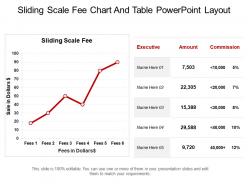
Sliding scale fee chart and table powerpoint layout





Try Before you Buy Download Free Sample Product
 Impress Your
Audience
 100%
Editable
 Save Hours
of Time


Dig away with our Sliding Scale Fee Chart And Table Powerpoint Layout. Your thoughts will bring up the truth.
People who downloaded this PowerPoint presentation also viewed the following :
Sliding scale fee chart and table powerpoint layout with all 5 slides:
Declare the results of your experiment. Our Sliding Scale Fee Chart And Table Powerpoint Layout help highlight the gains.


FAQs for Sliding scale fee chart and
So basically you create different price tiers based on what people can afford. Like someone making under $30k might pay $50, while someone earning $60k+ pays your full rate of $150. Healthcare places and therapists do this all the time - honestly it's pretty smart for keeping things accessible. You'll want to figure out your income brackets ahead of time, then just have clients tell you their situation. The tricky part is setting up some easy way to verify income without being weird about it. Just make sure your ranges are super clear so people know exactly what they qualify for right away.
So sliding scale charts basically solve the money problem that keeps people from getting help. Someone making 20K can't drop the same cash as someone pulling in 80K - that's just reality. The chart sets up different price tiers based on income, so clients know their rate upfront without any weird haggling conversations. You can still keep your practice running while actually serving people who need it. I'd say just make sure your income ranges go low enough to catch the folks who really can't afford traditional rates. Otherwise what's the point, right?
Start with figuring out who your clients actually are - income levels, family size, what stuff costs where you live. Then work backwards from your own numbers. What's the bare minimum you need to keep the lights on vs your normal rate? I'd definitely snoop around to see what similar places charge (competitive research sounds fancier but whatever). The tricky part is the logistics though. How do you verify income without being weird about it? Will you limit sliding scale spots? Maybe send a quick survey to current clients about income ranges first - that'll give you a good baseline to build from.
So healthcare sliding scales are way more aggressive with discounts - like $200 dropping to $20 based on federal poverty levels. Education is usually more cautious with smaller cuts. Healthcare mostly just looks at your income, but schools (especially private ones) dig into everything - assets, other kids' tuition, even where you live sometimes. It's honestly kind of invasive when you think about it. I'd check out maybe 3 or 4 examples in whatever field you're working with first. That'll give you a decent sense of what's normal before you set yours up.
Yeah totally! Don't blow up your whole pricing system though. Just treat sliding scale like a separate program - maybe for certain services or specific customer types. I've seen yoga studios crush this approach, honestly it works really well for them. You could try it during off-peak hours or with one product line first. Test it out small before going bigger. The trick is keeping your main fixed prices intact while adding this as like... an alternative option? That way you're not messing with what already works for your business.
Honestly, the biggest thing is making sure you're not accidentally discriminating against people. Your criteria need to be super objective - like income brackets or family size - not gut feelings about who "deserves" help. Be transparent about how it works too. Some therapists get weird about creating different tiers of service, but that's on them honestly. Document everything properly so you can show you're being consistent. Oh, and watch out for criteria that might exclude certain groups without you realizing it. Just write down clear guidelines and actually follow them - sounds obvious but you'd be surprised how many people wing it.
Put that sliding scale info right on your website - don't hide it! Use actual dollar amounts instead of vague "low income" stuff. Train your staff to mention it casually during intake calls so people don't have to awkwardly ask. I hate when places make you hunt for this info, honestly. A simple handout explaining how it works is clutch too. The whole point is making it feel normal, not like some charity thing. Short income brackets work better than these massive ranges some places use.
Track client retention first - are people sticking around longer? Then watch your monthly revenue. Is it steadier or still all over the map? Also check who's actually using those sliding scale spots. Nobody taking the cheaper options probably means your "affordable" pricing isn't really affordable yet. Oh, and throw in a simple survey every few months asking about payment stress. Honestly, you'll know you've hit it when you're helping more people but not lying awake wondering if you can pay rent.
Honestly, just get practice management software that handles the income calculations for you - way easier than doing it manually. Set up your income brackets and let it do the math. Patient portals are clutch here since people can upload their pay stubs or tax docs straight to you. Some systems even talk to your payment processor, so the discount happens automatically when they check out. The reporting stuff is pretty sweet too - you can see which income levels use your services most and tweak things from there. Oh, and make sure whatever you pick has solid documentation for compliance reasons. I'd start by checking what your current setup already connects with.
Honestly, your biggest headache will be staff pushback - nobody likes change, especially when their paycheck's involved. Training everyone on income verification and fee calculations is gonna eat up tons of time. Plus everyone interprets the guidelines differently at first, so you'll have inconsistent applications all over the place. The paperwork side gets crazy complicated too with multiple fee tiers to track. Oh, and don't even get me started on the documentation management - it's a nightmare compared to flat rates. My advice? Start with just one program as a pilot. Work out all the messy details there before you roll it out everywhere else.
Honestly, just ask your clients directly - that's the best way to figure out if your sliding scale actually works. I'd do anonymous surveys or casual check-ins about whether your income brackets make sense. Watch for red flags like people saying they can't even afford your lowest tier, or weird patterns where literally everyone picks the same payment level. That usually means your brackets are spaced wrong or something. The whole point is matching what people in your area can actually pay, not what sounds good in theory. Oh and don't do this once - keep asking and tweaking as you go!
Yeah, you definitely can't just wing this - federal poverty guidelines are basically mandatory, plus whatever your state requires for income verification. Medicaid compliance is a whole other headache if you're taking those patients. FPL percentages are pretty standardized because of federal funding rules, which honestly makes sense but limits your flexibility. Nonprofits sometimes have specific charity care requirements too, depends where you are. I'd seriously check your local regs first before building anything out. Getting this stuff wrong can really screw with your funding or tax status later.
Honestly, sliding scale charts are a game-changer for building trust with clients. People can see right away that you're serious about accessibility, not just talking about it. No more awkward "so... what can you afford?" conversations either - the income brackets and fees are all laid out clearly. It saves everyone from those weird moments where clients have to justify their financial situation just to get a lower rate. The whole thing shows you actually get that people have different economic realities. I'd definitely put the chart on your website and intake forms so folks know what they're walking into before they even reach out.
Check it every 6 months honestly - inflation's making everything nuts right now. Look up your local poverty guidelines and median income stuff first, then see how your clients actually break down across income levels. Are you hitting the accessibility you want? Gradual changes work way better than shocking people with big jumps. Bump both your income cutoffs and fee percentages slowly. Oh, and definitely survey your current clients about what they can afford before you finalize anything - saves awkward conversations later. I learned that one the hard way.
Honestly, sliding scale charts are a game-changer for nonprofits. You'll reach way more people without going broke. Think about it - there's this whole group stuck in the middle who make too much for free services but can't swing full price. With a sliding scale, they can actually pay something instead of you turning them away completely. Plus no more awkward income verification every single time (thank god). Clients feel more like partners instead of charity cases, which builds way better relationships. I'd start with maybe 3-4 income brackets and see how it goes.
-
Illustrative design with editable content. Exceptional value for money. Highly pleased with the product.
-
Awesome presentation, really professional and easy to edit.