


Smart Attendance Tracking Systems Dashboard Asset Tracking And Management IoT SS




Try Before you Buy Download Free Sample Product
 Impress Your
 Audience
 100%
100% Editable
 Save Hours
 of Time


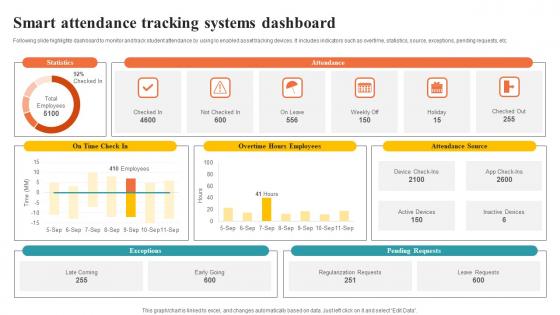
Following slide highlights dashboard to monitor and track student attendance by using Io enabled asset tracking devices. It includes indicators such as overtime, statistics, source, exceptions, pending requests, etc.
People who downloaded this PowerPoint presentation also viewed the following :
Smart Attendance Tracking Systems Dashboard Asset Tracking And Management IoT SS with all 10 slides:
Use our Smart Attendance Tracking Systems Dashboard Asset Tracking And Management IoT SS to effectively help you save your valuable time. They are readymade to fit into any presentation structure.










FAQs for Smart Attendance Tracking Systems Dashboard Asset Tracking And
Real-time tracking is huge - you'll want facial recognition, QR codes, maybe biometrics for check-ins. Mobile access is basically non-negotiable since everyone lives on their phones. Get something that connects to your payroll system because nobody wants to enter data twice. Geofencing helps with remote staff, plus automated alerts for when people are late or call out sick. Oh and make sure it handles weird shift schedules - some systems are surprisingly bad at that. Custom reports are clutch for compliance stuff. Just don't pick something that creates more work than it saves, you know?
Honestly, smart attendance beats the old ways by a mile. No more human error from manual roll calls, and employees can't clock in for their buddies anymore. Biometric scanners and facial recognition create records that can't be messed with - everything syncs automatically to your database. Real-time data instead of waiting around for manual input later. The timestamps are spot-on too, so you'll barely get any attendance disputes. Oh, and ditch those messy paper sheets! I'd suggest starting with one system first rather than changing everything at once though.
So you've got a few main options here. Biometric stuff like fingerprints and facial recognition is everywhere now. RFID badges are still solid though - honestly probably more reliable than the fancy face scanners everyone's obsessed with. QR codes work if people have phones, and there's GPS tracking for remote teams. Oh, and Bluetooth beacons are pretty cool - they just detect when you're nearby automatically. A lot of companies mix and match these technologies anyway. My advice? Pick whatever plays nice with your current HR system first. Trust me, you don't want to deal with integration nightmares later.
Dude, biometric systems totally kill all that attendance fraud stuff. No more buddy punching or people clocking in for their friends. Fingerprint readers are probably your best bet - they're cheap and nobody really minds using them. Facial recognition and iris scanning work too, but honestly that might freak some people out lol. The whole thing saves you tons of admin headaches since everything gets logged automatically with timestamps. Way better than those ancient punch card machines (do places still use those??). Your data becomes super accurate because it's tied to people's actual biological markers, so there's no cheating the system anymore.
So the mobile app is really where employees do everything - clock in/out, use GPS so people can't cheat the system, take selfies for face recognition. Managers can approve time off and see who's actually showing up in real time. Push notifications for schedule changes too, which is clutch. Without a decent mobile app you're basically forcing people to use those ancient time clock machines or weird web portals on their phones. Oh and make sure whatever system you pick works offline - nothing worse than the wifi going out and nobody being able to clock in.
So basically these systems track digital engagement instead of physical attendance. They monitor logins, discussion posts, assignment submissions - all that stuff. Some use webcam check-ins too, but honestly kids are way too clever with workarounds these days. The cool part is you get real-time data showing who's actually participating vs just signed in while binge-watching Netflix. You can set alerts for students going MIA so you catch them before they're completely lost. Way better than old school roll call, especially when half your class might be in different time zones now.
Okay so first thing - biometric stuff like fingerprints is super regulated, you'll definitely need proper consent from everyone. People already hate feeling micromanaged at work, so this could backfire if you're not careful about it. Encrypt everything and lock down access to just HR. Be upfront about what you're collecting and how long you're keeping it around. Oh and write up retention policies so employees can actually see their own data if they want. Honestly I'd get a solid privacy policy drafted before you even think about rolling this out.
Dude, this stuff is actually pretty wild. You can catch patterns you'd never notice otherwise - like how your team always calls in sick on Mondays or when bad weather hits. The predictive side is where it gets interesting though. It'll flag employees who might be burning out before they crash, and honestly? It's scary good at spotting time theft patterns. Weather correlations are weirdly fascinating too - didn't expect that one. Start simple with basic pattern recognition, then work up to the predictive analytics once you get comfortable. The automated reports alone will save you hours.
Dude, these systems are honestly a lifesaver. No more chasing people for timesheets or doing overtime calculations by hand - the whole thing runs automatically. Your payroll gets way more accurate since there's zero human error in the time tracking. You can actually see attendance patterns in real-time, which helps catch issues before they become problems. When your manager randomly asks for attendance data, you just hit a button instead of digging through those awful spreadsheets for hours. Oh, and it connects to your existing HR tools, so everything flows together nicely. Seriously cuts down on all that administrative busy work.
Looking at the numbers, most companies break even in 6-12 months. Basic systems cost around $50-200 per employee, though biometric ones can run $300+. The real savings come from cutting manual timesheet work and stopping buddy punching - that alone saves like 2-4% on payroll. Honestly, I was skeptical at first, but the time savings are pretty legit. You should probably add up how many hours your team spends on attendance stuff now and any payroll errors you're catching. Most HR people I know hit their ROI way sooner than they thought they would.
Honestly, these systems are game-changers for catching kids who're slipping through the cracks. You'll get instant alerts when someone's attendance tanks, so you can actually do something before it's too late. The data shows patterns too - like who's always rolling in late or bouncing early. I've found you can connect attendance drops with missed assignments pretty easily. Set up those automatic notifications first, then focus on your repeat offenders. Once you've got the numbers, sit down with those students and figure out what's actually going on. Way better than just wondering why someone disappeared halfway through the semester.
Honestly, the biggest pain points are usually privacy freakouts and cost. People get weird about biometric scanning - can't blame them really. The hardware costs add up fast too, especially if you've got multiple offices. Then there's the whole nightmare of getting it to actually work with your current HR stuff. Half the time the integration is more complicated than anyone expects. Training everyone is another headache. But here's what I'd do - test it with just one team first. Way easier to fix problems when you're not dealing with the entire company melting down at once.
Honestly, these systems are game-changers for cutting out all that tedious timesheet nonsense. No more hunting people down or dealing with messy spreadsheets. Your team can focus on actual work instead of admin stuff. The real-time data is clutch too - you'll catch patterns like people constantly rolling in late before it becomes a bigger headache. Managers save hours each week on reporting alone, which they can put toward coaching or bigger-picture stuff. I'd start by figuring out which attendance processes waste the most time. That's where you'll see the biggest wins from going automated.
Oh totally! Healthcare places use it for staff scheduling and patient check-ins. Manufacturing does it for safety reasons - they need to know who's on the floor. Retail's getting crazy with the facial recognition stuff for both employees and theft prevention, honestly kind of creepy but whatever. Corporate offices love it for tracking hybrid workers, and gyms do automatic member check-ins now. Even saw a coworking space using it the other day. Just make sure whatever system you pick actually talks to your current HR setup or you'll hate yourself later.
Honestly, biometric stuff is getting crazy good - fingerprints, voice recognition, even analyzing how people walk (which still feels like spy movie territory to me). AI facial recognition is way more accurate now, plus they're building in health monitoring like automatic temperature checks. Most solutions are going mobile-first since we're all on our phones constantly anyway. The analytics dashboards predict attendance patterns and catch weird stuff automatically now. But the real win is when it actually talks to your existing HR systems without breaking everything. Start looking at vendors soon though - the decent ones get booked solid during budget season.
-
Awesome use of colors and designs in product templates.
-
Innovative and Colorful designs.
-
Out of the box and creative design.
-
Very unique and reliable designs.