


Smart Farming Technology Pitch Deck For Food Security Ppt Template




Try Before you Buy Download Free Sample Product
 Impress Your
 Audience
 100%
100% Editable
 Save Hours
 of Time


Our Smart Farming Technology Pitch Deck For Food Security Ppt Template are topically designed to provide an attractive backdrop to any subject. Use them to look like a presentation pro.
People who downloaded this PowerPoint presentation also viewed the following :
Content of this Powerpoint Presentation
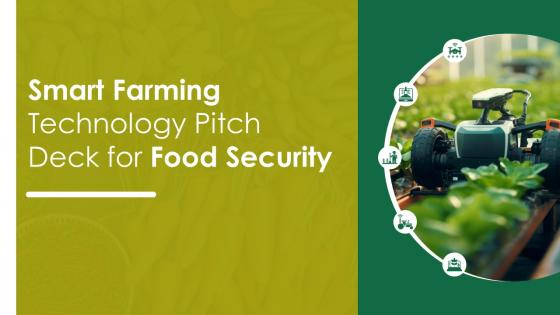
Slide 1: This slide introduces Smart Farming Technology Pitch Deck for Food Security. State your company name and begin.
Slide 2: This slide shows Table of Content for the presentation.
Slide 3: This slide highlights major challenges of agriculture sector and farmers of country.
Slide 4: This slide showcases solutions provided by company to solve major challenges associated with agriculture sector in country.
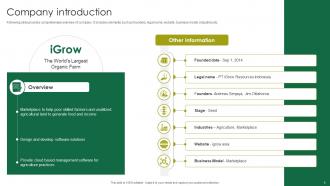
Slide 5: This slide provides comprehensive overview of company. It includes elements such as founders, legal name, website, business model, industries etc.
Slide 6: This slide showcases major facts associated with company performance. It includes elements such as average margin, total outstanding funding, disbursed funding etc.
Slide 7: This slide presents products and services provided by company to assure better agriculture practices and farming.
Slide 8: This slide showcases company value preposition that helps company to gain competitive edge and sustainability in market.
Slide 9: This slide displays key milestones achieved by company. It includes information about number of disbursement, agricultural land empowered, lenders associations etc.
Slide 10: This slide exhibits customer reviews and testimonials about company services. It includes viewpoints of happy clients.
Slide 11: This slide showcases major customers that require company services. It includes clients such as skilled farmers, land owners and investors.
Slide 12: This slide displays market potential that helps company to grow and expand.
Slide 13: This slide showcases business and operational model of company. It includes elements such as key partners, resources, channels etc.
Slide 14: This slide represents major sources through which company generate revenue. It includes pointers such as profit sharing and commission.
Slide 15: This slide presents competitive analysis of company. It includes information about company names, founded year, growth score, location, total funding etc.
Slide 16: This slide showcases company financial statements to understand performance. It provides insights about gross profit, ROI, gross merchandise value, profit and loss report.
Slide 17: This slide displays forecasted financial performance of company. It includes elements such as operating revenue, total expenses, profits, cash from operations etc.
Slide 18: This slide highlights major reasons that helps to attract investors for fund raising. It includes pointers such as impact funding, farmer empowerment etc.
Slide 19: This slide represents funding requirement for company development activities. It includes information about total funding amount requirement along with usage of funds.
Slide 20: This slide showcases company funds usage for various agriculture and farming development. It includes funds allocated for technology, marketing, food security etc.
Slide 21: This slide exhibits company funding history. It includes elements such as announced date, funding round, amount raised, number of investors, total funding amount etc.
Slide 22: This slide represents major exit strategies of company to be used during financial crisis. It includes strategies such as acquisitions, mergers and initial public offerings.
Slide 23: This slide exhibits key members associated with company. It includes members such as CEO, COO and Community based development organization (CBDO) with experience and designation details.
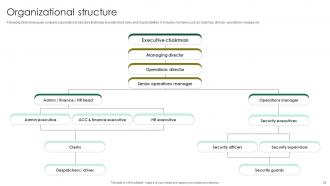
Slide 24: This slide showcases company organizational structure that helps to understand roles and responsibilities. It includes members such as chairman, director, operations manager etc.
Slide 25: This slide showcases shareholding pattern of company. It include details about company shareholders name, designation and percentage of shares holdings.
Slide 26: This is a Thank You slide with address, contact numbers and email address.
Slide 27: This slide shows all the icons included in the presentation.
Slide 28: This slide is titled as Additional Slides for moving forward.
Slide 29: This is a Sand Clock Timeline slide. Show data related to time intervals here.
Slide 30: This slide contains Puzzle with related icons and text.
Slide 31: This slide shows Post It Notes for reminders and deadlines. Post your important notes here.
Slide 32: This slide presents Roadmap with additional textboxes.
Slide 33: This is an Idea Generation slide to state a new idea or highlight information, specifications etc.
Smart Farming Technology Pitch Deck For Food Security Ppt Template with all 41 slides:
Use our Smart Farming Technology Pitch Deck For Food Security Ppt Template to effectively help you save your valuable time. They are readymade to fit into any presentation structure.














FAQs for Smart Farming Technology Pitch Deck For Food
IoT sensors are probably the biggest deal - they track soil moisture, crop health, all that stuff in real-time. Drones are super useful too for getting overhead shots and catching problems early. GPS tractors basically drive themselves now, which is pretty wild if you think about it. AI crunches all the data to predict yields and figure out resource allocation. Automated irrigation handles watering without you babysitting it constantly. Honestly, the whole thing feels like regular farming just got a massive tech upgrade. Start with basic soil sensors though - they're cheap and you'll see results right away.
So basically, IoT sensors track your soil moisture, pH, and nutrients in real-time - way better than just eyeballing it. When soil gets dry, irrigation kicks in automatically. Temperature and humidity sensors help dial in perfect growing conditions too. The cool part? You'll spot pest problems super early before they wreck everything. Only fertilize where it's actually needed instead of blasting the whole field (saves money and works better). Honestly, soil moisture sensors should be your first buy - they make the biggest difference. It's like having a bunch of tiny farm assistants watching everything 24/7.
So basically, data analytics takes all your farm info and turns it into stuff you can actually use. Like instead of guessing about watering, you'll get real recommendations from soil sensors and weather data. Pretty wild how it spots yield issues weeks early too. You can dial in fertilizer timing, track which field sections always suck, optimize equipment schedules - the whole deal. I'd probably start with something simple like irrigation first though. See how the data stacks up against what your gut tells you, then expand from there once you get the hang of it.
So you're asking about drones for farming? They're basically flying cameras that'll show you everything happening in your fields. Multispectral imaging picks up crop health issues way before you'd spot them walking around - stuff like pest problems or where nutrients are lacking. The precision spraying is cool too, much better than the old spray-everything approach. Honestly the image quality blew my mind first time I saw it. You can track irrigation and even keep tabs on livestock from up there. My buddy started with basic crop scouting drones since they pay for themselves pretty quick and aren't too complicated to learn.
Yeah, autonomous tractors can slash your labor costs by like 15-30% easy. You'll need way fewer operators plus they run all night during planting and harvest - which is honestly pretty amazing when you're stressed about weather windows. GPS keeps them on perfect lines, no wandering around or mistakes. Fuel costs usually drop too since they pick optimal speeds and routes. Don't think you're firing everyone though - you'll still need techs for repairs and someone watching things. It's more shifting people around than cutting jobs entirely. I'd crunch your per-acre labor costs first to see if it pencils out.
You can get these wearable sensors that track your animals' vitals - heart rate, temperature, how much they're moving around. Pretty neat stuff, honestly. They'll even monitor rumination in cattle, which I didn't even know was a thing until recently. All the data goes straight to your phone, so you'll get alerts when something seems off. Way better than waiting until an animal's obviously sick, you know? Saves on vet bills too since you catch problems early. I'd start with just a few sensors on your best animals first - see how it goes before investing in the whole herd.
Dude, smart farming is actually pretty game-changing for sustainability. Soil sensors tell you exactly what nutrients your crops need, so you're not just dumping fertilizer everywhere. Smart irrigation cuts water use by like 20-30% - which honestly should be standard by now. GPS equipment reduces fuel waste and keeps heavy machinery from compacting your soil as much. The monitoring tech catches pest issues early, so you can target pesticides instead of spraying everything. Over time you'll get better data for crop rotations and soil health. I'd start with moisture sensors - once you see the ROI it's easier to justify expanding.
So these platforms are basically the brain that connects all your farm tech together. Your sensors, drones, weather stations - they all feed data into one dashboard through APIs and cloud stuff. Before this, everything was separate which was such a pain. You'll see soil moisture, crop health, weather patterns all at once instead of jumping between different apps. Oh and definitely make sure whatever platform you pick works with your current equipment - learned that one the hard way. Makes everything way easier to manage.
Dude, remote sensing is honestly a game changer for catching pest issues early. Drones and satellite pics can spot stressed areas or weird color changes way before you'd see anything walking around. The best part? You get exact locations of problem spots instead of guessing where to spray. I'd set up regular drone flights and create some kind of threshold system - like if imagery shows X amount of stress, time to investigate. You can actually track how infestations move and sometimes predict where they'll hit next based on conditions. Way better than the old spray-and-pray method.
Honestly, it mostly comes down to money and how complicated everything is. Small farms can't drop thousands on sensors and software when margins are already razor-thin. Rural internet is trash half the time, which makes cloud stuff useless. Most farmers aren't tech people either - my uncle still barely uses email, you know? Plus these systems are built for massive operations, not your average family farm. Here's what I'd do: figure out what's actually killing you first. Maybe it's just soil monitoring or irrigation timing. Then find one simple tool that fixes that specific problem instead of trying to automate everything at once.
Yeah, climate change is pretty much what's driving all the smart farming stuff these days. Weather's gotten so unpredictable that farmers are throwing money at tech solutions - soil sensors, precision irrigation, crop planning software, you name it. The whole industry did like a complete 180 in the past decade, which honestly makes sense when you think about it. All this tech helps them use water smarter, cut back on chemicals, and figure out better planting schedules. If you're thinking about getting into this area, I'd focus on water scarcity solutions and anything that helps deal with crazy weather patterns.
Dude, start with the obvious stuff - good passwords and keep everything updated. Farms are huge targets now, which is honestly pretty scary when you think about it. Back up your data constantly. Don't put your irrigation controls on the same network as your bank info - segment that stuff. Any cloud platforms need multi-factor authentication, no exceptions. Your equipment vendors should actually care about security and prove it with real certifications. Oh, and do a quick inventory first of what's even connected to the internet. You might be surprised how much is actually online these days.
So blockchain basically creates this tamper-proof record of where your food's been - like a digital passport that follows everything from farm to your plate. You scan a QR code and boom, you can see harvest dates, farm locations, how it got transported, all that stuff. Pretty neat actually. If there's ever a recall, companies can trace contamination way faster instead of guessing. My cousin works in food safety and she says it's been a game changer for building trust with customers. You'd want to start by finding blockchain platforms that already work with whatever farm management systems you're using.
Honestly, start with the basics - get comfortable with data analysis and just general tech stuff. GPS and smartphone apps are basically required now, no way around it. Problem-solving is huge because this stuff always breaks at the worst times (trust me on that one). You'll want to understand precision agriculture too - like how to read what the sensors are telling you about soil and weather conditions. Don't try learning everything at once though. Pick one thing, maybe a farm management app, and go from there. Build up slowly.
So smart farming tech will probably make food cheaper long-term, but it's gonna create this huge divide between farmers who can afford it and those who can't. The efficiency gains are insane - production costs drop like crazy. But damn, the upfront costs are rough. We're talking hundreds of thousands for the full setup. Small farms without that kind of cash? They'll get squeezed out or have to merge with bigger operations. On the bright side, supply chains become way more stable and predictable. If you're in agriculture or food business, honestly you need to start figuring out how to either invest in this stuff or partner up with farms that already have it.
-
I was able to find the right choice of PPT template for my thesis with SlideTeam. Thank you for existing.
-
Excellent design and quick turnaround.