

Smart Grid Maturity Model Powerpoint Presentation Slides




Try Before you Buy Download Free Sample Product
 Impress Your
 Audience
 100%
100% Editable
 Save Hours
 of Time


Explore our comprehensive PowerPoint presentation titled, Smart Grid Maturity Model, offering valuable insights into intelligent grid technology, its comparison with traditional grids, market size, objectives, importance, technology gap, and its working with the Internet of Things IoT. The presentation begins with an overview of intelligent grids, highlighting their introduction, features, infrastructure, and what makes a grid smart. It also provides a brief overview of traditional grid systems and the problems associated with them. The Smart Grid Infrastructure deck delves into the market size, objectives, and importance of smart grid technology. The Smart Grid Technology PPT explores the relationship between smart grids and the Internet of Things IoT, user involvement, energy decentralization, the innovative grid maturity model, and various smart grid technologies. A comparison between intelligent and traditional grids is also presented, along with insights into the implementation and impact of smart grid technology. The Smart Grid Maturity Model deck covers aspects such as the modernization cost of conventional grids, an evolution roadmap, and an innovative home dashboard for appliance monitoring. Download this 100 percent editable and customizable template, compatible with Google Slides, to enhance your knowledge and effectively communicate the complexities and benefits of smart grid technology.
People who downloaded this PowerPoint presentation also viewed the following :
Content of this Powerpoint Presentation
Slide 1: This slide introduces Smart Grid Maturity Model. Commence by stating Your Company Name.
Slide 2: This slide depicts the Agenda of the presentation.
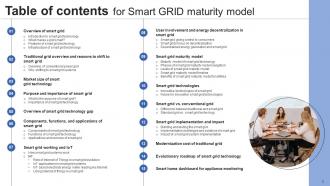
Slide 3: This slide includes the Table of contents.
Slide 4: This slide highlights the Title for the Topics to be covered further.
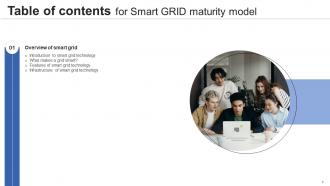
Slide 5: This slide represents the introduction to smart grid technology.
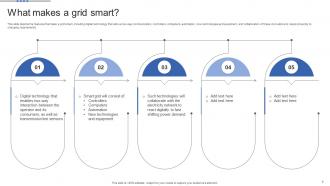
Slide 6: This slide depicts the features that make a grid smart.
Slide 7: This slide outlines the features of smart grid technology.
Slide 8: This slide displays the infrastructure of smart grid technology divided into four sections.
Slide 9: This slide includes the Heading for the Contents to be discussed next.
Slide 10: This slide portrays the overview of the conventional power grid.
Slide 11: This slide represents the challenges related to the conventional power plant and how smart grid technology can overcome those challenges.
Slide 12: This slide contains the Title for the Ideas to be covered in the upcoming template.
Slide 13: This slide depicts the market size of smart grid technology.
Slide 14: This slide highlights the Heading for the Ideas to be discussed in the next template.
Slide 15: This slide represents the purpose of a smart grid.
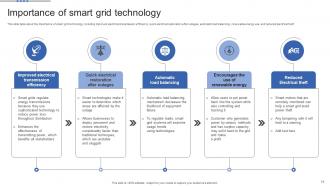
Slide 16: This slide reveals the Importance of smart grid technology.
Slide 17: This slide exhibits the Title for the Contents to be covered in the upcoming template.
Slide 18: This slide depicts the overview of the smart grid technology gap.
Slide 19: This slide includes the Title for the Contents to be covered in teh upcoming template.
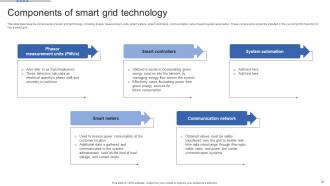
Slide 20: This slide describes the components of smart grid technology.
Slide 21: This slide depicts the functions of smart grid technology.
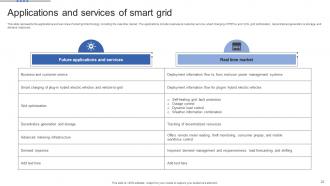
Slide 22: This slide represents the applications and services of smart grid technology, including the real-time market.
Slide 23: This slide portrays the Heading for the Topics to be discussed further.
Slide 24: This slide outlines the working of smart grid systems.
Slide 25: This slide describes the working of a smart grid system.
Slide 26: This slide includes the Title for the Topics to be covered in the upcoming template.
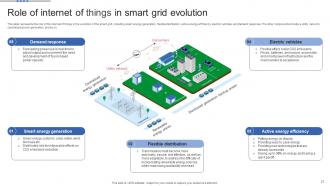
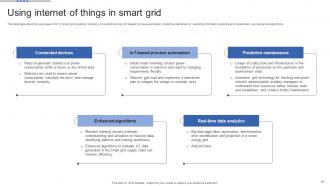
Slide 27: This slide represents the role of the internet of things in the evolution of the smart grid.
Slide 28: This slide describes the real-world applications internet of things in smart grid systems.
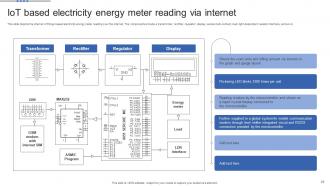
Slide 29: This slide depicts the internet of things based electricity energy meter reading over the internet.
Slide 30: This slide talks about the use cases of IoT in smart grid systems.
Slide 31: This slide includes the Heading for the Contents to be discussed enxt.
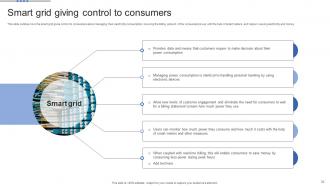
Slide 32: This slide outlines how the smart grid gives control to consumers.
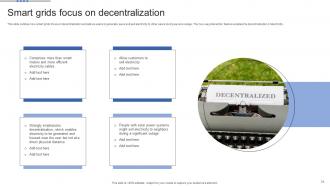
Slide 33: This slide portrays how smart grids focus on decentralization.
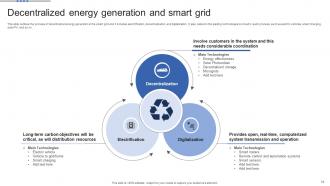
Slide 34: This slide exhibits the process of decentralized energy generation in the smart grid.
Slide 35: This slide presents the Title for the Idaes to be covered in the upcoming template.
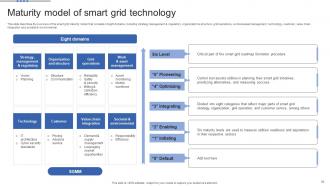
Slide 36: This slide describes the overview of the smart grid maturity model that consists of eight domains.
Slide 37: This slide reveals the Phases of smart grid maturity model navigation.
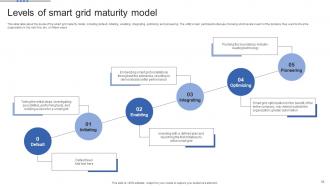
Slide 38: This slide talks about the levels of the smart grid maturity model.
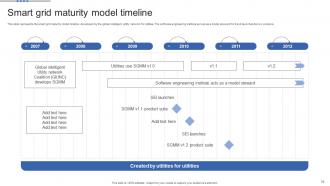
Slide 39: This slide represents the smart grid maturity model timeline developed by the global intelligent utility network for utilities.
Slide 40: This slide describes the use of the smart grid maturity model by electricity providers.
Slide 41: This slide reveals the Heading for the Ideas to be discussed further.
Slide 42: This slide depicts the technologies used in smart grid systems.
Slide 43: This slide shows the Future for innovative smart grid technologies.
Slide 44: This slide displays the Title for the Contents to be covered in the upcoming template.
Slide 45: This slide highlights the Difference between traditional and smart grid.
Slide 46: This slide depicts the comparison between conventional grid and smart grid technology.
Slide 47: This slide includes the Heading for the Topics to be discussed in the upcoming template.
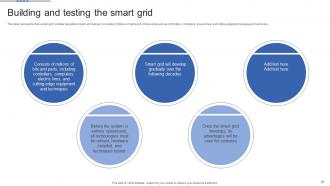
Slide 48: This slide represents that a smart grid will take decades to build and test as it consists of millions of parts and components.
Slide 49: This slide deals with Implementation challenges and solutions of smart grid.
Slide 50: This slide highlights the Impact of smart grid system implementation.
Slide 51: This slide includes the Title for the Topics to be covered in the upcoming template.
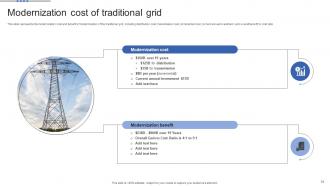
Slide 52: This slide represents the modernization cost and benefit of modernization of the traditional grid.
Slide 53: This slide presents the Heading for the Contents to be further discussed.
Slide 54: This slide represents the evolutionary roadmap of smart grid technology.
Slide 55: This slide contains the Title for the Ideas to be covered in teh next template.
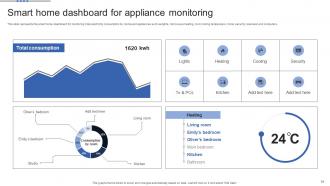
Slide 56: This slide represents the smart home dashboard for monitoring total electricity consumption by rooms and appliances.
Slide 57: This is the Icons slide containing all the Icons used in the plan.
Slide 58: This slide is used for depicting some Additional information.
Slide 59: This is the Quotes slide for motivation.
Slide 60: This slide elucidates information related to the Financial topic.
Slide 61: This slide exhibits the Mind map of the company.
Slide 62: This slide includes the organization's mission, vision, and values.
Slide 63: This is the 30,60,90 days plan slide for effective planning.
Slide 64: This is the Venn diagram slide.
Slide 65: This slide exhibits the firm's Timeline.
Slide 66: This is the Idea Generation slide for encouraging fresh ideas.
Slide 67: This is the Target slide. State your company-targets here.
Slide 67: This slide exhibits the firm's Roadmap.
Slide 69: This is the Thank You slide for acknowledgement.
Smart Grid Maturity Model Powerpoint Presentation Slides with all 77 slides:
Use our Smart Grid Maturity Model Powerpoint Presentation Slides to effectively help you save your valuable time. They are readymade to fit into any presentation structure.

































FAQs for Smart Grid Maturity Model
A Smart Grid Maturity Model encompasses infrastructure modernization, data analytics capabilities, cybersecurity frameworks, regulatory compliance measures, and stakeholder engagement processes. These components work together by enabling utilities to assess current capabilities, identify strategic gaps, and prioritize investments systematically, with many energy providers finding that structured maturity assessments accelerate grid transformation while optimizing resource allocation.
Organizations can assess their Smart Grid Maturity Model position through comprehensive technology audits, infrastructure capability evaluations, data analytics assessments, and operational efficiency benchmarking against industry standards. Through systematic analysis of grid automation, renewable integration, and customer engagement systems, utilities identify gaps while measuring performance metrics, ultimately enabling strategic roadmap development and prioritized investments for enhanced grid modernization.
Smart Grid maturity progression delivers enhanced operational efficiency, improved grid reliability, reduced energy costs, advanced demand response capabilities, and greater renewable energy integration. These advancements enable utilities to streamline grid management, minimize outages, and optimize resource allocation, while customers experience lower bills and more sustainable energy options, ultimately creating competitive advantages in an increasingly digital energy landscape.
Regulatory frameworks significantly shape Smart Grid Maturity Models by establishing compliance standards, security requirements, data privacy protocols, and interoperability guidelines that utilities must integrate into their development strategies. These frameworks create structured pathways for grid modernization, with regulatory bodies like FERC and state commissions providing clear benchmarks and funding incentives, ultimately enabling utilities to advance systematically while ensuring consumer protection and grid reliability.
Technology innovation serves as the primary catalyst for Smart Grid maturity, driving advancements in IoT sensors, artificial intelligence, blockchain integration, advanced analytics, and cybersecurity frameworks. These technologies enable utilities to achieve real-time monitoring, predictive maintenance, and automated demand response, with many organizations finding that strategic innovation investments ultimately deliver enhanced operational efficiency and improved customer experiences.
Utilities can leverage data analytics to enhance smart grid maturity through predictive maintenance, demand forecasting, real-time load balancing, outage detection, and energy optimization algorithms. These analytics capabilities enable utilities to reduce operational costs, minimize service disruptions, and improve grid reliability, with many power companies finding that data-driven insights ultimately deliver enhanced customer experiences and competitive advantage in an increasingly digital energy landscape.
Stakeholder engagement enhances Smart Grid Maturity Model effectiveness by ensuring comprehensive input from utilities, regulators, technology providers, and end-users during assessment and planning phases. Through collaborative workshops and feedback sessions, organizations identify blind spots, prioritize investments more strategically, and build consensus around modernization roadmaps, ultimately delivering faster implementation timelines and higher stakeholder buy-in across grid transformation initiatives.
Organizations face challenges including legacy infrastructure integration, cybersecurity vulnerabilities, regulatory compliance complexities, workforce skill gaps, and substantial capital investment requirements when advancing Smart Grid maturity. These obstacles often create implementation delays and cost overruns, with many utilities finding that strategic phased approaches, comprehensive staff training, and robust security frameworks ultimately streamline modernization while delivering enhanced operational efficiency.
Smart Grid Maturity Models accommodate policy and market changes through flexible frameworks that incorporate regulatory compliance assessments, adaptive technology roadmaps, and scalable governance structures. These models enable utilities to pivot strategies based on evolving renewable energy mandates, carbon pricing mechanisms, and grid modernization requirements, while maintaining operational efficiency and regulatory alignment, ultimately delivering competitive advantage in an increasingly dynamic energy landscape.
Smart Grid maturity progress is effectively measured through operational efficiency metrics, reliability indices, renewable energy integration percentages, cybersecurity compliance scores, and customer engagement analytics. These comprehensive metrics enable utilities to track grid modernization by monitoring outage reduction, demand response participation, and real-time data utilization, ultimately delivering enhanced service reliability and strategic competitive advantage in an increasingly digital energy landscape.
Public-private partnerships accelerate Smart Grid development by combining governmental regulatory support, funding incentives, and infrastructure access with private sector innovation, technical expertise, and operational efficiency. These collaborations enable faster deployment of advanced metering systems, grid automation technologies, and renewable energy integration, with utilities and municipalities finding that shared resources minimize implementation costs while delivering enhanced grid reliability and customer services.
Best practices from successful Smart Grid Maturity Model implementations include establishing clear governance structures, conducting comprehensive baseline assessments, prioritizing incremental technology upgrades, and fostering cross-functional stakeholder collaboration. Organizations across utilities and energy sectors find that phased implementation approaches, combined with robust data analytics capabilities and regulatory alignment, ultimately deliver enhanced operational efficiency, improved grid reliability, and measurable cost reductions while building sustainable competitive advantage.
Customer engagement serves as a critical pillar within the Smart Grid Maturity Model, influencing data transparency, demand response programs, energy efficiency initiatives, and real-time consumption feedback systems. Through advanced metering infrastructure and mobile applications, utilities enhance customer interactions, enable proactive energy management, and deliver personalized services, with many organizations finding that engaged customers drive grid optimization and operational efficiency.
Cybersecurity considerations significantly influence Smart Grid maturity assessments by determining infrastructure resilience, data protection capabilities, threat response mechanisms, and regulatory compliance levels. These security frameworks ultimately shape investment priorities, operational protocols, and system architecture decisions, with many utilities finding that robust cybersecurity measures accelerate overall grid modernization while delivering enhanced reliability and stakeholder confidence.
Smart Grid Maturity Models can be tailored through localized regulatory frameworks, regional infrastructure assessments, cultural energy consumption patterns, and country-specific economic conditions. These adaptations enable utilities and governments to address unique challenges like rural electrification in developing nations or renewable integration in Europe, ultimately delivering more relevant benchmarks and strategic roadmaps for sustainable energy transformation.
-
What an exhaustive collection of templates you guys have there in slideteam. Impressive!!!
-
My presentations were a bit amateur before I found SlideTeam’s designs. I’ve been able to find slides for nearly every topic I’ve had to present. Thanks, Slideteam!