


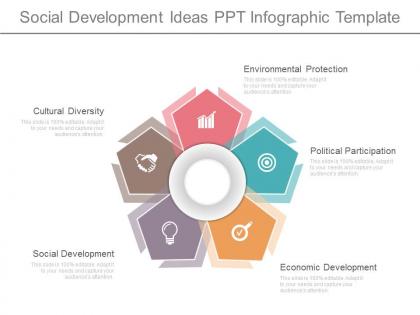
Social development ideas ppt infographic template




Try Before you Buy Download Free Sample Product
 Impress Your
 Audience
 100%
100% Editable
 Save Hours
 of Time


Jazz it up with our Social Development Ideas Ppt Infographic Template. They will jam well with your thoughts.
People who downloaded this PowerPoint presentation also viewed the following :
Social development ideas ppt infographic template with all 7 slides:
Our Social Development Ideas Ppt Infographic Template add greater glee to every event. They ensure fuller enjoyment.




FAQs for Social development ideas
Key indicators of social development in contemporary communities include educational attainment rates, healthcare accessibility, income equality measures, civic participation levels, and social mobility opportunities. These metrics work together by revealing community strengths and gaps, with many municipalities finding that tracking employment diversity, digital inclusion, and community cohesion ultimately delivers more targeted interventions and sustainable progress.
Education systems can be reformed through inclusive curriculum design, community-based learning programs, digital literacy integration, social-emotional learning frameworks, and stakeholder collaboration initiatives. These approaches enhance educational accessibility, foster critical thinking, and develop civic responsibility, with many institutions finding that strategic partnerships between schools, families, and local organizations ultimately deliver improved student outcomes and stronger community engagement.
Non-profit organizations drive social development through community outreach, policy advocacy, resource mobilization, capacity building, and direct service delivery to underserved populations. These organizations bridge gaps between government services and community needs, with healthcare foundations, educational nonprofits, and environmental groups delivering measurable impact while fostering sustainable change and social innovation.
Access to healthcare significantly influences social development by reducing mortality rates, improving educational participation, and enhancing workforce productivity across communities. Through preventive care and early intervention, societies experience decreased healthcare costs, increased economic mobility, and stronger family stability, with many developing regions finding that healthcare investments ultimately deliver improved social cohesion and sustainable community growth.
Technology enhances social development programs through digital platforms for service delivery, data analytics for targeted interventions, mobile applications for community engagement, AI-powered resource allocation, and blockchain for transparent fund management. These tools streamline program administration, enable real-time monitoring of outcomes, and facilitate direct beneficiary feedback, with many nonprofits and government agencies finding that technology-driven approaches deliver faster services, reduced operational costs, and measurably improved community impact.
Economic inequality significantly undermines social development efforts by limiting access to education, healthcare, and economic opportunities, creating persistent cycles of poverty, and reducing social mobility. While inequality presents challenges, targeted interventions like progressive taxation, skills training, and inclusive economic policies enable communities to bridge gaps, with many developing nations finding that reducing inequality accelerates overall development outcomes.
Community engagement can be fostered through participatory planning processes, regular town halls, digital feedback platforms, volunteer programs, and collaborative partnerships between local organizations and residents. These approaches streamline communication, enhance transparency, and build trust, with many municipalities finding that active citizen involvement ultimately delivers more effective resource allocation, stronger community ownership, and sustainable long-term outcomes.
Best practices for implementing social development policies at the local level include community engagement and consultation, stakeholder mapping and partnership building, phased implementation with pilot programs, continuous monitoring and evaluation systems, and resource mobilization strategies. These approaches streamline policy execution by ensuring local buy-in, addressing specific community needs, and building sustainable frameworks, with many municipalities finding that collaborative governance models ultimately deliver more effective outcomes and stronger community resilience.
Cultural factors significantly shape social development strategies by influencing communication preferences, leadership structures, community values, decision-making processes, and resource allocation priorities within diverse populations. Programs in rural Indigenous communities emphasize traditional governance and land-based practices, while urban immigrant neighborhoods focus on language accessibility and cultural bridge-building, with many organizations finding that culturally-responsive approaches deliver higher engagement and more sustainable outcomes.
Government policy serves as the primary catalyst for social development through education funding, healthcare systems, infrastructure investment, regulatory frameworks, and social safety nets. These policies can accelerate progress by ensuring equitable resource distribution and creating enabling environments, while poorly designed regulations or insufficient funding can create barriers, with many developing nations finding that strategic policy combinations ultimately determine their social advancement trajectory.
Social entrepreneurship contributes to sustainable social development by creating innovative solutions that address social problems while generating financial returns, ensuring long-term viability and scalability. These ventures tackle challenges like poverty, education, and healthcare through market-driven approaches, with organizations in sectors like microfinance, renewable energy, and healthcare delivery finding that sustainable business models ultimately create lasting community impact and economic growth.
Measuring social development program success faces challenges including defining clear metrics, tracking long-term behavioral changes, accounting for external variables, ensuring data quality across diverse populations, and balancing quantitative outcomes with qualitative impact. These measurement complexities require comprehensive evaluation frameworks combining surveys, community feedback, and longitudinal studies, with many organizations finding that mixed-method approaches ultimately deliver more accurate assessments and strategic insights.
Migration enhances social development by facilitating knowledge transfer, cultural exchange, and remittance flows that fund education and healthcare in origin countries. Destination countries benefit through increased labor force diversity, entrepreneurial innovation, and demographic balance, while origin nations gain from diaspora networks, skill circulation, and reduced unemployment pressures, ultimately creating interconnected development opportunities that strengthen both economies and social infrastructure across borders.
Strategies to promote gender equality include equal education access, workplace anti-discrimination policies, leadership development programs, economic empowerment initiatives, and legislative reforms. These approaches streamline social progress by enhancing women's participation in finance, healthcare, and technology sectors, while supporting policy changes that deliver inclusive economic growth and competitive advantages for organizations embracing diverse talent pools.
Inclusive practices can be integrated through community-led decision making, targeted resource allocation, accessible infrastructure development, and culturally responsive service delivery. These approaches streamline social development by ensuring equitable participation, addressing systemic barriers, and leveraging diverse perspectives, with many organizations finding that inclusive frameworks ultimately deliver better outcomes and sustainable community engagement.
-
Use of icon with content is very relateable, informative and appealing.
-
I discovered this website through a google search, the services matched my needs perfectly and the pricing was very reasonable. I was thrilled with the product and the customer service. I will definitely use their slides again for my presentations and recommend them to other colleagues.