

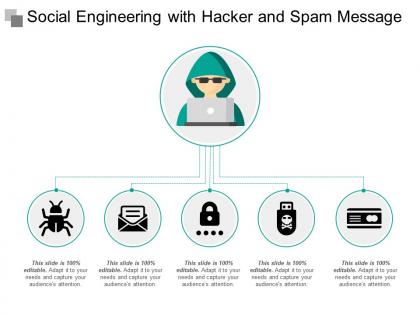
Social engineering with hacker and spam message




Try Before you Buy Download Free Sample Product
 Impress Your
Audience
 100%
Editable
 Save Hours
of Time


Call a halt to complacency with our Social Engineering With Hacker And Spam Message. Get all the efforts going again.
People who downloaded this PowerPoint presentation also viewed the following :
Social engineering with hacker and spam message with all 5 slides:
Our Social Engineering With Hacker And Spam Message will facilitate and ease your entry. Be confident of gaining acceptance.


FAQs for Social engineering with hacker
Common social engineering techniques include phishing emails, pretexting calls, baiting with malicious downloads, tailgating into secure areas, and quid pro quo schemes offering false services. These methods exploit human psychology by manipulating trust, urgency, and authority, with many organizations finding that employee training and multi-layered security protocols significantly reduce vulnerability while enhancing overall cybersecurity resilience.
Organizations identify social engineering threats through employee training programs, security awareness campaigns, phishing simulation exercises, behavioral monitoring systems, and regular vulnerability assessments. These comprehensive approaches enable companies to detect suspicious communications, verify unusual requests through multiple channels, and implement strict authentication protocols, ultimately reducing successful attacks while building a security-conscious culture across all organizational levels.
Psychological manipulation serves as the foundation of social engineering, exploiting cognitive biases like authority, urgency, reciprocity, and trust to bypass logical decision-making processes. These techniques enable attackers to manipulate emotions, create false scenarios, and pressure victims into divulging sensitive information, with many organizations finding that employee awareness training significantly reduces susceptibility to such tactics.
Effective phishing training combines simulated phishing exercises, interactive workshops, and regular awareness updates to help employees identify suspicious emails, verify sender authenticity, and recognize social engineering tactics. Organizations like banks and healthcare institutions implement ongoing programs with real-world scenarios, significantly reducing successful attacks while enhancing security awareness and ultimately strengthening their overall cybersecurity posture.
Notable social engineering attacks include the 2016 Democratic National Committee phishing campaign, Kevin Mitnick's telephone-based manipulations of telecom employees, and the 2020 Twitter bitcoin scam targeting high-profile accounts. These incidents demonstrate how attackers exploit human psychology, trust relationships, and authority dynamics across digital and physical channels, ultimately highlighting the critical need for comprehensive security awareness training and multi-layered verification processes in organizations.
Social engineers exploit trust and authority by impersonating legitimate figures like IT support, executives, or vendors, creating false urgency through fabricated deadlines or crises, and leveraging established relationships to bypass skepticism. These manipulation tactics enable unauthorized access to sensitive information, financial resources, and secure systems across organizations, with many businesses finding that employees naturally comply with perceived authority figures, ultimately making human psychology the weakest link in cybersecurity defenses.
Companies can implement employee training programs, multi-factor authentication, strict verification protocols for sensitive requests, regular security awareness campaigns, and access controls based on role requirements. These measures work by educating staff to recognize manipulation tactics, verifying identities through multiple channels, and creating security-conscious cultures, with many organizations finding that combining technical safeguards with human awareness training significantly reduces successful social engineering attacks.
Online social engineering leverages digital platforms through phishing emails, fake websites, social media manipulation, and impersonation attacks, while offline tactics rely on physical interactions like tailgating, phone calls, and face-to-face deception. While online attacks can reach thousands simultaneously with automated tools, offline approaches often involve more personalized psychological manipulation, with many organizations finding that comprehensive security training addressing both environments significantly reduces vulnerability to these increasingly sophisticated threats.
Social engineering significantly reshapes corporate cybersecurity policies by forcing organizations to address human vulnerabilities through comprehensive employee training, multi-factor authentication protocols, and behavioral monitoring systems. Companies increasingly implement zero-trust frameworks, regular phishing simulations, and incident response procedures, with many financial institutions and healthcare organizations finding that policy updates focusing on social awareness ultimately reduce successful breach attempts by over sixty percent.
Social engineers leverage social media through profile mining for personal details, relationship mapping to identify targets, posts analyzing behavioral patterns, and fake account creation for direct engagement. These platforms enable attackers to gather comprehensive intelligence about individuals and organizations, with many cybersecurity experts finding that oversharing on social networks significantly increases vulnerability to targeted phishing and manipulation attacks.
Cultural and social norms significantly influence social engineering techniques by dictating trust patterns, authority structures, communication styles, and behavioral expectations within different societies. Attackers exploit these cultural frameworks by mimicking respected authority figures, leveraging local customs around politeness or helpfulness, and adapting their manipulation tactics to align with regional business practices, ultimately making their deceptive approaches more credible and effective.
Businesses can create security awareness cultures through regular employee training programs, simulated phishing exercises, clear reporting protocols, multi-layered authentication systems, and ongoing communication about emerging threats. These approaches work by educating staff about manipulation tactics, establishing verification procedures for sensitive requests, and fostering vigilant organizational behavior, with many companies finding that comprehensive awareness programs significantly reduce successful social engineering attacks while enhancing overall cybersecurity resilience.
Social engineering attacks commonly utilize phishing emails, fake websites, voice calls (vishing), SMS messages (smishing), and social media platforms to manipulate targets. These technologies enable attackers by creating convincing impersonations, harvesting credentials through fraudulent portals, and exploiting trust relationships, with many organizations finding that employee awareness training and multi-layered security protocols significantly reduce vulnerability to these increasingly sophisticated tactics.
Social engineering techniques evolve by leveraging deepfakes, AI-generated content, sophisticated phishing campaigns, voice cloning, and automated targeting systems. These advancements enable cybercriminals to create more convincing impersonations and personalized attacks, while organizations increasingly implement multi-layered security awareness training, behavioral analytics, and zero-trust frameworks to counter these evolving threats.
Social engineering raises significant legal concerns including fraud, identity theft, data protection violations, and privacy breaches, while ethical implications involve consent, deception, and manipulation of human trust. Organizations increasingly face regulatory compliance challenges under frameworks like GDPR and CCPA, with many companies finding that implementing robust security awareness training and ethical guidelines helps minimize legal exposure while maintaining stakeholder trust.
-
Great quality slides in rapid time.
-
Great product with highly impressive and engaging designs.