

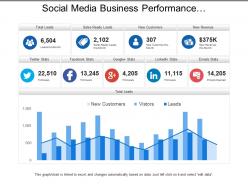
Social media business performance dashboards with total leads





Try Before you Buy Download Free Sample Product
 Impress Your
Audience
 100%
Editable
 Save Hours
of Time


Enlighten folks on investment with our Social Media Business Performance Dashboards With Total Leads. Enable them to generate high interest.
People who downloaded this PowerPoint presentation also viewed the following :
Social media business performance dashboards with total leads with all 6 slides:
Our Social Media Business Performance Dashboards With Total Leads are jampacked with information. It caters for every interest.


FAQs for Social media business performance dashboards
Key social media dashboard metrics include engagement rates, reach and impressions, follower growth, click-through rates, conversion tracking, and sentiment analysis. These metrics enable organizations to streamline campaign optimization, enhance audience targeting, and measure ROI effectively, with many marketing teams finding that comprehensive dashboards ultimately deliver faster decision-making and improved competitive positioning.
A social media dashboard enhances content strategy by providing unified analytics, scheduling capabilities, audience insights, performance tracking, and competitive analysis tools. Through centralized platforms, marketing teams streamline campaign planning, optimize posting schedules, and measure engagement metrics across multiple channels, ultimately delivering more targeted content and improved ROI.
**INPUT**: What tools are best for creating an efficient social media dashboard? **OUTPUT**: Top social media dashboard tools include Hootsuite, Sprout Social, Buffer, Google Analytics, and HubSpot, each offering comprehensive scheduling, monitoring, and analytics capabilities. These platforms streamline content management by automating posts, tracking engagement metrics, and consolidating multiple channels into unified interfaces, with many marketing teams finding that integrated dashboards ultimately deliver faster response times and enhanced campaign performance. **Word count: 59 words**
Real-time data from social media dashboards informs marketing tactics by identifying trending topics, monitoring audience engagement patterns, tracking competitor activities, and measuring campaign performance as it happens. This immediate visibility enables marketers to pivot strategies quickly, capitalize on viral moments, and optimize content timing, ultimately delivering more responsive campaigns and improved ROI across platforms.
Audience engagement tracking serves as the central performance indicator within social media dashboards, measuring likes, comments, shares, response rates, and follower growth across platforms. This data enables marketers to identify high-performing content, optimize posting schedules, and refine targeting strategies, ultimately delivering improved ROI and stronger customer relationships through data-driven social media management.
Social media dashboards should be updated in real-time or daily for optimal insights, depending on your campaign intensity, audience engagement patterns, and business objectives. High-volume brands and agencies typically benefit from real-time updates during active campaigns or product launches, while smaller businesses find daily updates sufficient for tracking performance trends, engagement metrics, and content effectiveness, ultimately enabling faster response times and more strategic decision-making.
Common mistakes include overcrowding dashboards with excessive metrics, neglecting mobile responsiveness, using irrelevant KPIs, poor visual hierarchy, and lacking real-time data integration. These design flaws significantly impact user adoption and decision-making effectiveness, with many marketing teams finding that streamlined, intuitive interfaces focusing on actionable insights deliver better strategic outcomes and enhanced operational efficiency.
A social media dashboard helps identify trending topics by aggregating real-time data across platforms, analyzing hashtag performance, monitoring engagement spikes, and tracking viral content patterns. Through advanced analytics and keyword tracking, marketing teams can spot emerging conversations, capitalize on trending hashtags, and create timely content that resonates, ultimately delivering enhanced audience engagement and competitive advantage.
Effective social media visualizations include line charts for engagement trends, heat maps for posting schedules, pie charts for audience demographics, bar graphs for platform comparisons, and sentiment analysis gauges. These visualizations streamline data interpretation by highlighting peak performance periods, identifying optimal content timing, and tracking competitor analysis, with many marketing teams finding that visual dashboards significantly enhance campaign optimization and strategic decision-making.
Businesses use social media dashboards to benchmark competitors by tracking engagement rates, follower growth, content performance metrics, posting frequency, and audience demographics across platforms. Through comparative analytics, companies identify content gaps, optimal posting strategies, and emerging trends, while monitoring competitor campaigns and hashtag performance, ultimately enabling strategic adjustments that enhance competitive positioning.
When choosing a social media dashboard template, consider data visualization capabilities, platform integration options, customization flexibility, real-time analytics features, and user interface design. These factors streamline social media management by enabling comprehensive performance tracking, automated reporting, and strategic decision-making, with many marketing teams finding that well-designed templates significantly enhance campaign efficiency and audience engagement insights.
Sentiment analysis integrates into social media dashboards through real-time monitoring tools, automated classification algorithms, visual sentiment indicators, and trend tracking capabilities that analyze customer emotions across platforms. These features enable brands to quickly identify negative feedback, measure campaign effectiveness, and respond proactively to customer concerns, ultimately delivering enhanced reputation management and improved customer relationships.
Integrating analytics from multiple social media platforms delivers comprehensive audience insights, unified performance tracking, cross-platform content optimization, streamlined reporting, and enhanced ROI measurement. This strategic approach enables businesses to identify high-performing content patterns, allocate resources more effectively across channels, and create cohesive campaigns, with many organizations finding significantly improved engagement rates and marketing efficiency.
User feedback improves social media dashboard design by identifying interface pain points, revealing workflow inefficiencies, and highlighting missing features that users actually need. Through surveys, usage analytics, and direct user testing, companies can streamline navigation, enhance data visualization clarity, and add relevant functionalities, ultimately delivering more intuitive dashboards that boost productivity and user satisfaction.
Future social media analytics trends include AI-powered sentiment analysis, predictive engagement modeling, cross-platform attribution tracking, real-time crisis detection, and voice/video content analytics. These advanced capabilities streamline decision-making by delivering deeper audience insights, automated trend identification, and proactive brand management, with many organizations finding that integrated predictive dashboards ultimately enhance competitive positioning and customer engagement strategies.
No Reviews