

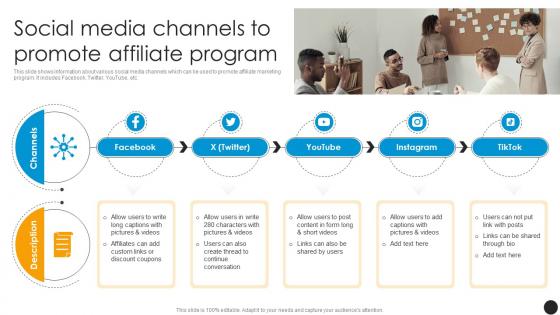
Social Media Channels To Promote Affiliate Program Affiliate Program To Expand Product Reach




Try Before you Buy Download Free Sample Product
 Impress Your
Audience
 100%
Editable
 Save Hours
of Time


This slide shows information about various social media channels which can be used to promote affiliate marketing program. It includes Facebook, Twitter, YouTube, etc.
People who downloaded this PowerPoint presentation also viewed the following :
Social Media Channels To Promote Affiliate Program Affiliate Program To Expand Product Reach with all 9 slides:
Use our Social Media Channels To Promote Affiliate Program Affiliate Program To Expand Product Reach to effectively help you save your valuable time. They are readymade to fit into any presentation structure.









FAQs for Social Media Channels To Promote Affiliate Program Affiliate Program To
Okay so first off, pick a niche you actually care about and find products that genuinely solve problems. Most people mess this up by just chasing money. Build real relationships with your audience - that's honestly where the magic happens. Content is huge too, like reviews and tutorials that actually help people. I'd diversify your promotion across email, social, maybe SEO if you're patient (takes forever though). Really dig into what frustrates your audience, then only recommend stuff you'd buy yourself. Trust me, people can smell fake recommendations from a mile away.
Honestly, just pick stuff you actually care about - you'll sound way more genuine that way. Commission rates matter (like 5-50% depending on what you're selling), but don't get caught up in huge percentages if the products suck. Amazon Associates is solid for starting out since everyone shops there anyway. Check their payment schedule and how long cookies last too. Oh, and never pay upfront fees - that's always sketchy. I'd stick with maybe 2-3 programs max at first. You can always add more later, but it's better to really understand what's working first instead of spreading yourself too thin.
Focus on CTR, conversion rates, and EPC - those are your money makers. CTR tells you if people actually want to click your stuff. Conversion rate shows whether you're sending decent traffic that buys things. EPC is honestly where it's at though, since it shows your real earning power per click no matter what weird commission setup they have. Oh, and definitely check average order value if the merchant gives you that data. I always forget to mention this part - break everything down by traffic source so you can see what's actually working. Check these numbers weekly and you'll start seeing patterns pretty quick.
Honestly, SEO is like your secret weapon for affiliate marketing. Instead of constantly throwing money at ads, you're getting free traffic from people already hunting for what you're selling. Picture this - someone searches "best running shoes 2024" and they're basically ready to whip out their credit card, you know? Your affiliate posts need to show up for those buyer keywords. Those visitors convert so much better than random people scrolling Instagram. I'd focus on longer, specific keywords and actually write helpful stuff about the products. Don't just throw together garbage reviews - Google's gotten way smarter about that lately.
Oh man, the biggest thing? Don't try promoting literally everything - pick ONE thing you actually know about. I see people jump into paid ads right away without even understanding who they're talking to. Recipe for disaster honestly. Better to start with content that actually helps people solve problems. Like, stuff you'd genuinely find useful yourself. Build some trust first instead of just throwing affiliate links around everywhere. Nobody wants to buy from someone who clearly just wants their money, you know? Test small before you go big. Way less painful when things don't work out.
Honestly, just pick Instagram or TikTok and stick with one - don't try to be everywhere at once. Post about stuff you actually use and like. People on those platforms love product recs anyway. Facebook groups can work too, but only if you're genuinely helping people, not just dropping links. Build trust first before pushing anything. I always tell people when something's an affiliate link (you have to legally anyway). Focus on products your followers would actually want. Oh, and post regularly - that's probably the hardest part but it makes a huge difference. Stories work great for this too since they feel more casual.
Dude, just be upfront about everything - like actually tell people when you're getting paid for recommendations. I learned this the hard way lol. Don't push stuff you wouldn't buy yourself because people can smell BS from miles away. Honestly? I think too many affiliates just focus on the good parts and ignore obvious flaws. That's sketchy. Skip the fake countdown timers and "only 3 left!" nonsense too. Your followers aren't stupid. Just think about it - would you want someone lying to you for commission? Probably not. Trust beats quick cash every single time.
Honestly, just help people solve actual problems instead of being all salesy. I do tutorials, honest reviews of stuff I've actually used, comparisons - things that genuinely help. People can smell a fake pitch from miles away, you know? Be upfront about your affiliate links and only recommend products you'd tell your sister to buy. Stories work way better than just listing features. Like, show how you used the product in real life. Most of my content is educational with maybe one subtle product mention thrown in. Oh, and definitely test different formats - what works for me might totally flop for you.
Dude, email marketing is seriously where it's at for affiliate stuff. You actually own that connection with people - unlike social media where one algorithm update can tank your reach overnight. I learned this the hard way lol. What's cool is you can split your list up based on what people actually buy or care about, so your conversion rates go way up. None of that spray-and-pray approach. You get to build real relationships over months instead of just hoping someone clicks once. The data's crystal clear too. Honestly, even a tiny engaged email list crushes having thousands of followers who barely see your posts.
So here's the thing - each industry picks affiliate partners based on how their customers actually shop. Fashion and beauty brands go all-in on influencers because people buy with their eyes, you know? Tech companies are more about those detailed review sites where people compare specs for hours. Finance is a nightmare though - their compliance rules are insane, so they only work with trusted partners who won't mess up their legal stuff. Meanwhile, e-commerce throws everything at the wall: cashback sites, coupon apps, deal hunters. You've just gotta match whatever your customers are already doing when they're researching purchases.
Okay so first thing - get a tracking platform like ClickFunnels or Voluum. Can't stress this enough because without it you're basically flying blind. Google Analytics is clutch for seeing traffic patterns. UTM parameters are boring but honestly game-changing once you start using them. For links, Pretty Links or Bitly keep everything clean. ConvertKit's solid for email stuff, and Buffer handles social posting. Oh and I'd actually start with tracking first since there's no point optimizing campaigns if you can't see what's working.
Honestly, data is everything here. Show them your conversion rates, traffic quality, revenue you've brought in for similar brands. That's what gets their attention. Wait until you've already made some sales though - don't go in empty-handed asking for better terms. What makes you different from every other affiliate hitting them up? Maybe it's your email list, social following, or you're in some niche they're trying to break into. I'd pitch performance tiers instead of just asking for higher rates straight up. Way more compelling when you can prove you're not just another random partner.
Dude, UX is everything in affiliate marketing. Seriously - if your site sucks, people bounce before they even see your links. I learned this the hard way when my conversion rates were trash for months. Fast loading times matter way more than you'd think. Clear navigation too. People need to actually find what they're looking for without getting frustrated. Your content should genuinely help solve their problems first - then the affiliate stuff feels natural instead of pushy. Honestly, good UX builds trust. Trust gets clicks. Clicks make money. It's that simple.
Dude, just be super obvious about your affiliate stuff - don't try to hide it. Use clear language like "I get paid if you buy this" or just say "affiliate link" right where people can see it. The FTC doesn't mess around with this anymore, they've cracked down hard. Put disclosures before people click or purchase anything. Oh and different platforms have their own quirks - like Instagram stories need the disclosure at the top, blog posts should mention it early on. Honestly? Better to over-explain than get in trouble later.
Dude, AI content tools are absolutely everywhere right now - you've gotta start playing with them. Voice search is blowing up too, especially for product stuff. Short-form video is where it's at though. TikTok and Reels engagement is honestly ridiculous compared to regular posts. Micro-influencers are crushing the big celebrity partnerships since people actually trust them. Privacy stuff is getting stricter (which is probably good tbh), so you'll want to focus on collecting your own data directly. Start messing around with video creation tools and learn the privacy-compliant tracking methods before you're forced to.
-
Design layout is very impressive.
-
SlideTeam never fails to surprise me with its amazing PPT designs. Thanks team for providing me with your constant support!