


Social Media Communication Framework Powerpoint Presentation Slides Strategy CD V




Try Before you Buy Download Free Sample Product
 Impress Your
 Audience
 100%
100% Editable
 Save Hours
 of Time


A Strategy for Corporate Communication can help understand your company and enhance its reputation with people whose attitudes and actions influence your success the most. Grab our Social media communication framework template. It is a well-crafted deck for organizations to communicate effectively with their stakeholders. Our Stakeholder communication PPT covers techniques for public relations, stakeholder communication, internal communication, etc. It stresses public relations, which plays a crucial role in building and maintaining a positive image for the organization in the eyes of the public. Stakeholder communication ensures the organizations effective communication with its investors, customers, suppliers, and other stakeholders. Internal communication facilitates smooth organizational communication among employees, departments, and management. Crisis communication is vital to any corporate communication strategy to manage and mitigate any negative impact on the organization during a crisis. A well-designed social media communication framework can enhance the organizations reach and engagement with its target audience. Event communication can create awareness about the organizations products, services, and initiatives. Lastly, our event communication module exhibits essential elements to enhance the organizations reputation, build stakeholder trust, and drive business success. Get access of our strategy template right away.
People who downloaded this PowerPoint presentation also viewed the following :
Content of this Powerpoint Presentation
Slide 1: This slide introduces Social media communication framework. Commence by stating Your Company Name.
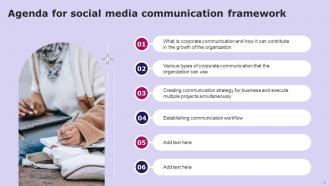
Slide 2: This slide depicts the Agenda of the presentation.
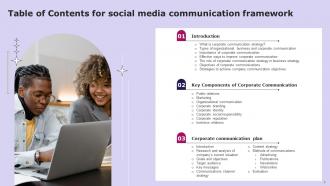
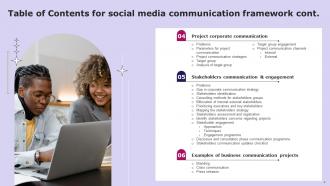
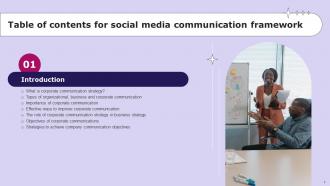
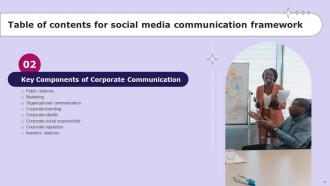
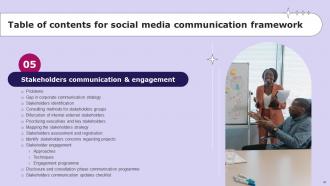
Slide 3: This slide incorporates the Table of contents.
Slide 4: This slide highlights the Title for the Topics to be covered further.
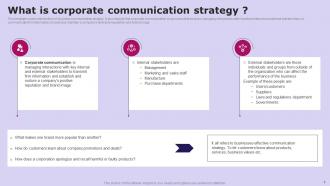
Slide 5: This template covers introduction of business communication strategy.
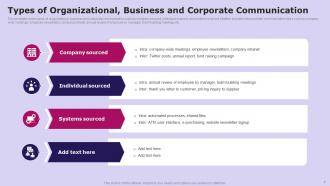
Slide 6: This slide states the types of organizational, business and corporate communication.
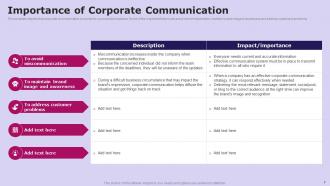
Slide 7: This slide depicts that corporate communication is crucial for a successful business.
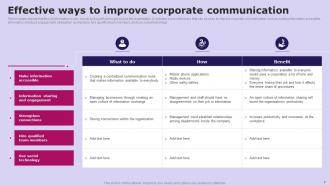
Slide 8: This template depicts the Effective ways to improve corporate communication.
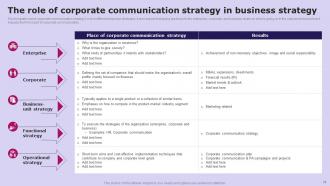
Slide 9: This slide exhibits the role of corporate communication strategy in business strategy.
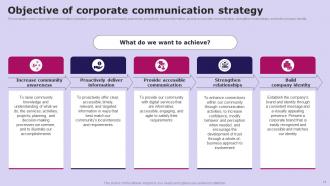
Slide 10: This slide displays the Objective of corporate communication strategy.
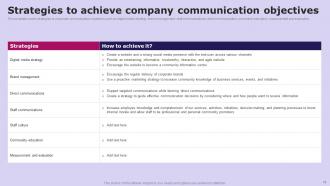
Slide 11: This slide showcases the Strategies to achieve company communication objectives.
Slide 12: This slide mentions the Heading for the Contents to be discussed next.
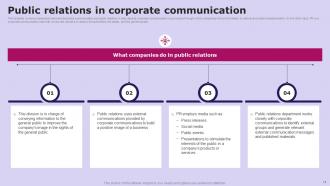
Slide 13: This template covers a comparison between business communication and public relations.
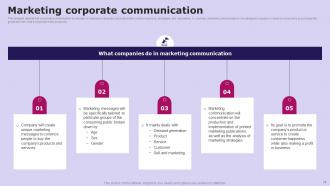
Slide 14: This slide illustrates the Marketing corporate communication.
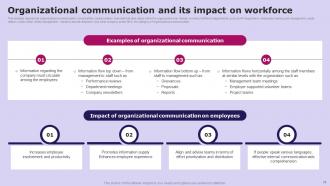
Slide 15: This slide portrays the Organizational communication and its impact on workforce.
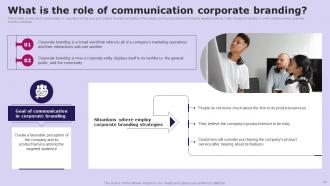
Slide 16: This template incorporates the role of communication in corporate branding.
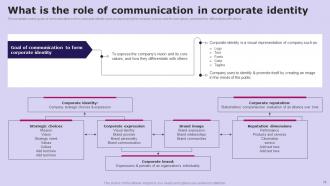
Slide 17: This slide states the goals of communication to form corporate identity.
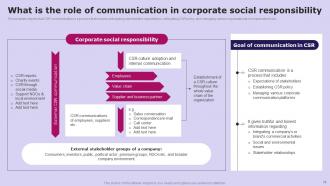
Slide 18: This slide depicts the role of communication in corporate social responsibility.
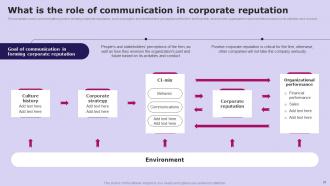
Slide 19: This template highlights the communication goals in building corporate reputation.
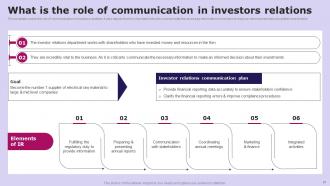
Slide 20: This template exhibits the role of communication in investors relations.
Slide 21: This slide showcases the Title for the Ideas to be discussed next.
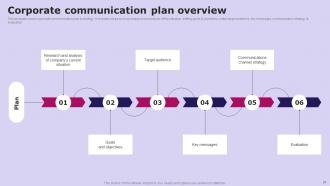
Slide 22: This slide presents the Corporate communication plan overview.
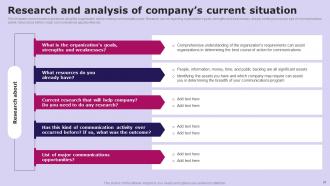
Slide 23: This slide shows the Research and analysis of company’s current situation.
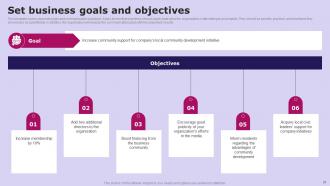
Slide 24: This template covers corporate goals and communication objectives.
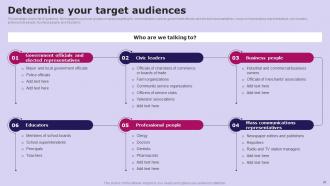
Slide 25: This slide talks about Determining your target audiences.
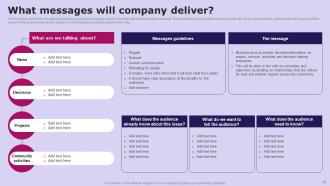
Slide 26: This template showcases the messages guidelines and questions company need to consider before delivering the message.
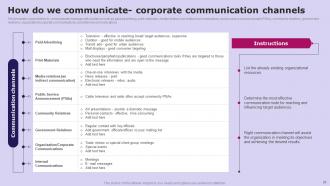
Slide 27: This template incorporates the tactics to communicate message with audience such as paid advertising, print materials, etc.
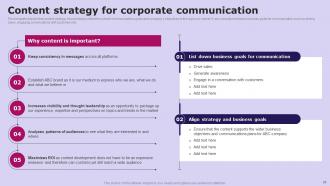
Slide 28: This slide displays the Content strategy for corporate communication.
Slide 29: This slide reveals the Heading for the Ideas to be covered next.
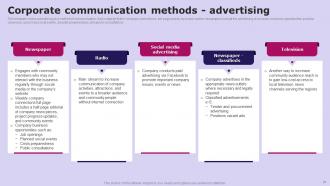
Slide 30: This template contains advertising as a method of communication.
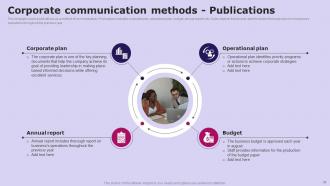
Slide 31: This slide elucidates publications as a method of communication.
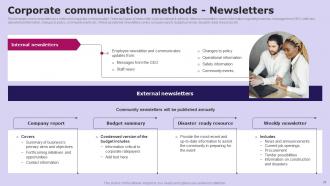
Slide 32: This template presents newsletter as a method of corporate communication.
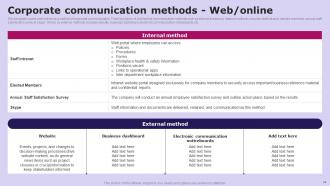
Slide 33: This template exhibits web/online as a method of corporate communication. T
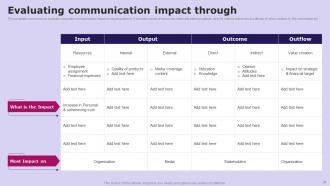
Slide 34: This slide deals with Evaluating communication impact.
Slide 35: This slide mentions the Title for the Components to be discussed next.
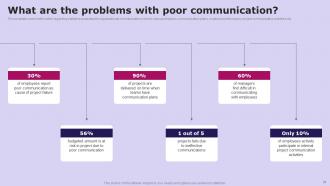
Slide 36: This template covers information regarding statistics associated to organizational communication in terms of project failures, communication plans, employee performance, etc.
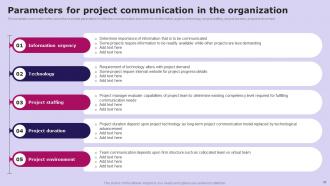
Slide 37: This slide lists the Parameters for project communication in the organization.
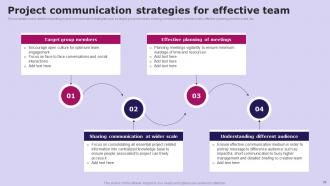
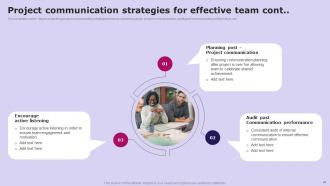
Slide 38: This slide focuses on Project communication strategies for effective team.
Slide 39: This slide continues the Project communication strategies for effective team.
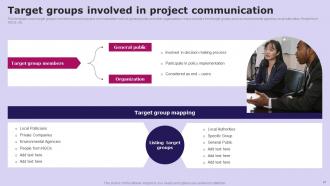
Slide 40: This template focuses on target groups members involved in project communication.
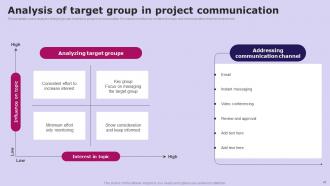
Slide 41: This slide exhibits the Analysis of target group in project communication.
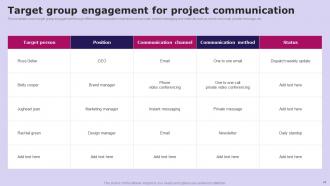
Slide 42: This slide incorporates the Target group engagement for project communication.
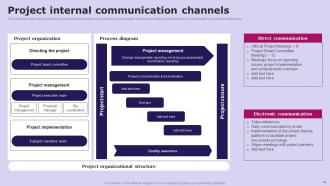
Slide 43: This slide deals with Project internal communication channels.
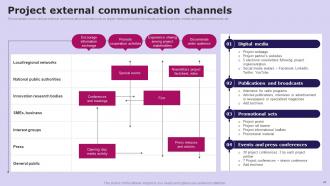
Slide 44: This slide talks about the Project external communication channels.
Slide 45: This slide presents the Heading for the Topics to be covered in the following template.
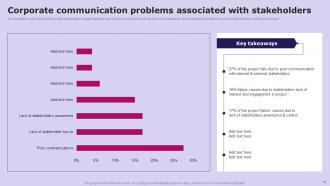
Slide 46: This template showcases the problems with stakeholders engagement plan due to which project fails.
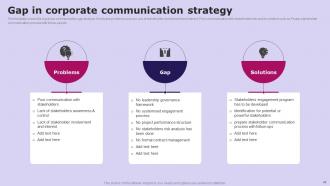
Slide 47: This slide template elucidates the Gap in corporate communication strategy.
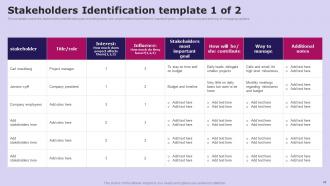
Slide 48: This template covers the stakeholders identification plan including name, role, project interest and interest, etc.
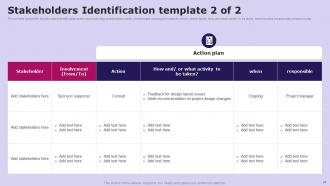
Slide 49: This temple covers the stakeholders identification action plan including stakeholders name, involvement covering from who to whom, action taken, etc.
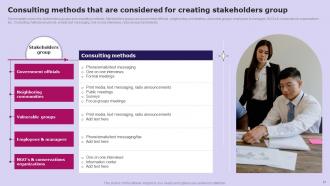
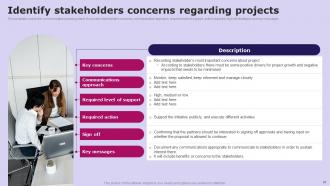
Slide 50: This slide focuses on the Consulting methods that are considered for creating stakeholders group.
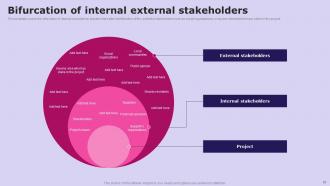
Slide 51: This slide reveals the Bifurcation of internal external stakeholders.
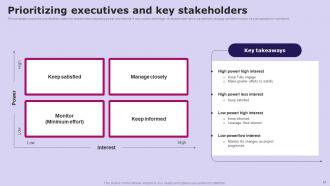
Slide 52: This template incorporates the prioritization matrix for stakeholders depicting power and interest.
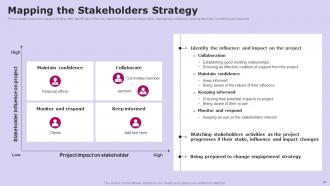
Slide 53: This slide talks about Mapping the Stakeholders Strategy.
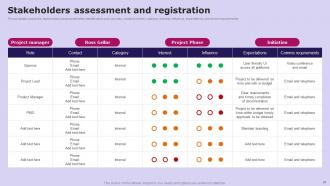
Slide 54: This slide exhibits Stakeholders assessment and registration.
Slide 55: This template covers the communication planning sheet.
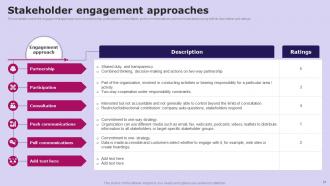
Slide 56: This template showcases the engagement approach such as partnership, participation, etc.
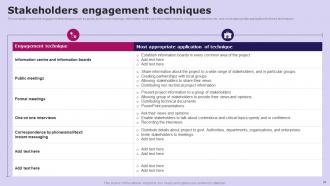
Slide 57: This slide deals with Stakeholders engagement techniques.
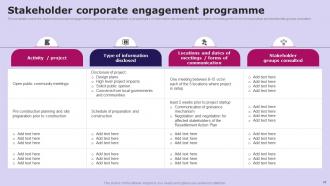
Slide 58: This slide represents the Stakeholder corporate engagement programme.
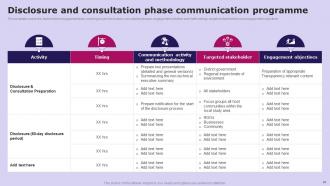
Slide 59: This slide provides information about the Disclosure and consultation phase communication programme.
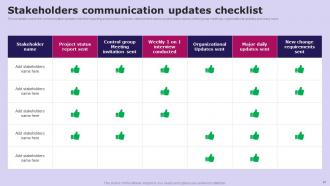
Slide 60: This slide elucidates the Stakeholders communication updates checklist.
Slide 61: This slide presents the Title for the Topics to be discussed further.
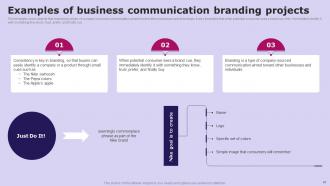
Slide 62: This slide portrays the Examples of business communication branding projects.
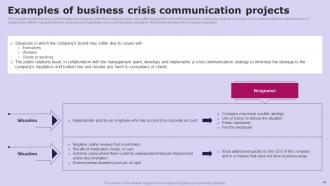
Slide 63: This slide depicts the Examples of business crisis communication projects.
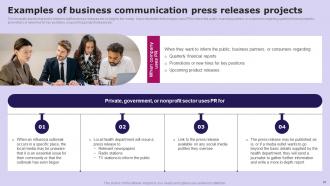
Slide 64: This slide reveals the Examples of business communication press releases projects.
Slide 65: This is the Icons slide containing all the Icons used in the plan.
Slide 66: This slide elucidates Additional information.
Slide 67: This slide is used for showcasing the organization's Vision & Mission.
Slide 68: This is the 30 60 90 Days Plan sldie for efficient planning.
Slide 69: This slide contains the Post it Notes for reminders and deadlines.
Slide 70: This is the Venn diagram slide.
Slide 71: This slide reveals the Company Timeline.
Slide 72: This slide is used for the purpose of Comparison.
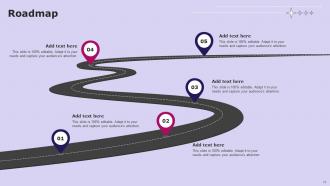
Slide 73: This slide represents the Roadmap of the firm.
Slide 74: This is the Thank you slide for acknowledgement.
Social Media Communication Framework Powerpoint Presentation Slides Strategy CD V with all 79 slides:
Use our Social Media Communication Framework Powerpoint Presentation Slides Strategy CD V to effectively help you save your valuable time. They are readymade to fit into any presentation structure.






FAQs for Social Media Communication Framework Powerpoint Presentation Slides
A comprehensive social media communication framework should include content strategy guidelines, audience segmentation protocols, brand voice standards, engagement response procedures, and performance measurement metrics. These components work together by ensuring consistent messaging, targeted outreach, and data-driven optimization, with many organizations finding that this strategic combination ultimately delivers enhanced customer relationships and measurable competitive advantage.
Organizations tailor social media messaging through audience segmentation, platform-specific content strategies, personalized messaging approaches, and data-driven targeting techniques. By analyzing demographic insights, behavioral patterns, and engagement preferences, companies create customized campaigns that resonate with distinct groups, ultimately delivering higher engagement rates, improved brand loyalty, and more effective customer acquisition across diverse market segments.
Brand voice serves as the foundation of social media communication frameworks, establishing consistent personality, tone, messaging style, and emotional connection across all platforms and interactions. This strategic consistency enables organizations to build authentic relationships, differentiate from competitors, and create memorable customer experiences, with many brands finding that a well-defined voice significantly enhances engagement rates and ultimately delivers stronger brand loyalty and recognition.
Businesses can measure social media communication effectiveness through engagement metrics, reach analytics, conversion tracking, sentiment analysis, and ROI measurement tools. Through platforms like Google Analytics and native social insights, companies streamline performance assessment, optimize content strategies, and enhance audience targeting, ultimately delivering improved customer engagement and measurable business growth across all digital channels.
Crisis communication best practices for social media include establishing monitoring systems, creating pre-approved response templates, designating authorized spokespeople, developing escalation protocols, and maintaining updated stakeholder contact lists. These frameworks enable organizations to respond swiftly during emergencies, control narrative spread across platforms, and preserve brand reputation, with many companies finding that proactive crisis preparation ultimately delivers faster resolution times and stronger customer trust.
Platform choice fundamentally shapes communication frameworks by dictating content format, audience demographics, engagement patterns, and messaging tone requirements. Different platforms demand distinct approaches, with LinkedIn favoring professional insights, Instagram emphasizing visual storytelling, and Twitter requiring concise messaging, ultimately enabling businesses to tailor their strategic communication for maximum audience resonance and engagement outcomes.
Key metrics include engagement rates, reach and impressions, click-through rates, conversion rates, and return on investment (ROI). These measurements enable organizations to optimize content strategies, allocate resources effectively, and demonstrate tangible business value, with many brands finding that tracking both vanity metrics and conversion-focused data ultimately delivers comprehensive campaign insights and competitive advantage.
Storytelling integrates into social media frameworks through consistent narrative arcs, authentic brand voice development, audience-centric content creation, and strategic emotional engagement across platforms. These storytelling elements enhance customer connection by humanizing brands, building community loyalty, and driving meaningful interactions, with companies like Nike and Airbnb finding that narrative-driven content significantly increases engagement rates and brand recall.
Strategies include establishing brand voice guidelines, creating content calendars, using cross-platform templates, maintaining visual identity standards, and implementing approval workflows. These approaches streamline messaging by ensuring unified tone, coordinating posting schedules, and standardizing design elements, with many organizations finding that consistent frameworks ultimately enhance brand recognition and customer trust across diverse social channels.
User-generated content and community engagement serve as cornerstone elements within social media frameworks, driving authentic brand advocacy, fostering two-way conversations, and creating scalable content ecosystems. These components enable brands to build trust through peer recommendations, reduce content creation costs, and cultivate loyal communities, with many organizations finding that user-driven strategies deliver higher engagement rates and stronger customer relationships.
Ethical social media content requires transparency, accuracy, respect for privacy, cultural sensitivity, and authentic representation of brand values. These considerations involve disclosing partnerships and sponsorships, fact-checking information before sharing, protecting user data, avoiding discriminatory messaging, and maintaining consistent authenticity, with many organizations finding that ethical practices ultimately enhance trust, credibility, and long-term audience engagement.
Organizations should adapt their communication framework by integrating real-time engagement capabilities, multi-platform content strategies, influencer partnerships, and data-driven personalization tools to stay relevant across evolving channels. This strategic approach enables businesses to maintain authentic connections with audiences while leveraging emerging trends like short-form video and social commerce, ultimately delivering enhanced brand visibility and competitive advantage in an increasingly dynamic digital landscape.
Social media communication management tools include scheduling platforms like Hootsuite and Buffer, analytics software such as Sprout Social, content creation tools, customer relationship management systems, and automated response technologies. These platforms streamline workflow management, audience engagement, and performance tracking across multiple channels, with many organizations finding that integrated solutions ultimately deliver improved response times, enhanced brand consistency, and measurable competitive advantage.
Social media feedback shapes communication frameworks by revealing audience preferences, identifying content gaps, and highlighting engagement patterns that drive strategic adjustments. Through sentiment analysis, comment evaluation, and engagement metrics, organizations can refine messaging tone, optimize content timing, and enhance audience targeting, with many brands finding that responsive framework evolution significantly improves customer satisfaction and competitive positioning.
Analytics inform social media communication strategies by revealing audience behavior patterns, optimal posting times, content performance metrics, engagement trends, and demographic insights. These data-driven insights enable organizations to refine messaging approaches, allocate resources strategically, and enhance targeting precision, with many businesses finding that analytics-informed strategies deliver significantly higher engagement rates and stronger customer relationships.
-
Excellent design and quick turnaround.
-
Based on my personal experience, I would recommend other people to subscribe to SlideTeam. No one can be disappointed here!