

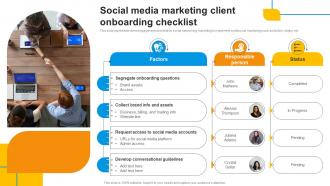
Social Media Marketing Client Onboarding Checklist





Try Before you Buy Download Free Sample Product
 Impress Your
Audience
 100%
Editable
 Save Hours
of Time


This slide represents client engagement checklist for social networking marketing to implement continuous monitoring such as factors, status, etc.
People who downloaded this PowerPoint presentation also viewed the following :
Social Media Marketing Client Onboarding Checklist with all 9 slides:
Use our Social Media Marketing Client Onboarding Checklist to effectively help you save your valuable time. They are readymade to fit into any presentation structure.








FAQs for Social Media Marketing
Gather essential brand information including company mission, values, unique selling propositions, brand voice, visual identity guidelines, and competitive positioning. Additionally, collect detailed target audience demographics, psychographics, preferred social platforms, content preferences, and engagement behaviors, while understanding their current social media challenges and specific business goals to create highly targeted, effective campaigns.
Assess your client's current social media presence by analyzing their platform performance metrics, audience demographics, content engagement rates, posting frequency, and brand consistency across channels. This comprehensive audit enables you to identify gaps, benchmark performance against competitors, and establish baseline metrics, ultimately delivering strategic insights that help prioritize improvements and demonstrate measurable growth throughout your partnership.
**INPUT**: What are the essential goals and objectives the client wants to achieve through social media marketing? **OUTPUT**: Essential social media marketing goals include brand awareness building, lead generation, customer engagement enhancement, website traffic increases, and sales conversion optimization. These objectives work together by targeting specific audiences, creating compelling content, and measuring performance metrics, with many businesses finding that strategic social media campaigns ultimately deliver measurable ROI and sustained competitive advantage. [Word count: 54 words]
Clients typically select social media platforms based on target audience demographics, business objectives, content format preferences, industry relevance, and budget allocation across channels. Through strategic platform selection, businesses enhance audience engagement, maximize ROI on advertising spend, and streamline content creation efforts, with many organizations finding that focusing on 2-3 primary platforms delivers better results than spreading resources too thin across multiple channels.
Determine client USPs through comprehensive discovery sessions, competitor analysis, customer feedback reviews, and value proposition workshops that identify their distinctive advantages, core strengths, and market differentiators. These strategic assessments enable social media campaigns that highlight unique benefits, resonate with target audiences, and create compelling brand narratives, ultimately delivering stronger market positioning and competitive advantage.
Clients typically envision content types including educational posts, behind-the-scenes stories, user-generated content, product showcases, and interactive polls or Q&As to engage their social media audiences. These diverse content formats work together to build authentic connections, drive engagement rates, and establish brand authority, with many businesses finding that mixing educational value with entertainment ultimately delivers stronger audience loyalty and conversion opportunities.
Establish a content calendar by analyzing the client's target audience, brand voice, marketing objectives, seasonal campaigns, and key messaging priorities during your discovery phase. Through strategic planning sessions, map content themes to their sales funnel stages, product launches, and industry events, while incorporating platform-specific posting frequencies and engagement patterns, ultimately delivering consistent brand presence and measurable campaign performance across all channels.
Client communication preferences typically include email for detailed reports, phone calls for urgent matters, video conferences for strategy discussions, messaging platforms for quick updates, and project management tools for ongoing collaboration. These channels enable streamlined information flow, timely feedback loops, and transparent progress tracking, with many agencies finding that establishing clear communication protocols upfront significantly enhances client satisfaction and project efficiency.
Key budgetary considerations include platform advertising costs, content creation expenses, social media management tools, influencer partnerships, and staff allocation for strategy execution. These investments vary significantly across industries like retail, healthcare, and B2B services, with many organizations finding that strategic budget allocation between organic content and paid promotions ultimately delivers higher engagement rates and measurable ROI.
Success in social media campaigns is measured through engagement metrics, reach and impressions, conversion rates, brand awareness indicators, and ROI calculations. These KPIs enable agencies to track follower growth, click-through rates, and lead generation across platforms, with many businesses finding that combining quantitative data with qualitative insights ultimately delivers comprehensive campaign optimization and sustained competitive advantage.
**INPUT**: What tools or software does the client currently use for social media management and analytics? **OUTPUT**: Current client tools typically include platforms like Hootsuite, Buffer, Sprout Social for scheduling, alongside Google Analytics, Facebook Insights, and native platform analytics for performance tracking. Understanding their existing technology stack enables agencies to streamline integration processes, minimize learning curves, and enhance reporting capabilities, ultimately delivering more efficient campaigns and stronger client relationships.
Customer inquiries through social media should be handled through dedicated monitoring tools, designated response teams, consistent brand voice guidelines, and established escalation procedures for complex issues. This strategic approach enables faster response times, maintains professional consistency across platforms, and transforms public interactions into positive brand experiences, with many organizations finding that proactive social media customer service significantly enhances customer satisfaction and builds stronger community engagement.
Client stance on user-generated content typically encompasses brand control preferences, content moderation policies, community management expectations, and legal compliance requirements for contests or campaigns. Understanding these parameters helps agencies develop strategic UGC initiatives that align with brand values while fostering authentic community engagement, ultimately delivering increased brand trust and customer loyalty.
Incorporating brand guidelines involves establishing visual consistency through approved colors, fonts, and imagery, while developing content pillars that reflect your brand's personality, values, and communication style. Create detailed tone-of-voice documentation with specific examples, messaging frameworks, and content templates that ensure every post aligns with your brand identity, ultimately delivering cohesive customer experiences and stronger brand recognition.
Establishing a crisis management plan involves creating response protocols, designating team roles, monitoring systems, escalation procedures, and pre-approved messaging templates for various scenarios. These frameworks enable organizations to respond swiftly and professionally during reputation threats, with many brands finding that proactive crisis planning minimizes damage while maintaining customer trust and competitive positioning.
-
“I really like the convenient operation and professionalism I saw on the SlideTeam website. I want to express my regards and appreciation to the team.”
-
“Superb. What a great finding. Thankful for SlideTeam. We were paying people to make slides which went all in vain. We are so happy to have found you.”