


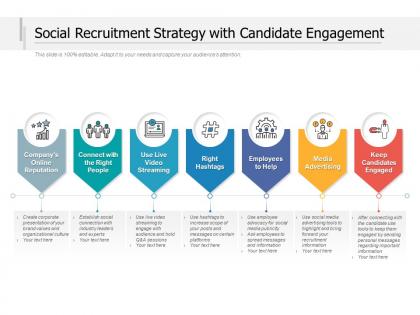
Social recruitment strategy with candidate engagement




Try Before you Buy Download Free Sample Product
 Impress Your
 Audience
 100%
100% Editable
 Save Hours
 of Time


Avoid intermittent bursts with our Social Recruitment Strategy With Candidate Engagement. Ensure consistency of effort all along.
People who downloaded this PowerPoint presentation also viewed the following :
Social recruitment strategy with candidate engagement with all 2 slides:
Ensure consistency of effort all along with our Social Recruitment Strategy With Candidate Engagement. Be able to avoid intermittent bursts.
FAQs for Social recruitment strategy
Social media recruitment delivers faster candidate sourcing, broader talent pool access, enhanced employer branding, cost-effective posting, and real-time engagement capabilities compared to traditional methods. These platforms enable recruiters to showcase company culture, target passive candidates through strategic outreach, and streamline hiring processes, with many organizations finding significantly reduced time-to-hire and improved candidate quality.
Companies effectively identify target candidates by analyzing professional profiles on LinkedIn, monitoring industry-specific discussions on Twitter, reviewing portfolios on Instagram and Behance, and leveraging platform analytics to understand candidate demographics and engagement patterns. Through strategic hashtag research, competitor follower analysis, and social listening tools, organizations streamline recruitment targeting while building talent pipelines, ultimately delivering more qualified applicants and faster hiring cycles.
Employer branding serves as the foundation of social recruitment strategy by showcasing company culture, values, and employee experiences across social platforms, attracting quality candidates who align with organizational goals. Strong employer branding on LinkedIn, Facebook, and Instagram enables companies to differentiate themselves in competitive talent markets, ultimately reducing hiring costs and improving candidate quality through authentic storytelling.
LinkedIn excels for professional roles and executive positions, while Instagram and TikTok effectively attract younger talent in creative industries, Facebook serves well for local and hourly positions, and Twitter works for tech and startup recruitment. These platforms enable targeted outreach, enhanced employer branding, and broader candidate reach, with many organizations finding that platform-specific strategies deliver faster hiring cycles, reduced recruitment costs, and access to passive candidates who aren't actively job searching.
Metrics and analytics enhance social recruitment by tracking candidate quality, engagement rates, cost-per-hire, and time-to-fill across different platforms. Through data analysis, organizations can identify which social channels deliver the best candidates, optimize posting times and content strategies, and measure ROI, ultimately enabling more strategic talent acquisition decisions that reduce costs while improving hiring outcomes.
Best practices for social media job postings include using engaging visuals, writing conversational yet professional copy, highlighting company culture and values, incorporating relevant hashtags, and showcasing employee testimonials or day-in-the-life content. These approaches enhance visibility and authenticity by creating emotional connections with candidates, demonstrating workplace environment, and leveraging platform-specific features, ultimately attracting higher-quality applicants who align with organizational values.
Companies engage passive candidates through targeted content marketing, personalized LinkedIn outreach, employee advocacy programs, industry thought leadership, and strategic social media presence across professional platforms. By sharing authentic company culture, career development opportunities, and industry insights, organizations build relationships with top talent who aren't actively job searching, ultimately creating a pipeline of qualified candidates when positions become available.
Legal considerations for social media recruitment include compliance with anti-discrimination laws, privacy regulations, data protection requirements, equal opportunity guidelines, and platform-specific terms of service. These frameworks help organizations streamline hiring processes while maintaining legal compliance, with many companies finding that structured social recruitment policies ultimately deliver reduced legal risks, enhanced candidate transparency, and stronger employer brand protection.
Social media enhances diversity and inclusion in hiring by expanding candidate reach beyond traditional networks, targeting underrepresented communities through specific platforms, and showcasing company culture authentically. Through strategic LinkedIn campaigns, Instagram stories highlighting diverse employees, and partnerships with diversity-focused groups, organizations streamline inclusive recruitment while building stronger employer brands, ultimately delivering broader talent pools and competitive advantage.
Social recruitment tools include applicant tracking systems with social media integration, AI-powered candidate sourcing platforms, social media management dashboards, automated screening software, and video interviewing technologies. These solutions streamline recruitment by automating candidate discovery, enhancing employer branding across platforms, and accelerating screening processes, with many organizations finding that strategic technology adoption reduces hiring time while improving candidate quality and engagement.
Visual content is critically important in social recruitment, as it significantly enhances engagement rates, builds authentic employer brand presence, and captures attention in crowded social feeds where text-only posts often go unnoticed. Through compelling graphics, behind-the-scenes videos, and employee testimonials, companies across sectors like tech, healthcare, and finance create more memorable candidate experiences, ultimately attracting higher-quality applicants and reducing recruitment timelines.
Organizations can foster community engagement through social media storytelling, employee advocacy programs, interactive content campaigns, user-generated content initiatives, and targeted community building platforms. These strategies enhance brand visibility by creating authentic conversations, showcasing company culture, and encouraging peer-to-peer recommendations, with many companies finding that engaged communities ultimately deliver stronger talent pipelines and improved employer branding.
Recruitment teams can effectively collaborate with marketing by establishing shared content calendars, aligning employer brand messaging, leveraging marketing's audience insights, and co-creating targeted campaigns for specific roles or talent pools. This strategic partnership enhances candidate reach through marketing's social media expertise while ensuring recruitment messaging resonates authentically, ultimately delivering higher-quality applicants and stronger employer brand positioning.
Measuring social recruitment ROI presents challenges including tracking candidate sources across multiple platforms, attributing hires to specific social activities, quantifying employer brand impact, calculating long-term retention costs, and establishing baseline metrics for comparison. These measurement complexities often require integrated analytics systems and standardized tracking methods, with many organizations finding that combining traditional recruitment metrics with social engagement data ultimately delivers clearer visibility into hiring effectiveness and strategic value.
Candidate feedback from social media enables organizations to refine their employer branding, optimize job descriptions, and enhance interview processes by identifying pain points and preferences across different talent segments. Through social listening tools and engagement analytics, companies can track sentiment patterns, adjust messaging strategies, and streamline candidate experiences, ultimately delivering more targeted recruitment approaches and higher-quality hires.
No Reviews