


Software Designs And Development Roles Playbook Software Design Development




Try Before you Buy Download Free Sample Product
 Impress Your
Audience
 100%
Editable
 Save Hours
of Time


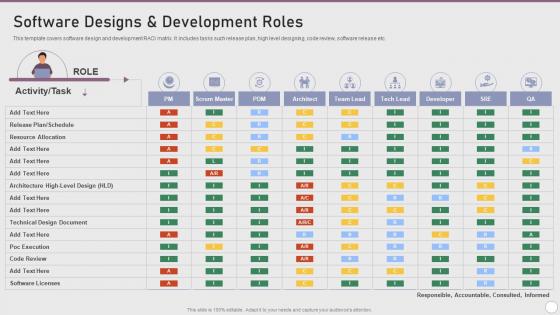
This template covers software design and development RACI matrix. It includes tasks such release plan, high level designing, code review, software release etc.
People who downloaded this PowerPoint presentation also viewed the following :
Software Designs And Development Roles Playbook Software Design Development with all 6 slides:
Use our Software Designs And Development Roles Playbook Software Design Development to effectively help you save your valuable time. They are readymade to fit into any presentation structure.






FAQs for Software Designs And Development Roles Playbook
Software developers handle requirements analysis, system design, code implementation, testing, debugging, and deployment throughout project lifecycles. These professionals collaborate with cross-functional teams, maintain code quality through reviews and documentation, and provide ongoing support, with many organizations finding that developers who engage across multiple phases deliver more robust solutions and faster project completion.
Software Architects design high-level system structures, define technical standards, make strategic technology decisions, and ensure scalability across entire applications or platforms. Software Engineers focus on implementing code, building specific features, debugging applications, and executing the architectural vision, with many organizations finding that this strategic combination delivers faster development cycles, reduced technical debt, and more robust, maintainable systems.
Essential DevOps skills include cloud platform expertise, automation scripting, containerization technologies, CI/CD pipeline management, and infrastructure monitoring capabilities. These competencies streamline software delivery by reducing deployment times, minimizing system downtime, and enabling faster feature releases, with many organizations finding that skilled DevOps engineers ultimately deliver enhanced collaboration between development teams and significantly improved operational efficiency.
Agile methodologies transform software development roles by encouraging cross-functional collaboration, shared responsibility for deliverables, continuous feedback loops, and adaptive planning cycles. These frameworks enable developers, testers, and product owners to work more iteratively and responsively, with many teams finding that traditional silos dissolve, ultimately delivering faster releases and enhanced customer satisfaction.
A Product Owner defines product vision, prioritizes features, manages the product backlog, and serves as the primary stakeholder liaison throughout development cycles. They collaborate with development teams through daily standups, sprint planning sessions, and backlog refinement meetings, ensuring clear requirements and acceptance criteria while balancing business objectives with technical constraints, ultimately delivering market-focused solutions.
QA Engineers ensure software quality through systematic testing methodologies, automated test suite development, bug identification and tracking, performance validation, and compliance verification. They collaborate closely with development teams throughout the software lifecycle, implementing comprehensive testing protocols across functional, security, and user experience domains, ultimately delivering reliable products that minimize post-launch issues and enhance customer satisfaction.
Emerging roles include AI/ML engineers, data scientists, prompt engineers, AI ethics specialists, and MLOps engineers. These positions enhance software development by integrating intelligent automation, ensuring responsible AI deployment, and streamlining machine learning workflows, with many organizations finding that these specialized roles deliver faster innovation, improved user experiences, and significant competitive advantage in an increasingly AI-driven marketplace.
Front-end and Back-end Developers collaborate through API integration, shared documentation, regular communication protocols, and coordinated testing phases to ensure seamless data flow and functionality. Through agile methodologies and version control systems, development teams streamline user interface design with server-side logic, ultimately delivering faster load times, intuitive navigation, and responsive applications that enhance customer satisfaction across web and mobile platforms.
UX/UI Designers focus on user research, interface design, prototyping, and usability testing to create intuitive user experiences, while developers concentrate on coding, technical implementation, and system architecture. These designers collaborate closely with development teams by providing wireframes, design specifications, and user feedback insights, ultimately ensuring that software applications deliver seamless user interactions and competitive market appeal.
Business Analysts serve as crucial translators between stakeholders and developers, converting complex business requirements into technical specifications, facilitating clear communication, and ensuring project alignment with organizational objectives. Through requirements gathering, process mapping, and stakeholder management, BAs streamline development workflows, minimize costly revisions, and accelerate project delivery, with many organizations finding that skilled analysts significantly reduce miscommunication and enhance overall project success rates.
Software development roles evolve from generalist positions in small teams to highly specialized functions in large organizations, with developers transitioning into architects, tech leads, product managers, DevOps engineers, and quality assurance specialists. As teams scale, companies increasingly implement formal hierarchies, cross-functional collaboration structures, and dedicated management tracks, ultimately delivering more efficient resource allocation and streamlined development processes across complex enterprise projects.
Remote software development teams face challenges including timezone coordination difficulties, reduced informal communication, code review delays, knowledge sharing gaps, and maintaining team cohesion across distributed locations. While these obstacles can impact project timelines and team dynamics, many organizations are finding that implementing structured communication protocols, leveraging collaborative development tools, and establishing regular virtual touchpoints ultimately delivers improved documentation practices and more inclusive team participation.
Project managers facilitate software development success by coordinating teams, managing timelines, mitigating risks, and ensuring clear communication across stakeholders. Through agile methodologies and strategic resource allocation, they streamline workflows, resolve bottlenecks, and maintain project scope, with many organizations finding that effective project management reduces development costs while delivering products faster to market.
Open-source software transforms traditional development roles by encouraging collaborative coding, community-driven innovation, and transparent development processes. While developers increasingly contribute to shared repositories and engage in peer review, organizations benefit from accelerated development cycles, reduced licensing costs, and access to diverse talent pools, ultimately delivering more robust solutions and competitive advantages.
Continuous learning is essential for software developers due to rapidly evolving technologies, programming languages, frameworks, and industry best practices that emerge constantly. Professionals who prioritize upskilling through certifications, online courses, and hands-on projects maintain competitive advantages, command higher salaries, and adapt seamlessly to market demands, with many organizations increasingly valuing developers who demonstrate growth mindsets.
-
I am glad to have come across Slideteam. I was searching for some unique presentations and templates for my business. There are a lot of alternatives available here.
-
I came across many PowerPoint presentations with excellent creatives and I believe they would be beneficial to my work.