


Software Development Project Management Dashboard Agile Project Management With Scrum Ppt Grid





Try Before you Buy Download Free Sample Product
 Impress Your
Audience
 100%
Editable
 Save Hours
of Time


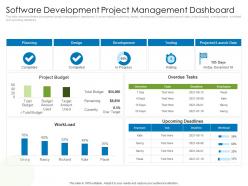
This slide shows software development project management dashboard. It covers status of planning, design, development, testing project launch date, project budget, overdue tasks, workload and upcoming deadlines.
People who downloaded this PowerPoint presentation also viewed the following :
Software Development Project Management Dashboard Agile Project Management With Scrum Ppt Grid with all 2 slides:
Use our Software Development Project Management Dashboard Agile Project Management With Scrum Ppt Grid to effectively help you save your valuable time. They are readymade to fit into any presentation structure.

FAQs for Software Development Project Management Dashboard Agile Project Management With
Agile Project Management principles include iterative development, customer collaboration, responding to change, working software over documentation, and individuals over processes. These approaches differentiate from traditional methodologies by emphasizing flexibility, continuous feedback, and adaptive planning, with many organizations finding that this enables faster delivery, reduced risk, and enhanced customer satisfaction in increasingly dynamic business environments.
Agile prioritizes customer collaboration through regular demonstrations, iterative feedback sessions, continuous stakeholder involvement, and adaptive planning cycles that respond to evolving requirements. Through sprint reviews, user story validation, and frequent communication touchpoints, organizations in software development, financial services, and healthcare deliver solutions aligned with customer needs, while reducing project risks and ultimately enhancing customer satisfaction and business outcomes.
Scrum provides structured sprints and roles, Kanban offers continuous flow visualization, and XP emphasizes technical practices like pair programming and test-driven development within Agile frameworks. While Scrum operates in fixed timeboxes and Kanban maintains flexible workflows, XP focuses on code quality and customer collaboration, with many software teams finding that combining these methodologies delivers enhanced project visibility, faster delivery cycles, and improved product quality.
Teams effectively manage changing requirements through iterative sprint planning, continuous stakeholder communication, and maintaining flexible product backlogs that prioritize features based on business value. Through regular retrospectives and daily standups, organizations streamline adaptation processes, enhance team responsiveness, and deliver customer-focused solutions, with many finding that this approach ultimately reduces project risks while accelerating time-to-market.
Agile project success metrics include velocity, sprint burndown, customer satisfaction scores, defect rates, and team productivity measures. These metrics enable project managers to track delivery speed, identify bottlenecks, and enhance team performance, with many organizations finding that combining velocity tracking with customer feedback delivers improved project outcomes and competitive advantage.
Agile Project Management enhances team communication through daily stand-ups, sprint reviews, regular retrospectives, and cross-functional collaboration structures. These practices streamline information flow by encouraging transparent progress updates, immediate problem-solving, and continuous feedback loops, with many software development teams and marketing departments finding that enhanced visibility ultimately delivers faster project completion and improved team alignment.
Organizations transitioning to Agile face challenges including resistance to change, inadequate training, cultural misalignment, unclear role definitions, and difficulty adapting existing processes. While these obstacles can initially slow adoption, companies across sectors like software development, manufacturing, and financial services find that structured change management, comprehensive team training, and executive support ultimately deliver enhanced collaboration, faster delivery cycles, and improved customer responsiveness.
Team autonomy is crucial in Agile environments, enabling faster decision-making, enhanced creativity, and improved ownership of outcomes. It can be nurtured through clear goal-setting, trust-building practices, removing organizational barriers, and empowering teams with decision-making authority, ultimately delivering increased innovation and project success across organizations.
Popular Agile project management tools include Jira, Trello, Azure DevOps, Asana, and Scrum-specific platforms like Monday.com. These solutions streamline sprint planning, backlog management, and team collaboration by automating workflow tracking, enhancing transparency across development cycles, and enabling real-time progress monitoring, ultimately delivering faster project completion and improved team productivity.
Agile incorporates continuous improvement through retrospectives, feedback loops, and iterative development cycles that enable teams to adapt and refine processes regularly. These mechanisms streamline project delivery by identifying bottlenecks, enhancing team collaboration, and optimizing workflows, with many organizations finding that this approach ultimately delivers faster time-to-market and improved product quality.
Effective Agile ceremonies require time-boxing meetings, maintaining focused agendas, encouraging active participation from all team members, and creating psychological safety for honest feedback. Organizations like software development teams and financial services firms find that rotating facilitation, using visual collaboration tools, and implementing action-oriented retrospectives significantly enhance team communication, accelerate problem-solving, and ultimately deliver improved project outcomes and team performance.
Agile Project Management addresses risk management through continuous assessment, iterative feedback loops, and adaptive planning, unlike traditional methods that rely on upfront risk analysis. Through regular sprints and stakeholder reviews, organizations identify and mitigate risks early, enabling faster pivots and reduced project failures, ultimately delivering more resilient outcomes than waterfall approaches.
Common Agile implementation pitfalls include inadequate stakeholder buy-in, insufficient training, rigid adherence to processes over principles, poor communication practices, and resistance to cultural change. These challenges can be avoided by investing in comprehensive team education, fostering open collaboration, maintaining flexibility while respecting Agile values, and securing leadership support, with many organizations finding that gradual implementation and continuous feedback loops ultimately deliver smoother transitions and better project outcomes.
Agile practices support remote teams through frequent virtual stand-ups, collaborative digital tools, and iterative feedback cycles that maintain alignment across locations. These methodologies enhance communication by establishing regular touchpoints, transparent progress tracking, and flexible workflows, with many distributed organizations finding that sprint-based structures deliver improved accountability and faster project delivery.
Agile significantly accelerates time-to-market by delivering working products in short iterations, enabling faster feedback cycles, and reducing development bottlenecks through continuous collaboration. Through iterative delivery and early stakeholder involvement, organizations streamline project timelines, enhance product quality, and respond quickly to market changes, with many companies finding that Agile approaches deliver competitive advantages in increasingly dynamic business environments.
-
Commendable slides with attractive designs. Extremely pleased with the fact that they are easy to modify. Great work!
-
Excellent design and quick turnaround.
-
Good research work and creative work done on every template.
-
Easily Editable.