

Software Development Project Report Card Playbook Software Design Development




Try Before you Buy Download Free Sample Product
 Impress Your
 Audience
 100%
100% Editable
 Save Hours
 of Time


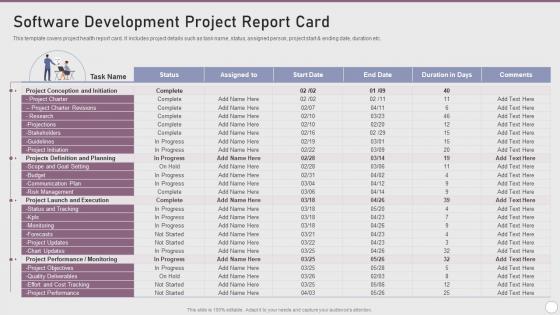
This template covers project health report card. It includes project details such as task name, status, assigned person, project start and ending date, duration etc.
People who downloaded this PowerPoint presentation also viewed the following :
Software Development Project Report Card Playbook Software Design Development with all 6 slides:
Use our Software Development Project Report Card Playbook Software Design Development to effectively help you save your valuable time. They are readymade to fit into any presentation structure.





FAQs for Software Development Project Report Card Playbook
Software development report cards should include code quality metrics, project timeline adherence, bug resolution rates, team collaboration scores, and customer satisfaction ratings. These criteria enable organizations to assess developer performance comprehensively, identify areas for improvement, and optimize resource allocation, with many technology companies finding that balanced scorecards enhance both individual accountability and overall project delivery efficiency.
Project management methodologies significantly impact software development assessments by establishing clear frameworks for measuring progress, resource allocation, and delivery timelines. Agile methodologies enable teams to demonstrate iterative value delivery and adaptability, while traditional approaches like Waterfall provide structured milestone tracking, with many organizations finding that methodology alignment enhances team performance visibility and strategic project outcomes.
Code quality significantly impacts software project success by reducing bugs, enhancing maintainability, accelerating development cycles, and minimizing technical debt accumulation. High-quality code enables teams to deliver more reliable products, respond faster to market changes, and scale efficiently, with organizations like financial services and healthcare finding that superior code standards ultimately translate into reduced costs, improved user experiences, and sustainable competitive advantage.
User feedback can be effectively incorporated through structured surveys, usability testing sessions, support ticket analysis, app store reviews, and in-app feedback mechanisms. These insights enhance software report cards by providing real-world performance data, identifying pain points, and measuring user satisfaction across different features, ultimately delivering more accurate assessments and enabling development teams to prioritize improvements that directly impact user experience.
Lines of code per developer, sprint velocity, cycle time, defect rates, and deployment frequency provide comprehensive productivity insights. These metrics work together by measuring output quality, delivery speed, and technical efficiency, with many development teams finding that balanced tracking across code quality, feature delivery, and deployment reliability ultimately delivers better project outcomes and competitive advantage.
Integration of new technologies should be assessed through adoption rates, implementation timelines, compatibility with existing systems, team training effectiveness, and measurable performance improvements. These metrics enable organizations to evaluate whether emerging technologies like AI integration, cloud migration, or automation tools deliver enhanced productivity, reduced development cycles, and competitive advantage, with many development teams finding that strategic technology adoption significantly accelerates delivery capabilities.
Deadline adherence should typically comprise 15-25% of software development performance evaluations, balanced with code quality, collaboration, and technical innovation metrics. While meeting timelines demonstrates reliability and project management skills, organizations increasingly recognize that sustainable development practices, mentoring contributions, and architectural decisions often deliver greater long-term value than strict schedule compliance alone.
Collaboration can be measured through peer feedback scores, cross-functional project contributions, communication frequency metrics, knowledge sharing activities, and conflict resolution effectiveness. These metrics translate into report card grades by tracking code review participation, meeting engagement levels, and mentorship activities, with many development teams finding that structured collaboration assessment improves overall project delivery and team cohesion.
Customer satisfaction metrics significantly influence software development grading by measuring user experience quality, feature usability, performance reliability, support responsiveness, and overall product value delivery. These metrics provide crucial feedback that helps development teams assess whether their technical achievements translate into real business outcomes, with many organizations finding that high customer satisfaction scores directly correlate with successful project evaluations and competitive advantage.
**INPUT**: What specific indicators can highlight the effectiveness of code reviews and quality assurance? **OUTPUT**: Effective code review indicators include defect detection rates, review cycle times, post-release bug frequencies, code coverage metrics, and reviewer participation levels. These measurements streamline development processes by identifying bottlenecks early, enhancing team collaboration, and minimizing costly production issues, with many software organizations finding that comprehensive tracking ultimately delivers faster deployment cycles and significantly improved product reliability.
Software scalability can be evaluated through performance metrics under increasing loads, resource utilization efficiency, response time consistency, and architectural flexibility assessments. These evaluations involve stress testing across different user volumes, monitoring system behavior during peak demands, and analyzing infrastructure adaptation capabilities, with many organizations finding that comprehensive scalability reporting ultimately delivers predictable growth capacity and competitive operational advantage.
Skill development and training significantly enhance report card ratings by improving code quality, reducing defect rates, accelerating delivery timelines, and strengthening team collaboration capabilities. Through targeted technical training programs, development teams deliver more robust applications, minimize costly rework, and adapt faster to emerging technologies, with many organizations finding that continuous learning initiatives ultimately drive higher client satisfaction and competitive advantage.
Alignment can be measured through key performance indicators like revenue impact, user adoption rates, time-to-market improvements, and strategic objective completion percentages. Organizations increasingly use balanced scorecards and OKR frameworks to track these metrics, with many finding that regular stakeholder reviews and business value assessments deliver clearer project prioritization and enhanced competitive positioning.
Technical debt indicators include code complexity metrics, test coverage percentages, bug frequency rates, deployment cycle times, and code review feedback patterns. These measurements enable development teams to identify bottlenecks, prioritize refactoring efforts, and streamline release processes, with many organizations finding that systematic debt tracking ultimately delivers faster feature deployment and reduced maintenance costs.
Software development teams should receive evaluations quarterly for comprehensive assessments, with monthly check-ins for ongoing projects and weekly sprint reviews for agile environments. This multi-layered approach enables managers to track progress, identify bottlenecks, and adjust resources strategically, while teams benefit from regular feedback cycles that enhance productivity, ultimately delivering faster project completion and improved software quality.
-
The visual appeal of the templates is just unparalleled! I was so worried about the design of my presentation but SlideTeam made it all so easy.
-
Kudos to SlideTeam for achieving the high success rate in delivering the top-notch slides.