

Software Project Management Dashboard Process Improvement Planning





Try Before you Buy Download Free Sample Product
 Impress Your
 Audience
 100%
100% Editable
 Save Hours
 of Time


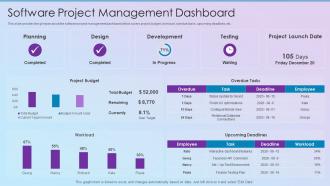
This slide provides the glimpse about the software project management dashboard which covers project budget, workload, overdue tasks, upcoming deadlines, etc.
People who downloaded this PowerPoint presentation also viewed the following :
Software Project Management Dashboard Process Improvement Planning with all 6 slides:
Use our Software Project Management Dashboard Process Improvement Planning to effectively help you save your valuable time. They are readymade to fit into any presentation structure.





FAQs for Software Project Management Dashboard
The key phases in software project management lifecycle include initiation, planning, execution, monitoring and control, and closure, with each phase containing specific deliverables and milestones. These phases streamline development by establishing clear requirements, managing resources effectively, and ensuring quality control, with many organizations finding that structured lifecycle management reduces project risks, accelerates delivery timelines, and ultimately enhances customer satisfaction.
Effective software project estimation involves breaking down projects into smaller tasks, analyzing historical data from similar projects, consulting with experienced team members, and accounting for potential risks and dependencies. Through techniques like story points, planning poker, and buffer allocation, project managers can deliver more accurate timelines and resource requirements, ultimately reducing cost overruns and improving delivery predictability.
Stakeholder communication serves as the foundation for successful software project management by ensuring alignment on requirements, managing expectations, and facilitating timely decision-making throughout development cycles. Effective communication strategies enable project managers to prevent scope creep, resolve conflicts quickly, and maintain transparency with clients, development teams, and executives, ultimately delivering projects on time while building stronger business relationships and trust.
Agile methodologies improve software project management by enabling iterative development, continuous stakeholder feedback, and rapid adaptation to changing requirements. Through shorter sprint cycles and daily standups, development teams deliver working software incrementally, reduce project risks, and enhance collaboration, with many organizations finding that Agile approaches ultimately accelerate time-to-market while maintaining higher quality standards.
Common software project risks include scope creep, resource constraints, technical debt, timeline delays, and stakeholder misalignment. These challenges can be mitigated through robust planning, regular communication protocols, and agile methodologies, with many organizations finding that proactive risk assessment, continuous stakeholder engagement, and iterative development cycles ultimately deliver enhanced project success rates and operational efficiency.
Software project success is measured through delivery metrics like on-time completion, budget adherence, and scope fulfillment, combined with quality indicators including defect rates, user satisfaction scores, and performance benchmarks. These measurements enable organizations to assess both immediate project outcomes and long-term business value, with many development teams finding that balanced scorecards ultimately deliver enhanced stakeholder confidence and operational efficiency.
Best practices for managing remote software development teams include establishing clear communication protocols, implementing robust project tracking systems, scheduling regular video check-ins, defining precise deliverable expectations, and fostering virtual team collaboration through shared platforms. These approaches streamline coordination by enhancing transparency, maintaining accountability, and ensuring consistent progress monitoring, with many technology companies finding that structured remote workflows ultimately deliver faster project completion and improved developer productivity.
Project management tools enhance collaboration in software projects by centralizing communication, providing real-time visibility into progress, streamlining task allocation, and enabling seamless file sharing across distributed teams. These platforms deliver improved coordination between developers, testers, and stakeholders, while reducing miscommunication and accelerating delivery timelines, ultimately enabling organizations to scale their development operations more efficiently.
Requirements gathering and analysis forms the foundation of successful software project management by defining project scope, stakeholder expectations, and technical specifications upfront. This critical phase prevents costly scope creep, reduces development rework, and ensures alignment between business needs and technical solutions, with many organizations finding that thorough requirements analysis significantly improves project delivery timelines and stakeholder satisfaction.
Managing scope creep requires establishing clear project boundaries, implementing formal change control processes, maintaining regular stakeholder communication, and documenting all requirements upfront with detailed specifications. Through strategic change management protocols, project managers can evaluate new requests against budget and timeline constraints, approve valuable additions while rejecting scope drift, ultimately delivering high-quality outcomes within agreed parameters.
Continuous integration and delivery strategies include automated testing pipelines, version control systems, containerization technologies, deployment automation tools, and monitoring frameworks. These approaches streamline development by enabling frequent code commits, reducing integration conflicts, and accelerating release cycles, with many software teams finding that automated CI/CD pipelines ultimately deliver faster time-to-market and enhanced product reliability.
Effective conflict management involves establishing clear communication protocols, defining roles and responsibilities, implementing regular feedback sessions, and creating psychological safety for open dialogue. Through structured retrospectives and one-on-one meetings, project managers can address issues early, facilitate collaborative problem-solving, and maintain team cohesion, ultimately delivering better project outcomes and stronger team relationships.
Key software project metrics include velocity, burn-down rates, code quality indicators, defect density, sprint completion rates, and resource utilization. These measurements enable project managers to identify bottlenecks, optimize team performance, and maintain delivery schedules, with many development teams finding that consistent tracking ultimately delivers better predictability and stakeholder confidence.
Technology stack choices significantly impact project management through development speed, team expertise requirements, integration complexity, and maintenance costs. Strategic selections like established frameworks, cloud-native architectures, and compatible tools streamline workflows, reduce technical debt, and accelerate delivery timelines, with many organizations finding that aligned technology decisions ultimately enhance team productivity and project predictability.
Failed software projects teach valuable lessons including inadequate requirements gathering, poor stakeholder communication, unrealistic timelines, insufficient risk management, and lack of user involvement throughout development. These failures highlight that successful project management requires continuous stakeholder engagement, iterative development approaches, and robust change management processes, with many organizations finding that embracing agile methodologies and maintaining transparent communication ultimately delivers better outcomes and competitive advantage.
-
Wonderful templates design to use in business meetings.
-
I have been using SlideTeam for the past six months. Very happy and satisfied!