

Software Testing Strategies Technology Development Project Planning




Try Before you Buy Download Free Sample Product
 Impress Your
 Audience
 100%
100% Editable
 Save Hours
 of Time


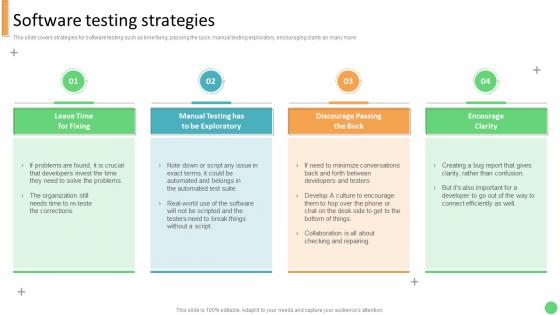
This slide covers strategies for software testing such as time fixing, passing the buck, manual testing exploratory, encouraging clarity an many more.
People who downloaded this PowerPoint presentation also viewed the following :
Software Testing Strategies Technology Development Project Planning with all 6 slides:
Use our Software Testing Strategies Technology Development Project Planning to effectively help you save your valuable time. They are readymade to fit into any presentation structure.





FAQs for Software Testing Strategies Technology
Manual testing involves human testers executing test cases, exploring functionality, and identifying usability issues through direct interaction with software interfaces. Automated testing uses scripts and tools to execute repetitive tests, perform regression testing, and validate system performance at scale, with many organizations finding that combining both approaches delivers comprehensive coverage while optimizing resource allocation and testing efficiency.
Risk-based testing improves software quality by prioritizing test efforts on high-risk areas, allocating resources strategically based on failure probability and business impact, and focusing on critical functionalities first. This approach enables organizations to detect critical defects earlier, optimize testing budgets more effectively, and deliver more reliable software products, with many development teams finding that targeted testing significantly enhances overall system stability.
User acceptance testing serves as the final validation checkpoint where real users verify that software meets business requirements, functional specifications, and usability expectations before release. This critical phase enables organizations to identify gaps between technical implementation and user needs, reduce post-launch support costs, and ensure market readiness, with many companies finding that thorough UAT significantly minimizes costly rollbacks and enhances customer satisfaction.
Exploratory testing enhances structured methodologies by uncovering unexpected issues, validating real-world user scenarios, and identifying gaps that scripted tests miss. While automated regression testing ensures consistency and manual test cases verify requirements, exploratory testing delivers creative problem-solving and adaptive investigation, with many development teams finding that this combination significantly improves software quality and user experience.
Choosing testing frameworks requires evaluating project complexity, team expertise, integration capabilities, maintenance requirements, and scalability needs. Organizations should assess framework compatibility with existing technologies, community support, documentation quality, and long-term viability, with many development teams finding that strategic framework selection significantly reduces testing overhead while enhancing code reliability and delivery speed.
CI/CD revolutionizes testing strategies by automating test execution, enabling faster feedback loops, and integrating quality checks throughout the development pipeline. This approach streamlines testing through automated unit tests, integration testing, and deployment validation, with many software teams finding that continuous testing reduces bugs, accelerates releases, and ultimately delivers more reliable applications.
Test automation integrates into agile development through continuous integration pipelines, sprint-based test planning, automated regression testing, and parallel development-testing workflows. This strategic combination enables development teams to maintain rapid release cycles while ensuring quality, with many software companies finding that automated testing delivers faster feedback loops, reduced manual effort, and enhanced product reliability throughout iterative development phases.
Essential metrics include test coverage percentage, defect detection rate, test execution velocity, defect leakage ratio, and mean time to resolution. These KPIs enable organizations to streamline quality assurance processes, enhance release reliability, and optimize resource allocation, with many software teams finding that comprehensive metrics tracking ultimately delivers faster deployment cycles and improved customer satisfaction.
Mobile and web applications require different testing approaches due to distinct environments, user interactions, and technical constraints including device fragmentation, operating systems, network connectivity, and touch interfaces versus mouse-keyboard interactions. Mobile testing emphasizes battery performance, offline functionality, and cross-device compatibility, while web testing focuses on browser compatibility, responsive design, and load handling, with many organizations finding that specialized testing frameworks ultimately deliver more reliable user experiences across platforms.
Best practices for creating a comprehensive test plan include defining clear objectives, establishing scope and requirements, identifying test scenarios and data sets, allocating resources effectively, and setting measurable success criteria. These strategic approaches streamline testing processes by ensuring thorough coverage, minimizing redundancies, and enabling systematic quality assurance, with many software teams finding that structured planning ultimately delivers faster deployment cycles and enhanced product reliability.
Performance testing ensures applications meet usage demands by simulating real-world traffic loads, identifying bottlenecks, and measuring response times under various stress conditions. Through automated load testing and monitoring tools, organizations can optimize database queries, server configurations, and code efficiency before deployment, ultimately delivering faster user experiences and preventing costly system failures during peak usage periods.
Security testing strategies include static code analysis, dynamic application security testing, penetration testing, vulnerability scanning, and threat modeling. These approaches streamline security assessments by identifying code weaknesses, testing runtime behaviors, and simulating real-world attacks, with many organizations finding that comprehensive security testing ultimately delivers reduced breach risks and enhanced customer trust.
Businesses can leverage user feedback by integrating beta testing programs, conducting usability studies, analyzing support tickets for recurring issues, and implementing continuous feedback loops throughout development cycles. This approach enables organizations to identify real-world pain points, prioritize critical fixes, and enhance user experiences, with many companies finding that user-driven testing significantly reduces post-launch issues while improving customer satisfaction.
Testing microservices presents challenges including service interdependency complexities, distributed system failures, network latency issues, data consistency across services, and contract testing between APIs. These distributed architectures require comprehensive integration testing, service virtualization, and end-to-end monitoring, with many organizations finding that automated testing pipelines and containerized environments ultimately streamline validation processes.
Cross-browser testing can be streamlined through automated testing frameworks, cloud-based testing platforms, parallel execution environments, and AI-powered compatibility tools that identify potential issues across multiple browsers simultaneously. These technologies enable development teams to reduce testing cycles from weeks to days, minimize manual effort, and ensure consistent user experiences across all platforms, with many organizations finding that automated cross-browser solutions deliver faster deployment and improved digital reliability.
-
Wow, never been this impressed with any online service provider. Really appreciate the customer support all along from the navigation to purchasing the right products.
-
The slides come with appealing color schemes and relevant content that helped me deliver a stunning presentation without any hassle!