

Spend Category Analysis And Management Dashboard Evaluating Key Risks In Procurement Process




Try Before you Buy Download Free Sample Product
 Impress Your
 Audience
 100%
100% Editable
 Save Hours
 of Time


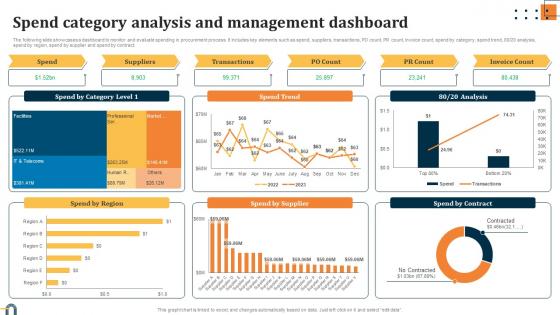
The following slide showcases a dashboard to monitor and evaluate spending in procurement process. It includes key elements such as spend, suppliers, transactions, PO count, PR count, invoice count, spend by category, spend trend, 80 20 analysis, spend by region, spend by supplier and spend by contract.
People who downloaded this PowerPoint presentation also viewed the following :
Spend Category Analysis And Management Dashboard Evaluating Key Risks In Procurement Process with all 10 slides:
Use our Spend Category Analysis And Management Dashboard Evaluating Key Risks In Procurement Process to effectively help you save your valuable time. They are readymade to fit into any presentation structure.









FAQs for Spend Category Analysis And Management Dashboard Evaluating Key Risks
**INPUT**: What are the key components of a spend category analysis? **OUTPUT**: Key components of spend category analysis include supplier performance evaluation, cost structure assessment, market dynamics research, risk identification, and strategic sourcing opportunities. These elements work together by streamlining procurement decisions, enhancing supplier relationships, and minimizing operational costs, with many organizations finding that comprehensive category analysis ultimately delivers significant competitive advantage and improved resource allocation.
Spend category analysis influences procurement strategies by identifying spending patterns, supplier dependencies, cost-saving opportunities, and risk concentrations across different categories. Through detailed data analysis, organizations can consolidate suppliers, negotiate better contracts, and optimize resource allocation, with many companies finding that strategic category management reduces costs by 10-15% while enhancing supplier relationships and operational efficiency.
Effective spend category analysis tools include procurement software platforms, data analytics dashboards, AI-powered classification systems, spend visualization tools, and automated reporting solutions. These technologies streamline operations by centralizing procurement data, identifying cost-saving opportunities, and enhancing supplier performance tracking, with many organizations finding that strategic combinations ultimately deliver improved operational efficiency and significant competitive advantage.
Businesses prioritize spend categories for analysis by focusing on high-volume expenditures, strategic importance to operations, risk exposure, and compliance requirements. Organizations typically start with categories representing the largest financial impact, such as procurement, payroll, and vendor payments, while simultaneously examining high-risk areas like travel expenses and contractor spending, ultimately delivering comprehensive visibility and enhanced cost control across their most critical operational areas.
A comprehensive spend category analysis should incorporate procurement data, invoice records, contract databases, supplier performance metrics, and market intelligence reports. These data sources enable organizations to identify spending patterns, supplier consolidation opportunities, and cost reduction potential across categories like IT services, professional consulting, and facilities management, ultimately delivering enhanced procurement efficiency and strategic sourcing advantages.
Market trends significantly influence spend category analysis by revealing pricing fluctuations, supplier consolidations, emerging technologies, and shifting demand patterns that directly affect procurement strategies. These trends enable organizations to identify cost-saving opportunities, anticipate supply chain disruptions, and negotiate better contracts, with many companies finding that trend-aware analysis delivers improved supplier relationships, reduced costs, and enhanced competitive positioning in increasingly dynamic markets.
Common pitfalls include incomplete data collection, overlooking indirect spending categories, failing to engage key stakeholders, and neglecting supplier performance metrics beyond cost. These oversights can significantly undermine analysis accuracy, with many organizations finding that poor stakeholder alignment and data gaps lead to missed savings opportunities, ineffective supplier negotiations, and ultimately compromised procurement strategies that fail to deliver competitive advantage.
Spend category analysis aids supplier relationship management by identifying top suppliers, revealing dependency patterns, and highlighting consolidation opportunities across procurement categories. This strategic approach enables organizations to negotiate better terms with key vendors, diversify supplier bases in critical categories, and build stronger partnerships, ultimately delivering cost savings and supply chain resilience.
Critical metrics for evaluating spend categories include total spend volume, supplier concentration ratios, contract compliance rates, cost per unit trends, and savings opportunity identification. These metrics enable procurement teams to assess risk exposure, negotiate better contracts, and optimize supplier relationships across categories like IT services, facilities management, and professional services, ultimately delivering improved cost control and operational efficiency.
Businesses align spend category analysis with corporate goals by establishing clear procurement KPIs, mapping spending patterns to strategic objectives, and implementing performance metrics that track cost optimization alongside quality outcomes. Through systematic category management, organizations streamline resource allocation, enhance supplier relationships, and minimize operational inefficiencies, ultimately delivering measurable ROI and competitive advantage.
Stakeholder engagement ensures comprehensive data collection, accurate category insights, and successful implementation of spend optimization strategies across departments. Through collaborative workshops, cross-functional teams, and regular communication with procurement, finance, and end-users, organizations enhance category understanding, identify cost-saving opportunities, and secure buy-in for strategic sourcing initiatives, ultimately delivering improved compliance and sustainable cost reductions.
Insights from spend category analysis drive cost-saving initiatives by identifying spending patterns, consolidating suppliers, and revealing negotiation opportunities across procurement categories. Through strategic analysis, organizations streamline vendor relationships, eliminate redundant purchases, and optimize contract terms, with many companies finding that targeted category management reduces procurement costs by 10-15% while enhancing operational efficiency.
Spend category analysis helps risk management by identifying supplier concentration risks, detecting unusual spending patterns, and monitoring contract compliance across categories. Through systematic categorization, organizations can assess vendor dependencies in critical areas like IT services or manufacturing components, enabling proactive diversification strategies and contingency planning that ultimately reduces supply chain vulnerabilities and financial exposure.
Spend category analysis enables organizations to identify environmentally impactful suppliers, assess carbon footprints across procurement categories, and prioritize sustainable sourcing opportunities within their supply chains. Through detailed expenditure mapping, companies can redirect spending toward eco-friendly vendors, implement green procurement policies, and track sustainability metrics, ultimately reducing environmental impact while often discovering cost savings and enhanced brand reputation.
Organizations should conduct spend category analysis quarterly for strategic categories and annually for comprehensive reviews, with monthly monitoring for high-volume or volatile spend areas. This frequency enables businesses to capture market fluctuations, identify cost-saving opportunities, and optimize supplier relationships effectively, with many enterprises finding that regular analysis delivers improved procurement efficiency and significant budget reductions.
-
Spacious slides, just right to include text. SlideTeam has also helped us focus on the most important points that need to be highlighted for our clients.
-
Keep doing the good work guys. Surpass the needs and expectations always!!