

Staff Productivity Enhancement Techniques Powerpoint Presentation Slides




Try Before you Buy Download Free Sample Product
 Impress Your
 Audience
 100%
100% Editable
 Save Hours
 of Time


Maximize organizational performance with our comprehensive Staff Productivity Enhancement Techniques template. This indispensable resource optimizes workforce efficiency and drives effective work execution. By utilizing this template, you can effectively align organizational goals with the capabilities of your workforce. Our Performance Management deck goes beyond conventional boundaries, providing a global perspective on hybrid, WFH work from home, and WFO work from the office scenarios. It also features a timeline for implementing performance improvement strategies, ensuring a structured and timely approach. Additionally, our Employee performance management PPT offers a range of designs and initiatives to boost employee engagement and productivity across all scenarios. It further provides a detailed employee engagement plan, outlining goals, purposes, and essential KPIs for measuring success. Moreover, our Performance improvement methods module delves into workflow charts, clearly defining the roles and responsibilities of HR managers and their teams. It also includes a comprehensive cost analysis and comparative software assessment to optimize overall performance. With KPI dashboards and impact analysis, youll have the tools to accurately measure your employee engagement strategies effectiveness. Get instant access.
People who downloaded this PowerPoint presentation also viewed the following :
Content of this Powerpoint Presentation
Slide 1: This slide introduces Staff Productivity Enhancement Techniques. Commence by stating Your Company Name.
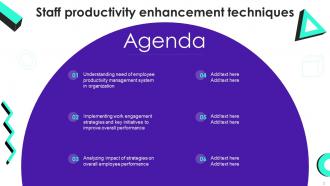
Slide 2: This slide depicts the Agenda of the presentation.
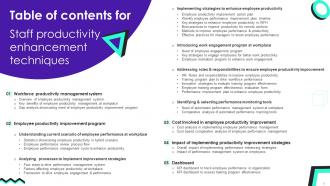
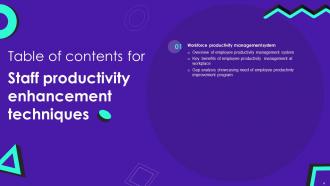
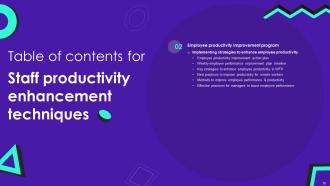
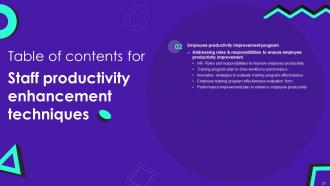
Slide 3: This slide includes the Table of contents.
Slide 4: This slide highlights the Title for the Topics to be covered further.
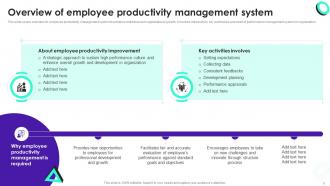
Slide 5: This slide covers overview for employee productivity management system to enhance individual and organizational growth.
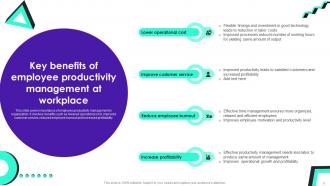
Slide 6: This slide hgihlights the importance of employee productivity management in organization.
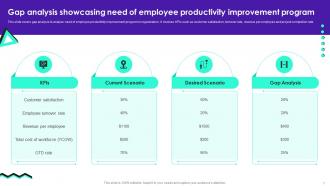
Slide 7: This slide illustrates the Gap analysis showcasing need of employee productivity improvement program.
Slide 8: This slide includes the Heading for the Contents to be discussed next.
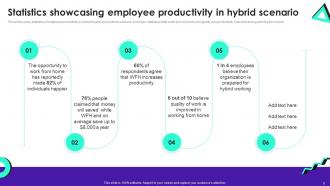
Slide 9: This slide covers the statistics of employee productivity in current hybrid work culture scenario.
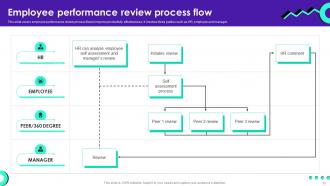
Slide 10: This slide portrays the employee performance review process flow to improve productivity effectiveness.
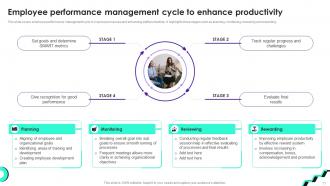
Slide 11: This slide presents the Employee performance management cycle to enhance productivity.
Slide 12: This slide depicts the Title for the Ideas to be covered in the upcoming template.
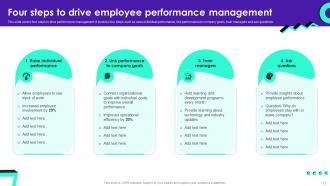
Slide 13: This slide states the Four steps to drive employee performance management.
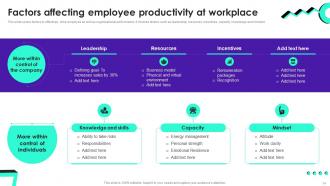
Slide 14: This slide lists the Factors affecting employee productivity at workplace.
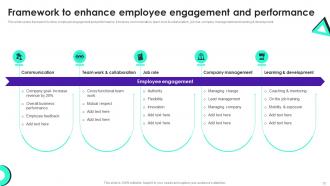
Slide 15: This slide illustrates the Framework to enhance employee engagement and performance.
Slide 16: This slide exhibits the Heading for the Ideas to be discussed further.
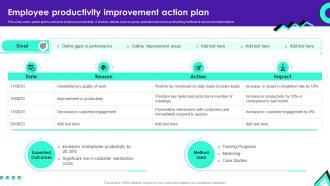
Slide 17: This slide indicates the Employee productivity improvement action plan.
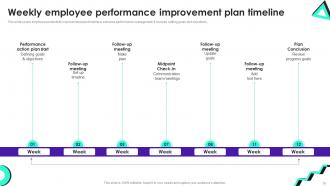
Slide 18: This slide covers employee productivity improvement plan timeline to enhance performance management.
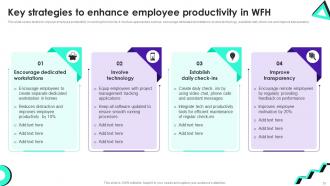
Slide 19: This slide depicts the Key strategies to enhance employee productivity in WFH.
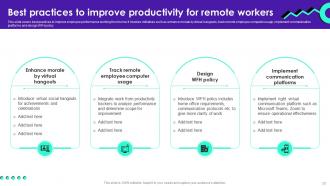
Slide 20: This slide states the Best practices to improve productivity for remote workers.
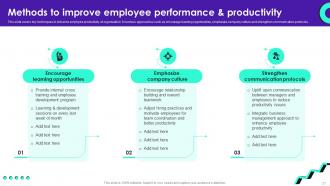
Slide 21: This slide covers key techniques to enhance employee productivity at organization.
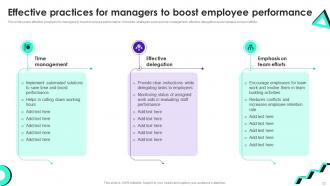
Slide 22: This slide shows the Effective practices for managers to boost employee performance.
Slide 23: This slide presents the Title for the Contents to be covered next.
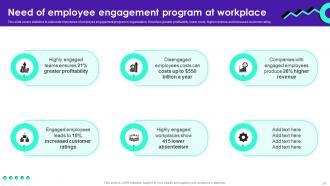
Slide 24: This slide exhibits the Need of employee engagement program at workplace.
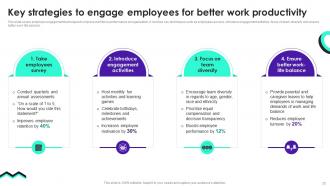
Slide 25: This slide mentions the Key strategies to engage employees for better work productivity.
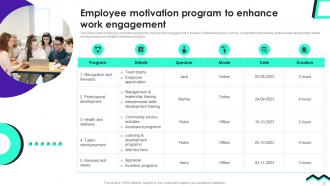
Slide 26: This slide covers employee motivation program to improve work engagement.
Slide 27: This slide states the Heading for the Topics to be discussed further.
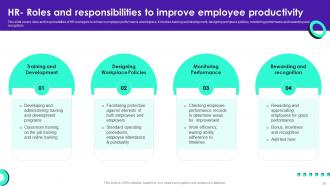
Slide 28: This slide portrays the roles and responsibilities of HR managers to enhance employee performance at workplace.
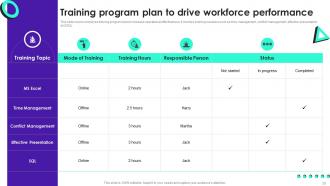
Slide 29: This slide covers employee training program plan to increase operational effectiveness.
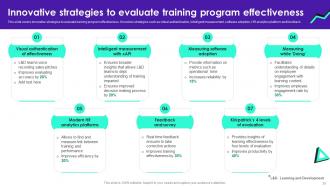
Slide 30: This slide includes the Innovative strategies to evaluate training program effectiveness.
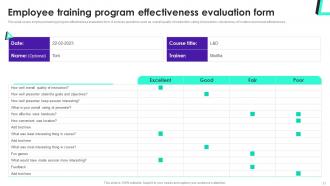
Slide 31: This slide showcases the employee training program effectiveness evaluation form.
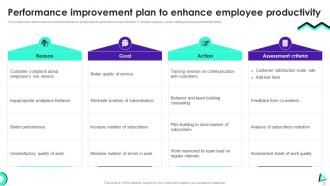
Slide 32: This slide depicts the Performance improvement plan to enhance employee productivity.
Slide 33: This slide displays the Title for the Contents to be covered in the upcoming template.
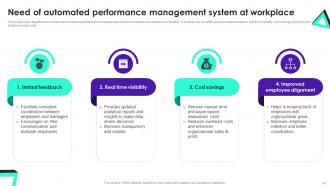
Slide 34: This slide displays the Need of automated performance management system at workplace.
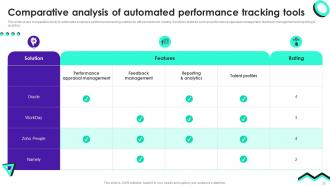
Slide 35: This slide illustrates the Comparative analysis of automated performance tracking tools.
Slide 36: This slide displays the Heading for the Topics to be discussed next.
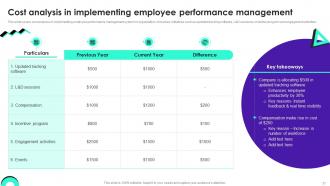
Slide 37: This slide covers cost analysis in implementing employee performance management system in organization.
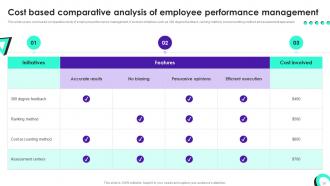
Slide 38: This slide reveals the Cost based comparative analysis of employee performance management.
Slide 39: This slide depicts the Title for the Topics to be discussed in the upcoming template.
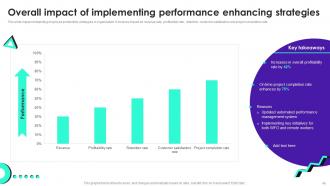
Slide 40: This slide reveals the impact of depicting employee productivity strategies in organization.
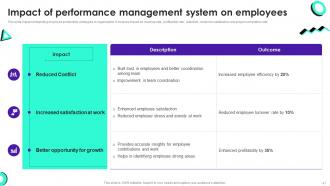
Slide 41: This slide highlights the Impact of performance management system on employees.
Slide 42: This slide includes the Heading for the Contents to be covered further.
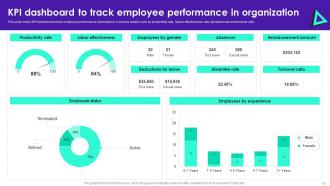
Slide 43: This slide illustrates the KPI dashboard to track employee performance in organization.
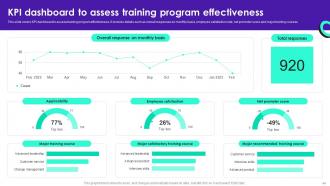
Slide 44: This slide covers KPI dashboard to assess training program effectiveness.
Slide 45: This is the Icons Slide containing all the Icons used in the plan.
Slide 46: This slide depicts some Additional information.
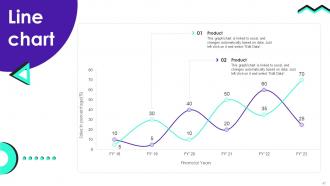
Slide 47: This slide showcases the Line chart.
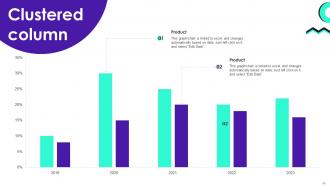
Slide 48: This is the Clustered column slide.
Slide 49: This is the About us slide. State your company-related information here.
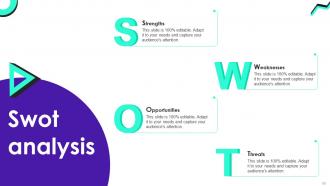
Slide 50: This slide reveals the Swot analysis.
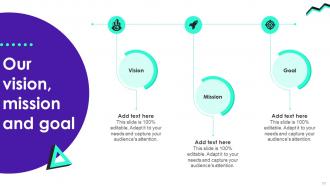
Slide 51: This slide displays the organization's vision, mission and goal.
Slide 52: This slide elucidates information related to the Financial topic.
Slide 53: This slide contains the Post it notes for reminders and deadlines.
Slide 54: This is the Puzzle slide with related imagery.
Slide 55: This is Our target slide. State your firm's targets here.
Slide 56: This is Our team slide. State your team-related information here.
Slide 57: This is the Venn diagram slide.
Slide 58: This is the Thank You slide for acknowledgement.
Staff Productivity Enhancement Techniques Powerpoint Presentation Slides with all 63 slides:
Use our Staff Productivity Enhancement Techniques Powerpoint Presentation Slides to effectively help you save your valuable time. They are readymade to fit into any presentation structure.






FAQs for Staff Productivity Enhancement Techniques
Key factors influencing staff productivity in remote work environments include clear communication protocols, flexible scheduling, proper technology infrastructure, defined performance metrics, and regular virtual check-ins. These elements work together by minimizing distractions, enhancing work-life balance, and streamlining collaboration, with many organizations finding that structured remote policies ultimately deliver higher employee satisfaction and measurable productivity gains.
Presentation tools enhance communication and collaboration by enabling visual storytelling, real-time editing, and centralized content sharing across teams. These platforms streamline project updates, client presentations, and brainstorming sessions through interactive features, comment systems, and version control, with many organizations finding that teams deliver faster decisions, improved alignment, and enhanced creative outcomes.
Employee engagement significantly enhances productivity by fostering motivation, reducing absenteeism, improving quality of work, and increasing retention rates. Engaged employees demonstrate greater initiative, collaborate more effectively, and deliver superior customer experiences, with organizations like retail chains and financial services finding that highly engaged teams achieve 20-25% higher productivity and profitability.
Organizations can effectively measure staff productivity through key performance indicators, output-per-hour metrics, goal completion rates, quality assessments, and employee engagement scores. These analytics enable managers to identify performance patterns, optimize resource allocation, and enhance operational efficiency, with many companies finding that data-driven insights ultimately streamline workflows and deliver measurable improvements in overall business outcomes.
Best practices include setting SMART objectives, establishing clear performance metrics, aligning individual goals with team objectives, implementing regular check-ins, and creating accountability frameworks. These approaches enhance productivity by fostering transparency, enabling continuous feedback, and maintaining strategic focus, with many organizations finding that balanced goal-setting ultimately delivers improved performance and employee engagement across departments.
Feedback mechanisms improve staff performance by providing clear expectations, identifying skill gaps, and recognizing achievements, enabling targeted development and motivation. Through regular one-on-ones, performance reviews, and real-time coaching, organizations streamline communication, enhance employee engagement, and accelerate professional growth, ultimately delivering higher productivity and retention rates.
Workplace culture significantly impacts employee motivation and output by shaping engagement levels, communication patterns, and job satisfaction across organizations. A positive culture enhances productivity through increased collaboration, reduced turnover, and stronger alignment with company goals, with many businesses finding that supportive environments deliver higher performance, improved innovation, and ultimately greater competitive advantage in talent retention.
Managers can identify productivity bottlenecks through performance analytics, workflow mapping, employee feedback surveys, time-tracking tools, and regular one-on-one meetings. These approaches streamline operations by revealing process inefficiencies, resource constraints, and skill gaps, with many organizations finding that addressing communication barriers, automating repetitive tasks, and providing targeted training ultimately delivers enhanced team performance and competitive advantage.
Training and development programs enhance employee efficiency by upgrading technical skills, streamlining workflows, and reducing knowledge gaps that slow productivity. Through targeted learning initiatives, organizations accelerate task completion, minimize errors, and boost employee confidence, with many companies finding that strategic training investments ultimately deliver measurable improvements in output quality and operational performance.
Technology integration optimizes workflows by automating repetitive tasks, centralizing data management, streamlining communication channels, and providing real-time analytics for decision-making. Through cloud-based platforms and AI-powered tools, organizations enhance collaboration, minimize manual errors, and accelerate project timelines, with many companies finding that strategic technology adoption delivers measurable productivity gains and competitive advantage.
Strategies include flexible scheduling, remote work options, wellness programs, clear boundary setting, and mental health support initiatives. These approaches enhance productivity by reducing burnout, improving employee satisfaction, and minimizing turnover, with many organizations finding that strategic work-life balance policies ultimately deliver higher engagement and competitive talent retention advantages.
Physical workspace design significantly influences employee productivity through ergonomic furniture, natural lighting, optimized layouts, noise management, and collaborative spaces. Well-designed offices enhance focus, reduce fatigue, and facilitate communication, with many organizations finding that strategic workspace investments deliver improved employee satisfaction, reduced absenteeism, and measurable productivity gains across teams.
Flexible working arrangements enhance staff productivity by reducing commute stress, improving work-life balance, and allowing employees to work during their peak performance hours. Organizations across industries, from tech companies to financial services, report increased output, reduced absenteeism, and higher employee retention, ultimately delivering competitive advantage through enhanced operational efficiency.
Recognition and rewards programs drive productivity by increasing employee engagement, motivation, and job satisfaction, creating clear performance incentives and fostering competitive excellence. These strategic initiatives enhance retention, accelerate goal achievement, and strengthen team collaboration, with many organizations finding that well-structured recognition systems deliver measurable productivity gains and sustainable competitive advantage.
Cultivating continuous improvement requires establishing regular feedback loops, setting incremental goals, celebrating small wins, implementing suggestion systems, and fostering learning cultures. These approaches enhance productivity by encouraging experimentation, reducing resistance to change, and empowering teams to identify inefficiencies, with many organizations finding that employee-driven improvements deliver more sustainable results than top-down mandates.
-
Amazing slides! Unique, attractive, and easy to understand.
-
Commendable slides with attractive designs. Extremely pleased with the fact that they are easy to modify. Great work!