

Stage analysis in customer engagement journey
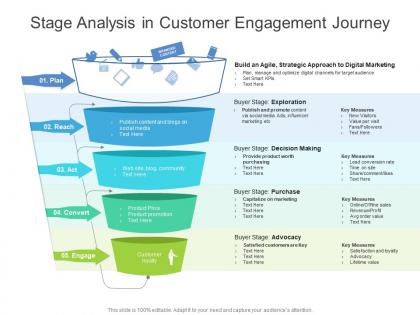




Try Before you Buy Download Free Sample Product
 Impress Your
Audience
 100%
Editable
 Save Hours
of Time


Our Stage Analysis In Customer Engagement Journey are topically designed to provide an attractive backdrop to any subject. Use them to look like a presentation pro.
People who downloaded this PowerPoint presentation also viewed the following :
Stage analysis in customer engagement journey with all 2 slides:
Use our Stage Analysis In Customer Engagement Journey to effectively help you save your valuable time. They are readymade to fit into any presentation structure.


FAQs for Stage analysis in
The key stages in customer engagement journey include awareness, consideration, purchase, onboarding, retention, and advocacy, with businesses mapping them through customer data analysis, touchpoint identification, behavioral tracking, and feedback collection. This strategic mapping enables organizations to optimize interactions at each phase, personalize experiences, and identify conversion opportunities, with many retail and financial services companies finding that comprehensive journey mapping ultimately delivers higher customer satisfaction and increased lifetime value.
Customer segmentation enhances engagement journey understanding by revealing distinct behavioral patterns, preferences, pain points, and decision-making triggers specific to different customer groups at each stage. Through demographic, psychographic, and behavioral segmentation, businesses can identify how millennials versus baby boomers navigate awareness differently, or how high-value customers require different nurturing approaches during consideration, ultimately enabling personalized experiences and targeted interventions.
Customer feedback serves as the critical data source for identifying friction points, measuring satisfaction levels, and understanding customer expectations across all engagement stages. Through systematic feedback collection at touchpoints like onboarding, purchase, and support interactions, organizations can pinpoint specific stage improvements, personalize experiences more effectively, and reduce churn rates, with many companies finding that feedback-driven optimization increases customer lifetime value and competitive positioning.
Technology and data analytics enhance customer engagement tracking through real-time monitoring, predictive modeling, behavioral segmentation, and cross-channel integration capabilities. These tools enable organizations to identify engagement patterns, predict customer needs, and personalize interactions at scale, with retail and financial services companies finding significantly improved conversion rates and customer lifetime value through strategic data-driven approaches.
Common pitfalls include treating stages as linear progressions, ignoring cross-channel touchpoints, focusing solely on acquisition metrics, inadequate data integration, and failing to personalize experiences based on behavioral insights. These analytical gaps prevent organizations from understanding true customer motivations and decision-making patterns, with many businesses finding that siloed approaches ultimately limit their ability to optimize conversion rates and deliver seamless experiences.
Businesses ensure seamless stage transitions through integrated customer data platforms, consistent messaging across touchpoints, and automated workflow triggers that anticipate customer needs at each progression point. Strategic mapping of handoff processes, personalized content delivery, and proactive support interventions enable organizations to guide customers smoothly through awareness, consideration, and decision phases, ultimately delivering enhanced experiences and higher conversion rates.
Customer engagement journey metrics include conversion rates, time-to-progression, engagement scores, customer satisfaction ratings, and retention percentages at each stage. These measurements enable organizations to identify bottlenecks, optimize touchpoints, and enhance customer experiences, with many companies finding that systematic stage analysis ultimately delivers improved customer lifetime value and competitive advantage.
Personalized marketing strategies align with engagement stages through targeted content delivery, behavioral trigger campaigns, dynamic segmentation, and adaptive messaging frameworks that respond to customer actions and preferences. Through AI-driven analytics and customer data platforms, retailers and financial services enhance acquisition efforts, nurture consideration phases, and optimize retention strategies, ultimately delivering higher conversion rates and stronger customer lifetime value.
Customer personas significantly influence engagement journey design by informing stage-specific touchpoint strategies, content personalization approaches, channel preferences, and communication timing that align with distinct user behaviors and motivations. Through persona-driven analysis, organizations in retail, healthcare, and financial services can tailor each journey stage more precisely, ultimately delivering more relevant customer experiences and improving conversion rates across different user segments.
Content best practices include creating awareness-stage educational materials, consideration-stage comparison guides, decision-stage testimonials and demos, and retention-stage value-added resources. These approaches enhance engagement by addressing specific customer needs, building trust through relevant messaging, and delivering personalized experiences, with many organizations finding that stage-specific content significantly improves conversion rates and customer lifetime value.
Emotional drivers can be integrated through sentiment analysis tools, behavioral pattern mapping, customer feedback systems, and psychological profiling at each engagement touchpoint. By combining these approaches with traditional metrics, organizations streamline their understanding of customer motivations, enhance personalization strategies, and ultimately deliver more resonant experiences that drive loyalty and conversion rates.
A multi-channel approach creates complex data integration challenges, requires unified analytics platforms, demands consistent messaging across touchpoints, increases attribution complexity, and necessitates cross-channel journey mapping capabilities. Through integrated analytics platforms, organizations can deliver seamless customer experiences, reduce engagement friction, and enhance conversion rates, with many financial services and retail companies finding that synchronized multi-channel strategies significantly improve customer satisfaction and lifetime value.
Businesses maintain customer loyalty by delivering consistent value through personalized experiences, proactive support, and strategic touchpoint optimization at each engagement stage. Through data-driven insights and omnichannel approaches, companies in retail, financial services, and healthcare enhance customer satisfaction, reduce churn rates, and build long-term relationships, ultimately delivering sustained revenue growth and competitive advantage.
Social media influences customer experience by providing awareness through targeted content, consideration via reviews and comparisons, purchase through social commerce features, and retention through community building and support. Platforms like Instagram and Facebook enable brands to deliver personalized interactions, gather real-time feedback, and foster loyalty programs, ultimately creating seamless omnichannel experiences that enhance customer satisfaction.
Businesses can identify touchpoints through customer data analytics, journey mapping, feedback collection, and behavioral tracking across digital and physical channels. These insights enable strategic optimization by personalizing communications, streamlining processes, and addressing pain points, with many retail and financial services organizations finding that targeted touchpoint enhancement significantly improves conversion rates and customer satisfaction.
-
Very well designed and informative templates.
-
Wonderful templates design to use in business meetings.
-
Excellent products for quick understanding.
-
Much better than the original! Thanks for the quick turnaround.