

Stakeholder Analysis And Communication Plan Waterfall Project Management PM SS




Try Before you Buy Download Free Sample Product
 Impress Your
 Audience
 100%
100% Editable
 Save Hours
 of Time


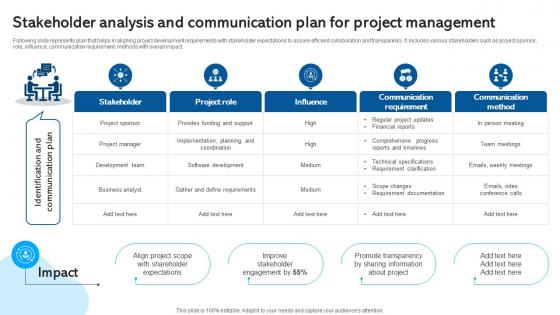
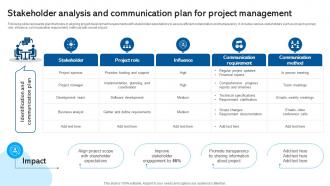
Following slide represents plan that helps in aligning project development requirements with stakeholder expectations to assure efficient collaboration and transparency. It includes various stakeholders such as project sponsor, role, influence, communication requirement, methods with overall impact.
People who downloaded this PowerPoint presentation also viewed the following :
Stakeholder Analysis And Communication Plan Waterfall Project Management PM SS with all 9 slides:
Use our Stakeholder Analysis And Communication Plan Waterfall Project Management PM SS to effectively help you save your valuable time. They are readymade to fit into any presentation structure.








FAQs for Stakeholder Analysis And Communication Plan Waterfall Project
Stakeholder analysis involves identifying all relevant stakeholders, mapping their influence and interest levels, assessing their potential impact on project outcomes, and developing tailored engagement strategies for each group. This systematic approach enables organizations to prioritize relationships, anticipate resistance or support, and streamline communication efforts, ultimately delivering stronger project buy-in and reduced implementation risks.
Stakeholder analysis influences project decision-making by identifying key interests, assessing influence levels, and prioritizing engagement strategies based on stakeholder power and impact. This systematic approach enables project managers to anticipate resistance, secure critical buy-in, and allocate resources strategically, with many organizations finding that proactive stakeholder mapping significantly reduces project risks while accelerating implementation timelines.
Effective stakeholder identification techniques include stakeholder mapping, brainstorming sessions, organizational chart analysis, process flow reviews, and impact assessment matrices. These methods work together by systematically examining internal structures, external relationships, and project touchpoints, with many organizations finding that combining multiple approaches reveals hidden stakeholders and ensures comprehensive engagement strategies.
Stakeholder prioritization involves mapping individuals and groups based on their power to impact your project and their level of engagement with outcomes. High influence, high interest stakeholders require active management and regular communication, while low influence, low interest groups need minimal monitoring, with many organizations finding that this strategic segmentation enables more targeted engagement strategies, ultimately optimizing resource allocation and project success rates.
Stakeholder mapping serves as the foundational visualization tool that identifies all relevant parties, categorizes them by influence and interest levels, and reveals critical relationships within the project ecosystem. This strategic process enables project managers to prioritize engagement efforts, allocate resources effectively, and develop targeted communication strategies, with many organizations finding that comprehensive mapping significantly reduces project risks while enhancing stakeholder buy-in and overall success rates.
Stakeholder analysis contributes to risk management by identifying potential sources of project opposition, resource constraints, and communication breakdowns before they escalate into critical issues. Through systematic stakeholder mapping, project managers can anticipate regulatory challenges, budget disputes, and timeline conflicts, while developing targeted mitigation strategies that ultimately reduce project delays and cost overruns.
Common stakeholder analysis challenges include identifying all relevant stakeholders, managing conflicting interests, accurately assessing influence levels, handling stakeholder expectations, and maintaining engagement throughout project lifecycles. These complexities often arise in large organizations where stakeholders span multiple departments, with many project managers finding that systematic mapping and regular communication ultimately streamline decision-making and enhance project outcomes.
Ensuring stakeholder engagement requires regular communication touchpoints, structured feedback mechanisms, transparent progress reporting, and adaptive involvement strategies tailored to each stakeholder's influence level. Through consistent status updates, collaborative decision-making sessions, and proactive issue resolution, project managers maintain active participation while building trust, ultimately delivering higher project success rates and stakeholder satisfaction across complex organizational initiatives.
**INPUT**: What tools or software are best suited for stakeholder analysis? **OUTPUT**: Effective stakeholder analysis tools include stakeholder mapping software like Lucidchart, project management platforms such as Microsoft Project, collaborative tools like Miro, and specialized solutions including Stakeholder Circle. These platforms streamline stakeholder identification, influence assessment, and engagement planning by enabling visual mapping, real-time collaboration, and systematic tracking, ultimately delivering enhanced project outcomes and strategic alignment. [Word count: 60 words]
Cultural differences significantly impact stakeholder analysis by influencing communication styles, decision-making processes, power structures, and relationship expectations across diverse groups. Organizations operating globally must adapt their engagement strategies to account for varying cultural norms, with many finding that culturally-sensitive approaches enhance stakeholder buy-in and project success rates.
Stakeholder satisfaction metrics include feedback surveys, Net Promoter Scores, engagement frequency analysis, project milestone approvals, and communication response rates. These measurement tools enable organizations to track relationship health, identify potential concerns early, and adjust stakeholder management strategies accordingly, with many companies finding that regular satisfaction monitoring ultimately delivers stronger project outcomes and sustained partnerships.
Stakeholder analysis integrates into agile project management through continuous stakeholder mapping during sprint planning, regular feedback loops with key stakeholders, and adaptive communication strategies that evolve with project iterations. This approach enables development teams to maintain stakeholder alignment throughout rapid development cycles, ensuring user requirements remain current while delivering incremental value, ultimately reducing project risks and enhancing stakeholder satisfaction in dynamic environments.
Looking at your question about stakeholder analysis case studies, here's a response following the established writing style: **Case studies demonstrating stakeholder analysis effectiveness include Toyota's supplier relationship management, Microsoft's Windows development process, and London's Olympic Games planning initiatives. These organizations streamlined project delivery by identifying key influencers early, mapping power dynamics strategically, and aligning diverse interests, ultimately reducing conflicts by 40% while accelerating implementation timelines and enhancing stakeholder satisfaction across complex organizational environments.** [Word count: 60 words]
Stakeholder analysis evolves through continuous reassessment of influence levels, interest changes, and emerging stakeholder groups as projects progress through different phases. Dynamic mapping techniques enable project managers to track shifting alliances, regulatory requirements, and market conditions, with many organizations finding that quarterly stakeholder reviews significantly enhance project adaptability and stakeholder satisfaction.
Effective communication enhances stakeholder relationships by building trust through transparency, ensuring alignment on project goals, and facilitating timely feedback loops that prevent misunderstandings. Organizations leveraging structured communication frameworks, particularly in sectors like healthcare and financial services, find that regular updates and clear expectations ultimately deliver stronger partnerships, reduced conflicts, and improved project outcomes.
-
Commendable slides with attractive designs. Extremely pleased with the fact that they are easy to modify. Great work!
-
“Excellent service from the customer support team when I wanted a slide that was a bit different from those on their standard menu. Super helpful.”