

Stakeholder Analysis Powerpoint PPT Template Bundles




Try Before you Buy Download Free Sample Product
 Impress Your
 Audience
 100%
100% Editable
 Save Hours
 of Time


Our Stakeholder Analysis Powerpoint PPT Template Bundles are topically designed to provide an attractive backdrop to any subject. Use them to look like a presentation pro.
People who downloaded this PowerPoint presentation also viewed the following :
Stakeholder Analysis Powerpoint PPT Template Bundles with all 20 slides:
Use our Stakeholder Analysis Powerpoint PPT Template Bundles to effectively help you save your valuable time. They are readymade to fit into any presentation structure.






FAQs for Stakeholder Analysis Powerpoint
Key steps in stakeholder analysis include identifying all relevant stakeholders, mapping their influence and interest levels, assessing their needs and expectations, determining engagement strategies, and establishing communication plans. Through systematic stakeholder mapping, organizations streamline project approval processes, minimize resistance, and enhance collaboration across departments, with many finding that early stakeholder engagement ultimately delivers smoother implementations and stronger buy-in.
**INPUT**: How can we effectively identify and categorize stakeholders in a project? **OUTPUT**: Effective stakeholder identification involves mapping all individuals, groups, and organizations impacted by or influencing your project, then categorizing them by power, interest, influence, and project impact levels. This systematic approach enables project managers to prioritize engagement strategies, allocate communication resources strategically, and anticipate potential challenges, with many organizations finding that comprehensive stakeholder analysis ultimately delivers smoother project execution and higher success rates. **Word count: 60 words**
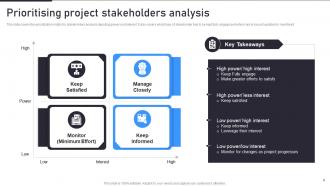
Stakeholder mapping tools include power-interest grids, influence-impact matrices, stakeholder wheels, relationship maps, and RACI charts. These techniques streamline stakeholder identification by visualizing relationships, prioritizing engagement levels, and clarifying communication pathways, with many project managers finding that systematic mapping ultimately delivers more targeted outreach and stronger stakeholder alignment.
Stakeholder interests and influence levels significantly impact project outcomes by determining resource allocation, decision-making speed, and implementation success through their ability to provide funding, approvals, and organizational support. Projects with aligned high-influence stakeholders typically experience smoother execution and faster delivery, while conflicting interests can create delays, budget overruns, and scope changes, ultimately affecting project viability and strategic objectives.
Communication serves as the foundation of effective stakeholder engagement, enabling relationship building, expectation management, trust development, and feedback collection throughout project lifecycles. Through strategic messaging, regular updates, and tailored communication channels, organizations streamline stakeholder alignment, minimize conflicts, and enhance project outcomes, with many finding that proactive communication ultimately delivers stronger partnerships and competitive advantage.
Organizations can prioritize stakeholders by assessing their influence, interest levels, potential impact on business outcomes, and strategic importance to long-term goals. This systematic approach enables more effective resource allocation, with many companies finding that focusing on high-influence stakeholders like key investors, major customers, and regulatory bodies delivers enhanced operational efficiency, stronger partnerships, and ultimately sustainable competitive advantage.
Common challenges during stakeholder analysis include identifying all relevant stakeholders, accurately assessing their influence and interest levels, managing conflicting priorities, and maintaining updated stakeholder information throughout project lifecycles. Organizations often find that stakeholder dynamics shift unexpectedly, requiring continuous monitoring and strategic communication adjustments, while balancing diverse expectations ultimately enables more successful project outcomes and stronger organizational relationships.
Technology enhances stakeholder analysis through automated data collection, AI-powered sentiment analysis, real-time feedback platforms, and comprehensive mapping software. These digital tools streamline identification and prioritization by processing vast datasets, tracking engagement patterns, and delivering predictive insights, with many organizations finding that automated stakeholder monitoring significantly reduces analysis time while improving strategic decision-making accuracy.
Stakeholder engagement success metrics include participation rates, feedback quality scores, response times to communications, satisfaction surveys, and behavioral change indicators. These measurements enable organizations to assess relationship strength, communication effectiveness, and collaboration outcomes across different stakeholder groups, with many companies finding that consistent tracking ultimately delivers improved project outcomes and stronger strategic partnerships.
Stakeholder analysis should be revisited at key project milestones, phase transitions, and whenever significant changes occur, typically every 3-6 months for ongoing projects. Many organizations find that regular reassessment during planning, execution, and closing phases enables project managers to adapt engagement strategies, address evolving stakeholder priorities, and maintain critical support throughout delivery.
Ethical considerations in stakeholder analysis include transparency in data collection, respecting privacy rights, ensuring inclusive representation, avoiding manipulation or coercion, and maintaining confidentiality of sensitive information. These principles enable organizations to build authentic stakeholder relationships while protecting vulnerable groups, ultimately delivering sustainable engagement strategies and competitive advantage through ethical business practices that enhance long-term organizational reputation.
Stakeholder feedback can be effectively gathered through surveys, interviews, focus groups, workshops, and digital feedback platforms, ensuring diverse perspectives are captured systematically. Through structured analysis frameworks, organizations can categorize responses by stakeholder groups, identify common themes, and prioritize actionable insights, ultimately enabling data-driven decision-making that enhances stakeholder satisfaction and project success rates.
Cultural differences significantly affect stakeholder engagement through varying communication styles, decision-making processes, relationship-building preferences, power dynamics, and conflict resolution approaches. These variations require organizations to adapt their strategies accordingly, with many multinational companies finding that culturally-sensitive engagement approaches ultimately deliver stronger partnerships, enhanced trust, and more successful project outcomes across diverse global markets.
Ignoring key stakeholders in project planning leads to scope creep, budget overruns, resource conflicts, resistance to implementation, and potential project failure. Without stakeholder buy-in, organizations face delayed approvals, last-minute requirement changes, and reduced adoption rates, with many finding that excluded stakeholders ultimately become the primary obstacles to successful project delivery.
Stakeholder analysis contributes to risk management by identifying potential sources of project resistance, support gaps, and communication breakdowns early in planning phases. Through systematic stakeholder mapping, project managers can anticipate conflicts, resource constraints, and approval delays, while proactively developing mitigation strategies, ultimately reducing project failure rates and enhancing stakeholder buy-in across complex initiatives.
-
The service is fast, and I could access any presentation after buying the subscription. I don’t think I’ll ever have to worry about a presentation in my life.
-
The way SlideTeam professionals work is exceptional. Thanks for being so helpful!