


Startup Academy Go To Market Strategy Powerpoint Presentation Slides GTM CD




Try Before you Buy Download Free Sample Product
 Impress Your
 Audience
 100%
100% Editable
 Save Hours
 of Time


A startup academy is an educational institution that provides guidance, resources, and training for individuals or teams looking to establish and grow their businesses. Our professionally designed Startup Academy Go to Market Strategy helps in launching and ensures the startup is well equipped to thrive in the dynamic landscape of professional services. The E learning Platform PPT begins with an overview of the global e learning market. Additionally, the Online Course PPT highlights problems and solutions, showing how the startup business will resolve market problems. It also shows an overview of the business, including the introduction, products services offered, value proposition, and target audience. Furthermore, the Training Module conducts competitor analysis of businesses offering similar solutions. It comes with various strategies, including pricing strategy, branding and positioning strategy, marketing strategy, lead generation strategy, sales strategy, distribution strategy, customer onboarding strategy, and customer retention strategy. Lastly, the Skills Development Deck provides elements like performance metrics, cost and investment, financial forecasts, legal consideration, and risk analysis. Get access now.
People who downloaded this PowerPoint presentation also viewed the following :
Content of this Powerpoint Presentation
Slide 1: This slide introduces Startup Academy- Go to Market Strategy. State Your Company Name and begin.
Slide 2: This slide is an Agenda slide. State your agendas here.
Slide 3: This slide shows a Table of Contents for the presentation.
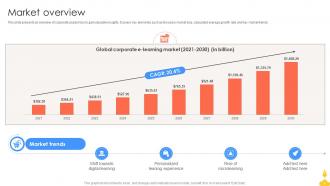
Slide 4: This slide presents an overview of corporate academics to gain valuable insights.
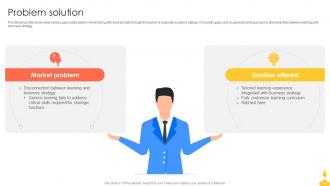
Slide 5: This slide showcases various gaps addressed in market along with desired state through the launch of corporate academy startup.
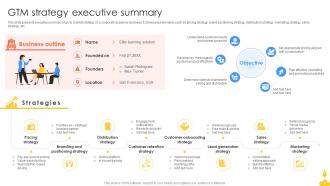
Slide 6: This slide presents executive summary of go to market strategy of a corporate academy business.
Slide 7: This slide outlines a business overview of a corporate academy startup business.
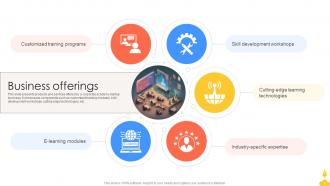
Slide 8: This slide presents products and services offered by a corporate academy startup business.
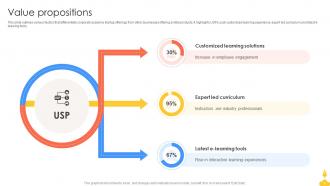
Slide 9: This slide contains various factors that differentiate corporate academy startup offerings from other businesses offering similar products.
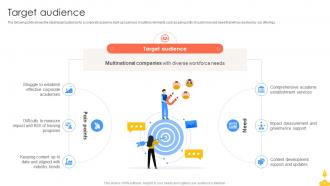
Slide 10: This slide shows the ideal target audience for a corporate academy start-up business.
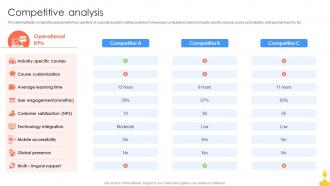
Slide 11: The slide highlights comparative assessment of key operators of corporate academy startup business.
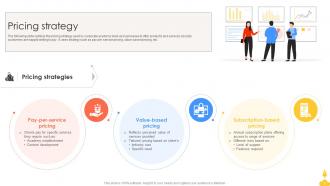
Slide 12: This slide mentions the pricing strategy used by corporate academy start-up businesses to offer products and services.
Slide 13: This slide showcases the branding strategy to position corporate academy startup business among the target audience.
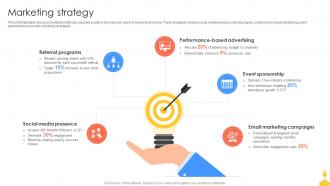
Slide 14: This slide highlights various promotional methods corporate academy business can use to increase its presence.
Slide 15: The slide showcases lead generation strategy for a corporate academy startup business to attract and retain audience.
Slide 16: This slide puts various strategies to maximize sales.
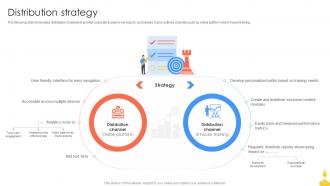
Slide 17: This slide entails distribution channels to provide corporate academy services to businesses.
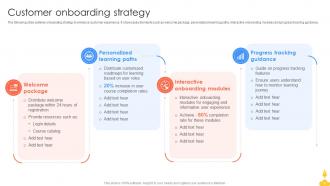
Slide 18: This slide marks onboarding strategy to enhance customer experience.
Slide 19: The slide showcases various strategies to maximize customer retention rate and maximize business profitability.
Slide 20: This slide presents a timeline showing time required for each task for successful market entry of a corporate academy startup business.
Slide 21: This slide outlines various KPIs to track and measure business operational performance.
Slide 22: This slide represents financial analysis showing investment requirements to build and set up a corporate academy business.
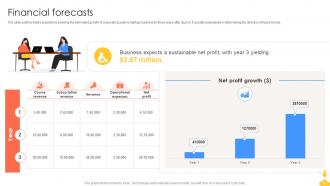
Slide 23: The slide outlines future projections showing the estimated growth of corporate academy startup business for three years after launch.
Slide 24: This slide showcases legal compliance considerations for a corporate academy start-up business.
Slide 25: The slide shows potential risks and challenges in corporate academy start-up business.
Slide 26: This slide shows all the icons included in the presentation.
Slide 27: This slide is titled Additional Slides for moving forward.
Slide 28: This slide contains a Puzzle with related icons and text.
Slide 29: This slide depicts a Venn diagram with text boxes.
Slide 30: This slide is a Timeline slide. Show data related to time intervals here.
Slide 31: This slide is a financial slide. Show your finance-related stuff here.
Slide 32: This slide provides a 30-60-90-day plan with text boxes.
Slide 33: This slide is a thank-you slide with address, contact numbers, and email address.
Startup Academy Go To Market Strategy Powerpoint Presentation Slides GTM CD with all 41 slides:
Use our Startup Academy Go To Market Strategy Powerpoint Presentation Slides GTM CD to effectively help you save your valuable time. They are readymade to fit into any presentation structure.






















FAQs for Startup Academy Go To Market Strategy Powerpoint Presentation
A comprehensive go-to-market strategy should include target market segmentation, competitive positioning, pricing strategy, distribution channels, and messaging framework. These elements work together by identifying ideal customers, differentiating your offering, and creating scalable pathways to market, with many organizations finding that integrated execution across all components ultimately delivers faster market penetration and sustainable competitive advantage.
Market segmentation significantly enhances go-to-market effectiveness by enabling targeted messaging, optimized resource allocation, and tailored product positioning for specific customer groups. Through strategic segmentation, companies streamline their marketing efforts, accelerate customer acquisition, and maximize conversion rates, with many organizations finding that focused approaches deliver higher ROI and stronger competitive advantage than broad-based strategies.
Competitor analysis reveals market positioning opportunities, pricing benchmarks, messaging gaps, distribution channel effectiveness, and customer acquisition strategies that inform strategic differentiation. Through comprehensive competitive intelligence, businesses identify underserved market segments, refine value propositions, and develop targeted approaches that capitalize on competitor weaknesses, ultimately delivering sustainable competitive advantage and accelerated market penetration.
Companies measure go-to-market success through key performance indicators including customer acquisition cost, conversion rates, market penetration metrics, revenue growth, and customer lifetime value. These metrics enable organizations to track campaign effectiveness, sales velocity, and market share growth, with many businesses finding that combining quantitative data with customer feedback delivers comprehensive insights for strategic optimization and competitive advantage.
Pricing strategies within go-to-market plans should consider market research and competitor analysis, target customer segments and their price sensitivity, value proposition alignment, cost structures, and revenue objectives. These factors work together by ensuring competitive positioning, maximizing customer acquisition, and optimizing profitability, with many organizations finding that strategic pricing ultimately drives market penetration and sustainable growth.
Customer personas refine go-to-market strategies by enabling precise audience segmentation, targeted messaging development, optimal channel selection, and strategic resource allocation. Through detailed persona analysis, organizations can streamline product positioning, enhance marketing campaigns, and accelerate sales cycles, with many companies finding that persona-driven approaches deliver significantly higher conversion rates and improved customer acquisition costs.
Effective distribution channels include digital marketplaces, direct-to-consumer e-commerce, strategic partnerships, social commerce platforms, and omnichannel retail networks. These approaches work by maximizing market reach, reducing customer acquisition costs, and enabling personalized experiences, with many companies finding that combining online and offline channels delivers greater market penetration and competitive advantage.
Emerging technologies enhance go-to-market strategies by enabling data-driven customer targeting, automating marketing processes, and personalizing customer experiences at scale. Through AI analytics, CRM automation, and digital engagement platforms, companies streamline product launches, accelerate market penetration, and optimize resource allocation, with many organizations finding significantly faster time-to-market and improved conversion rates.
A value proposition serves as the foundation of your go-to-market plan by clearly articulating how your product solves customer problems, differentiates from competitors, and delivers measurable benefits. It guides messaging consistency across sales, marketing, and customer success teams, while enabling organizations to position offerings strategically, ultimately driving customer acquisition and competitive advantage in increasingly crowded markets.
Cultural differences significantly influence go-to-market strategies through localized messaging, culturally appropriate channels, region-specific pricing models, and tailored product positioning. Companies entering global markets must adapt their approaches by understanding local communication styles, consumer behaviors, and business practices, with many organizations finding that culturally-sensitive strategies deliver higher market penetration and stronger customer relationships.
Essential integrated marketing communications tactics include content marketing, social media engagement, email campaigns, public relations, and strategic partnerships. These approaches work synergistically by building brand awareness, nurturing leads through multiple touchpoints, and creating consistent messaging across channels, with many organizations finding that coordinated campaigns deliver significantly higher conversion rates and faster market penetration.
Customer feedback loops enhance go-to-market strategies by revealing market preferences, identifying product-market fit gaps, and uncovering unmet customer needs through direct insights. These continuous feedback mechanisms enable organizations to refine messaging, adjust pricing strategies, and optimize distribution channels, with many companies finding that systematic customer input significantly reduces launch risks while accelerating market penetration.
Common go-to-market pitfalls include inadequate market research, unclear value propositions, poor target audience definition, insufficient competitive analysis, and unrealistic pricing strategies. These missteps often result in misaligned messaging, wasted resources, and failed product launches, with many organizations finding that thorough planning and iterative testing ultimately deliver stronger market penetration and sustainable growth.
Partnerships and alliances enhance go-to-market strategies by expanding distribution channels, accessing new customer segments, and leveraging complementary expertise to accelerate market entry. Through strategic collaborations, companies streamline resource allocation, reduce market penetration costs, and deliver enhanced value propositions, with many organizations finding that alliance-driven approaches ultimately provide competitive advantages and faster scalability.
Businesses should track customer acquisition cost, lifetime value, conversion rates, sales cycle length, and market penetration metrics to optimize go-to-market performance. These measurements enable organizations to identify bottlenecks, refine targeting strategies, and allocate resources more effectively, with many companies finding that consistent metric analysis delivers improved ROI and accelerated market expansion.
-
SlideTeam’s readymade presentations have landed my unique images with my bosses in the past and it continues to reward me.
-
I’m not a design person, so I couldn’t make a presentation to save my life. Thankfully, they have all kinds of templates that I regularly use for my work.