

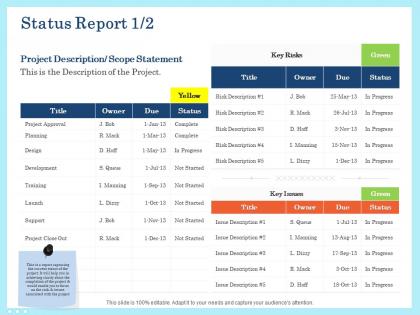
Status report key issues ppt powerpoint presentation pictures design inspiration




Try Before you Buy Download Free Sample Product
 Impress Your
Audience
 100%
Editable
 Save Hours
of Time


Our Status Report Key Issues Ppt Powerpoint Presentation Pictures Design Inspiration are topically designed to provide an attractive backdrop to any subject. Use them to look like a presentation pro.
People who downloaded this PowerPoint presentation also viewed the following :
Status report key issues ppt powerpoint presentation pictures design inspiration with all 2 slides:
Use our Status Report Key Issues Ppt Powerpoint Presentation Pictures Design Inspiration to effectively help you save your valuable time. They are readymade to fit into any presentation structure.


FAQs for Status report key issues ppt powerpoint presentation
Critical components include project milestones and progress percentages, budget allocation and spending analysis, risk assessments with mitigation strategies, resource utilization metrics, and upcoming deliverable timelines. These elements streamline stakeholder communication by providing comprehensive visibility, enabling proactive decision-making, and ensuring accountability across teams, with many organizations finding that structured reporting ultimately delivers improved project outcomes and enhanced operational efficiency.
Visual elements enhance status reports through charts, graphs, color coding, progress bars, and infographics that transform complex data into easily digestible formats. These tools enable stakeholders to quickly identify project bottlenecks, resource allocation issues, and timeline deviations, while dashboard-style presentations streamline decision-making processes, ultimately delivering faster approvals and more strategic responses.
Common pitfalls include providing vague progress updates, omitting critical risks, overwhelming stakeholders with excessive detail, failing to highlight actionable items, and missing deadline updates. These communication gaps can derail project momentum by creating confusion, delaying decision-making, and reducing stakeholder confidence, with many organizations finding that clear, focused reporting ultimately enhances project transparency and accelerates successful outcomes.
Status reports should typically be generated weekly for most projects, though frequency depends on project complexity, stakeholder needs, timeline urgency, and organizational requirements. High-priority initiatives may require daily updates, while stable, long-term projects might warrant bi-weekly or monthly reporting, with many organizations finding that consistent timing enhances communication effectiveness and enables proactive issue resolution.
Better status reporting enhances team collaboration by providing transparent progress visibility, identifying cross-functional dependencies, establishing regular communication rhythms, and creating shared accountability frameworks. Through structured status updates, teams can proactively address blockers, coordinate resource allocation, and align priorities more effectively, ultimately delivering improved project outcomes and stronger working relationships.
Different stakeholders influence status reports by requiring tailored information depth, specific metrics, and relevant focus areas based on their decision-making needs and organizational responsibilities. Executives typically need high-level summaries with strategic implications, while project managers require detailed progress metrics, team members focus on operational updates, and clients emphasize deliverable timelines, ultimately ensuring comprehensive communication that enhances transparency and enables informed decision-making across all organizational levels.
Project status reports should prioritize schedule adherence, budget variance, scope completion percentage, risk assessment levels, and stakeholder satisfaction metrics. These indicators streamline project oversight by identifying potential delays, cost overruns, and quality concerns early, with many project managers finding that focusing on these core metrics ultimately delivers better resource allocation and stakeholder confidence.
Technology automates status report generation through project management platforms, AI-powered analytics, real-time data integration, workflow automation tools, and dashboard creation software. These solutions streamline reporting by automatically collecting project data, tracking milestones, and generating comprehensive updates, with many organizations finding significantly reduced administrative overhead and enhanced accuracy across their operations.
Best practices for presenting status reports include preparing concise summaries, using visual aids like charts and dashboards, focusing on key metrics and exceptions, and structuring updates chronologically or by priority. These approaches enhance meeting efficiency by streamlining communication, minimizing discussion time, and ensuring stakeholders quickly grasp project health, with many organizations finding that visual presentations deliver clearer insights and faster decision-making.
The audience significantly affects status report tone and structure by determining technical depth, communication formality, and focus areas required. Executive audiences need concise, strategic summaries with high-level metrics, while technical teams require detailed implementation specifics, troubleshooting data, and operational insights, with many organizations finding that tailored reporting enhances decision-making efficiency and stakeholder engagement.
Follow-up transforms status reports from static documents into dynamic management tools by ensuring accountability, clarifying ambiguities, and driving resolution of identified issues. Through structured follow-up processes, organizations enhance project transparency, accelerate decision-making, and maintain stakeholder engagement, with many finding that consistent follow-up routines ultimately deliver improved project outcomes and stronger team collaboration.
Status reports facilitate agile methodologies by providing regular sprint progress updates, identifying blockers quickly, and maintaining stakeholder transparency throughout iterative cycles. These reports enable agile teams to adapt rapidly to changing requirements, track velocity metrics, and communicate effectively with product owners, while ultimately delivering faster iterations and improved project outcomes in increasingly dynamic development environments.
Transparency in status reporting significantly enhances team morale by building trust, reducing uncertainty, and fostering open communication, while strengthening accountability through clear visibility of progress and challenges. When teams can access comprehensive project updates and performance metrics, they feel more engaged and empowered, with many organizations finding that transparent reporting cultures ultimately deliver higher productivity and stronger collaborative relationships.
Risks and issues should be communicated through clear categorization by severity, detailed impact descriptions, proposed mitigation strategies, and assigned ownership with timelines. This structured approach enables stakeholders to quickly assess priorities and resource requirements, while providing transparency that builds trust, ultimately delivering proactive problem-solving and enhanced project outcomes across organizations.
Techniques for engaging status reports include visual dashboards, concise executive summaries, color-coded progress indicators, milestone tracking charts, and interactive data presentations. These approaches streamline communication by highlighting critical updates, contextualizing achievements against goals, and presenting complex project information accessibly, with many organizations finding that visual storytelling ultimately enhances stakeholder engagement and accelerates decision-making processes.
-
Helpful product design for delivering presentation.
-
Excellent Designs.
-
Helpful product design for delivering presentation.
-
Great quality slides in rapid time.
-
Designs have enough space to add content.