

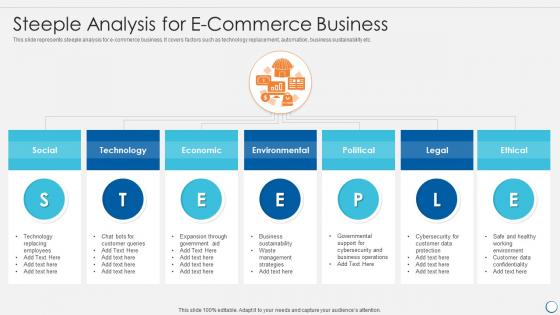
Steeple analysis for e commerce business




Try Before you Buy Download Free Sample Product
 Impress Your
 Audience
 100%
100% Editable
 Save Hours
 of Time


This slide represents steeple analysis for e-commerce business. It covers factors such as technology replacement, automation, business sustainability etc.
People who downloaded this PowerPoint presentation also viewed the following :
Steeple analysis for e commerce business with all 6 slides:
Use our Steeple Analysis For E Commerce Business to effectively help you save your valuable time. They are readymade to fit into any presentation structure.





FAQs for Steeple analysis for
Key social factors influencing e-commerce consumer behavior include changing demographics, social media influence, lifestyle shifts toward convenience, cultural attitudes toward online shopping, and peer reviews and recommendations. These social dynamics shape purchasing decisions by driving demand for personalized experiences, mobile-first interactions, and socially conscious brands, with many retailers finding that understanding generational preferences and social trends ultimately delivers higher conversion rates and customer loyalty.
Technology adoption fundamentally reshapes e-commerce competitive dynamics by enabling advanced personalization, automating customer service, and streamlining supply chain operations. Companies leveraging AI-driven recommendations, chatbots, and predictive analytics can deliver superior customer experiences while reducing operational costs, with many retailers finding that early technology adopters gain significant market share advantages over slower-moving competitors.
E-commerce companies should monitor carbon footprint from logistics and data centers, packaging waste reduction, renewable energy adoption, supply chain environmental impact, and regulatory compliance requirements. These factors enable sustainable operations by streamlining delivery routes, implementing eco-friendly packaging, and adopting green technologies, with many retailers finding that environmental consciousness ultimately delivers cost savings and enhanced customer loyalty.
E-commerce platforms can navigate regulatory challenges by implementing comprehensive compliance frameworks, establishing local legal partnerships, utilizing automated tax calculation systems, and maintaining flexible platform architectures. Through strategic regional adaptation, companies like Amazon and Shopify successfully manage varying data protection laws, tax requirements, and consumer regulations across markets, ultimately delivering seamless global operations while minimizing compliance risks.
Economic indicators significantly affecting e-commerce include consumer spending power, inflation rates, unemployment levels, interest rates, and GDP growth patterns. These metrics influence online shopping through disposable income fluctuations, credit accessibility, and consumer confidence, with retail and fashion e-commerce sectors finding that economic stability drives higher conversion rates and increased average order values.
Political environments significantly shape e-commerce regulations through data protection laws, taxation policies, cross-border trade agreements, consumer protection standards, and digital governance frameworks. These regulatory structures directly impact how online retailers operate internationally, with companies like Amazon and Alibaba adapting their compliance strategies across different jurisdictions, ultimately determining market access, operational costs, and competitive positioning in the global digital marketplace.
Demographic changes influence e-commerce market segmentation by shifting age distributions, income levels, family structures, and lifestyle preferences, requiring businesses to realign their targeting strategies accordingly. Through advanced analytics and consumer behavior tracking, e-commerce companies adapt product offerings, pricing models, and marketing channels to serve emerging segments like aging millennials or Gen Z shoppers, ultimately delivering more personalized experiences and competitive advantage.
Cultural awareness enables global e-commerce brands to tailor messaging, product positioning, visual design, and customer engagement approaches to resonate with local values, preferences, and communication styles. Through localized content strategies, region-specific promotional campaigns, and culturally sensitive user experiences, brands like Amazon and Nike enhance customer connection, reduce market entry barriers, and build authentic relationships, ultimately delivering higher conversion rates and sustainable competitive advantage across diverse international markets.
E-commerce companies can leverage ethical considerations by implementing sustainable packaging, ensuring fair labor practices, maintaining transparent supply chains, and supporting social causes that resonate with their target audience. These strategies enhance brand reputation and customer trust, with many consumers increasingly choosing brands that align with their values, ultimately delivering stronger customer retention and competitive advantage in today's socially conscious marketplace.
AI-powered personalization, blockchain for secure transactions, augmented reality shopping experiences, voice commerce, and automated customer service are revolutionizing e-commerce operations. These technologies streamline inventory management, enhance customer engagement, and reduce operational costs, with many retailers finding that strategic implementation delivers faster checkout processes, improved fraud detection, and ultimately sustainable competitive advantage in increasingly digital markets.
Competitor analysis enhances e-commerce strategic positioning by identifying market gaps, pricing opportunities, customer pain points, and differentiation strategies that enable businesses to carve unique competitive advantages. Through systematic evaluation of rival offerings, marketing approaches, and customer feedback, e-commerce companies streamline their value propositions, optimize pricing models, and develop targeted campaigns, ultimately delivering superior customer experiences while capturing underserved market segments.
Customer data privacy regulations significantly impact e-commerce operations through enhanced compliance requirements, modified data collection practices, stricter consent mechanisms, updated privacy policies, and revised customer communication strategies. These regulatory frameworks ultimately deliver improved customer trust and competitive differentiation, with many e-commerce businesses finding that transparent data practices enhance brand loyalty while streamlined compliance processes reduce operational risks.
Social media trends significantly impact e-commerce by driving product discovery, influencing purchasing decisions, and creating viral marketing opportunities through user-generated content and influencer partnerships. These platforms enable retailers to engage customers through interactive features, targeted advertising, and real-time feedback, with many brands finding that social commerce integration delivers higher conversion rates and enhanced customer loyalty.
E-commerce platforms can enhance user experience through intuitive navigation, mobile-responsive design, fast loading speeds, personalized recommendations, streamlined checkout processes, and comprehensive search functionality. These design elements work together to reduce cart abandonment, increase conversion rates, and build customer loyalty, with many retail giants like Amazon and Shopify demonstrating how strategic UX improvements ultimately deliver higher sales and competitive advantage.
Supply chain management practices can be optimized through automated inventory tracking, predictive demand forecasting, strategic supplier partnerships, real-time logistics coordination, and integrated technology platforms. These approaches streamline operations by reducing stockouts, minimizing delivery times, and enhancing customer satisfaction, with many e-commerce companies finding that strategic automation ultimately delivers competitive advantage and operational efficiency.
-
Very unique, user-friendly presentation interface.
-
Use of different colors is good. It's simple and attractive.