

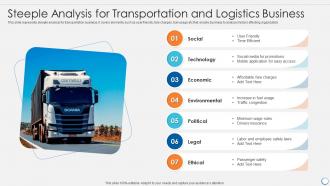
Steeple analysis for transportation and logistics business





Try Before you Buy Download Free Sample Product
 Impress Your
 Audience
 100%
100% Editable
 Save Hours
 of Time


This slide represents steeple analysis for transportation business. It covers elements such as user friendly, fare charges, fuel usage etc that enable business to analysis factors affecting organization.
People who downloaded this PowerPoint presentation also viewed the following :
Steeple analysis for transportation and logistics business with all 6 slides:
Use our Steeple Analysis For Transportation And Logistics Business to effectively help you save your valuable time. They are readymade to fit into any presentation structure.





FAQs for Steeple analysis for transportation
STEEPLE analysis components include Social, Technological, Economic, Environmental, Political, Legal, and Ethical factors that organizations systematically evaluate to understand their operating environment. These interconnected elements work together by revealing how demographic shifts influence technology adoption, economic conditions affect regulatory responses, and environmental concerns drive legal frameworks, ultimately enabling businesses to identify strategic opportunities and anticipate market changes more effectively.
Organizations effectively gather data for STEEPLE analysis through market research reports, government publications, industry associations, expert interviews, and social media monitoring. These comprehensive sources enable businesses to identify emerging trends across social, technological, economic, environmental, political, legal, and ethical factors, with many companies finding that combining internal expertise with external research partnerships delivers more accurate strategic insights and competitive advantage.
STEEPLE analysis supports strategic planning by identifying external factors across social, technological, economic, environmental, political, legal, and ethical dimensions that impact business operations. This comprehensive framework enables organizations to anticipate market shifts, assess competitive positioning, and develop robust strategies, with many companies finding that systematic environmental scanning ultimately delivers better risk management and strategic advantage.
Socio-cultural factors in STEEPLE analysis examine demographic trends, lifestyle changes, cultural values, education levels, and consumer behavior patterns that influence business operations. These factors help organizations understand shifting market demands, adapt product offerings, and develop targeted strategies, with companies like Netflix and McDonald's successfully leveraging cultural insights to expand globally while maintaining local relevance.
Economic factors in STEEPLE analysis impact long-term sustainability by influencing operational costs, consumer purchasing power, investment availability, and market demand patterns. Through careful economic assessment, businesses can anticipate recession impacts, inflation pressures, and currency fluctuations, enabling strategic resource allocation and adaptive pricing strategies that maintain competitive advantage during economic uncertainty.
Companies should consider regulatory compliance requirements, intellectual property laws, employment legislation, data protection regulations, and industry-specific legal frameworks when conducting STEEPLE analysis. These legal factors significantly impact strategic planning, with organizations in healthcare, financial services, and manufacturing finding that proactive legal assessment streamlines decision-making, minimizes compliance risks, and ultimately delivers competitive advantage through informed strategic positioning.
Technological advancements can be incorporated into STEEPLE analysis by evaluating emerging technologies, automation trends, digital transformation impacts, innovation cycles, and technological disruption patterns within the technology factor. Organizations systematically assess how technologies like artificial intelligence, IoT, and blockchain will reshape their industry landscape, ultimately enabling more accurate future forecasting and strategic planning decisions.
Common pitfalls include relying on outdated data, focusing too narrowly on obvious factors, failing to consider factor interconnections, and conducting analysis in isolation without stakeholder input. Organizations often overlook emerging trends or assign equal weight to all factors, when strategic priorities should guide emphasis, ultimately delivering less actionable insights for decision-making processes.
STEEPLE analysis proves especially beneficial in industries like healthcare, technology, financial services, energy, and telecommunications, where external factors significantly impact strategic planning. These sectors face rapid regulatory changes, technological disruptions, and shifting social expectations, with many organizations finding that comprehensive environmental scanning through STEEPLE enables proactive adaptation, risk mitigation, and competitive positioning in increasingly complex markets.
Startups can adapt STEEPLE analysis by focusing on emerging trends, regulatory changes, and market entry opportunities, while established businesses examine stability, compliance, and competitive positioning. Startups typically prioritize social shifts and technological disruptions for growth opportunities, whereas established companies assess environmental regulations and political stability for risk management, with many startups finding this framework helps identify agile market positioning strategies.
Resources for comprehensive STEEPLE analysis include industry reports, government databases, economic forecasts, regulatory updates, environmental impact studies, and legal compliance guides. These tools enable organizations to systematically evaluate Social, Technological, Economic, Environmental, Political, Legal, and Ethical factors, with many strategic planning teams finding that combining multiple data sources delivers more accurate market insights and competitive positioning advantages.
Environmental sustainability appears prominently in STEEPLE analysis through the ecological/environmental factor, examining climate regulations, resource scarcity, carbon footprint requirements, and green technology adoption. This analysis enables organizations to identify sustainability risks and opportunities, develop eco-friendly products and services, ensure regulatory compliance, and build competitive advantage through environmental responsibility, ultimately delivering cost savings and enhanced brand reputation.
STEEPLE analysis informs risk management by systematically identifying external threats across social, technological, economic, environmental, political, legal, and ethical dimensions that could impact operations. This comprehensive framework enables organizations to develop proactive mitigation strategies, prioritize resource allocation, and create contingency plans, with many financial institutions and manufacturing companies finding that regular STEEPLE assessments significantly enhance their risk preparedness and strategic resilience.
Stakeholders influence STEEPLE analysis findings through providing sector-specific insights, regulatory expertise, market intelligence, environmental compliance knowledge, and legal risk assessments. Their diverse perspectives, especially from government relations, industry associations, and regulatory bodies, help organizations identify emerging trends, anticipate policy changes, and uncover blind spots, ultimately delivering more comprehensive strategic planning and competitive advantage.
Effective STEEPLE analysis presentation strategies include visual dashboards with clear metrics, prioritized risk matrices, scenario planning workshops, and executive summary reports tailored to each stakeholder group. These approaches streamline complex data by connecting social, technological, and economic factors to specific business impacts, while enabling organizations to facilitate strategic discussions, enhance decision-making processes, and ultimately deliver actionable insights that drive competitive advantage.
-
Topic best represented with attractive design.
-
Unique and attractive product design.