


Steps To Design Work Intake Procedure Form




Try Before you Buy Download Free Sample Product
 Impress Your
Audience
 100%
Editable
 Save Hours
of Time


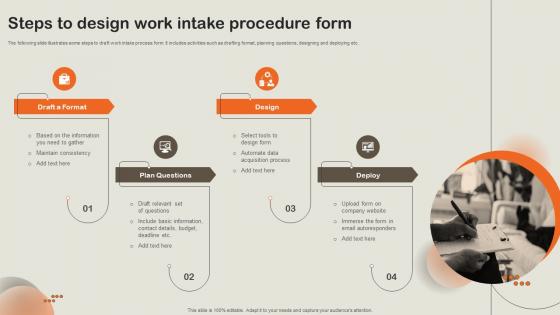
The following slide illustrates some steps to draft work intake process form. It includes activities such as drafting format, planning questions, designing and deploying etc.
People who downloaded this PowerPoint presentation also viewed the following :
Steps To Design Work Intake Procedure Form with all 6 slides:
Use our Steps To Design Work Intake Procedure Form to effectively help you save your valuable time. They are readymade to fit into any presentation structure.






FAQs for Steps To Design Work
Key elements include project details and scope, requester information and contact details, timeline requirements and deadlines, resource needs and budget parameters, and priority level classifications. These components streamline workflow management by ensuring complete information capture, facilitating proper resource allocation, and enabling efficient project prioritization, with many organizations finding that comprehensive intake forms reduce project delays and improve stakeholder communication.
Digital tools enhance work intake procedures by automating data collection, streamlining approval workflows, and providing real-time tracking capabilities across departments. Through cloud-based platforms and automated routing systems, organizations can reduce processing times by up to 60%, minimize manual errors, and enable instant status updates, ultimately delivering faster project initiation and improved resource allocation efficiency.
Common mistakes include overly complex layouts, unclear instructions, redundant fields, missing required information sections, and poor visual hierarchy. These design flaws create confusion, slow processing times, and reduce completion rates, with many organizations finding that streamlined forms with logical flow, clear labeling, and mobile-friendly formats significantly enhance user experience and operational efficiency.
Determining appropriate detail levels involves balancing comprehensive data collection with user experience, considering the complexity of requests, stakeholder requirements, and processing timelines. Organizations streamline intake by using conditional fields, tiered information gathering, and priority-based questions, with many finding that strategic form design ultimately enhances workflow efficiency while reducing abandonment rates.
User experience plays a critical role in work intake procedure form design by ensuring intuitive navigation, clear field labeling, logical flow sequences, and mobile responsiveness that minimizes completion time. Through streamlined UX design, organizations enhance data accuracy, reduce form abandonment rates, and accelerate project initiation processes, with many finding that well-designed intake forms ultimately deliver faster turnaround times and improved stakeholder satisfaction.
**INPUT**: How can you ensure that your work intake procedure form is compliant with relevant regulations? **OUTPUT**: Ensuring compliance requires incorporating mandatory data fields, privacy controls, audit trails, and regulatory-specific requirements into your form design. Organizations across healthcare, financial services, and manufacturing find that automated compliance checks, regular legal reviews, and built-in documentation features streamline regulatory adherence while minimizing risk exposure and operational delays. **Word count: 50 words**
**INPUT**: What strategies can be used to make the work intake process more user-friendly? **OUTPUT**: User-friendly work intake strategies include simplified form layouts, clear step-by-step guidance, conditional logic that shows relevant fields, mobile optimization, and automated progress saving. These approaches streamline submissions by reducing cognitive load, minimizing data entry errors, and enabling seamless completion across devices, with organizations finding that intuitive intake processes significantly enhance user adoption and operational efficiency. [Word count: 55 words]
Stakeholder feedback can be incorporated through structured consultation sessions, usability testing, iterative design reviews, and pilot implementations with key user groups. Organizations like healthcare systems and consulting firms find that engaging department heads, end users, and process owners throughout the design phase streamlines form adoption, reduces revision cycles, and ultimately delivers more intuitive workflows.
Best practices for ensuring consistency across multiple work intake forms include standardized field labels, uniform data validation rules, consistent formatting templates, aligned approval workflows, and centralized form libraries. These approaches streamline operations by reducing training time, minimizing data entry errors, and enabling seamless integration across departments, with many organizations finding that standardized intake processes ultimately deliver faster project initiation and improved resource allocation.
Effective training on work intake procedure forms involves comprehensive documentation, hands-on practice sessions, role-specific workflows, and regular feedback loops. Organizations streamline adoption by providing step-by-step tutorials, conducting mock scenarios with real client requests, and establishing peer mentoring systems, ultimately ensuring consistent data capture, reduced processing errors, and faster project initiation across teams.
Key metrics for assessing work intake procedure effectiveness include request processing time, approval rates, stakeholder satisfaction scores, resource allocation accuracy, and bottleneck identification rates. These measurements help organizations streamline workflows by reducing delays, improving decision-making speed, and enhancing project prioritization, with many companies finding that systematic intake tracking ultimately delivers better resource utilization and faster project delivery.
Intake forms facilitate prioritization and resource allocation by capturing project scope, urgency levels, required resources, strategic alignment, and expected outcomes in standardized formats. Through structured data collection, organizations can systematically evaluate competing projects, assign appropriate team members, allocate budgets effectively, and establish realistic timelines, ultimately enabling strategic resource distribution and ensuring high-impact initiatives receive priority attention.
**INPUT**: What design principles should guide the visual layout of the work intake procedure form? **OUTPUT**: Visual layout principles include logical information hierarchy, clear sectioning with white space, intuitive field grouping, consistent typography, and mobile-responsive design. These design elements streamline data collection by reducing cognitive load, minimizing completion time, and improving accuracy rates, with many organizations finding that well-designed intake forms increase submission completion by 40-60% while enhancing user experience. **Word count: 59 words**
Automation integration transforms work intake through smart routing, auto-assignment based on criteria, real-time notifications, and workflow triggers that eliminate manual handoffs. These capabilities streamline operations by automatically categorizing requests, escalating urgent items, and updating project management systems, with many organizations finding that automated intake reduces processing time by 60% while improving accuracy and accountability.
Poorly designed work intake procedures create project scope creep, resource misallocation, timeline delays, and stakeholder confusion, ultimately leading to budget overruns and quality compromises. These inefficiencies cascade through organizations by creating communication gaps, duplicated efforts, and unclear priorities, with many project managers finding that inadequate intake processes significantly undermine deliverable quality and client satisfaction.
-
Every time I ask for something out-of-the-box from them and they never fail in delivering that. No words for their excellence!
-
Great product with highly impressive and engaging designs.