


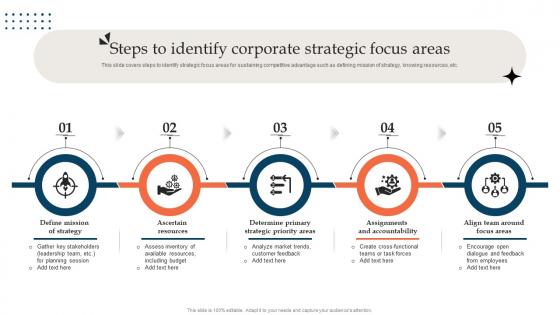
Steps To Identify Corporate Strategic Focus Areas




Try Before you Buy Download Free Sample Product
 Impress Your
Audience
 100%
Editable
 Save Hours
of Time


This slide covers steps to identify strategic focus areas for sustaining competitive advantage such as defining mission of strategy, knowing resources, etc.
People who downloaded this PowerPoint presentation also viewed the following :
Steps To Identify Corporate Strategic Focus Areas with all 9 slides:
Use our Steps To Identify Corporate Strategic Focus Areas to effectively help you save your valuable time. They are readymade to fit into any presentation structure.









FAQs for Steps To Identify Corporate
Key components of a successful corporate strategic focus area include clear market positioning, resource allocation priorities, competitive differentiation strategies, measurable performance metrics, and stakeholder alignment mechanisms. These elements work together by ensuring operational efficiency, enabling strategic decision-making, and maintaining organizational coherence, with many corporations finding that focused execution ultimately delivers sustained competitive advantage and scalable growth outcomes.
Organizations effectively align strategic focus areas with their mission and vision by conducting comprehensive stakeholder assessments, establishing clear performance metrics, and creating cross-functional implementation teams. Through regular strategic reviews and adaptive planning processes, companies in sectors like healthcare, technology, and manufacturing streamline resource allocation, enhance operational efficiency, and maintain competitive positioning, ultimately delivering measurable outcomes that reinforce their core organizational purpose.
Market trends influence strategic focus areas by revealing emerging customer needs, technological opportunities, regulatory changes, competitive shifts, and economic conditions that organizations must address. Companies increasingly analyze consumer behavior patterns, digital transformation requirements, and sustainability demands to align their strategic priorities, with many finding that trend-responsive strategies deliver enhanced market positioning and competitive advantage.
Corporate strategic focus areas vary significantly by industry based on regulatory environments, customer expectations, and competitive dynamics. While technology companies prioritize innovation and scalability, healthcare organizations emphasize compliance and patient outcomes, financial services focus on risk management and digital transformation, and manufacturing concentrates on operational efficiency and supply chain optimization, ultimately enabling each sector to deliver competitive advantages tailored to their specific market demands.
Stakeholder analysis helps organizations identify strategic focus areas by mapping key influencer expectations, resource dependencies, and competitive pressures across different business segments. Through systematic stakeholder mapping, companies can prioritize initiatives that align with investor priorities, customer needs, and regulatory requirements, while balancing conflicting interests, ultimately delivering sustainable growth strategies that enhance stakeholder value and operational effectiveness.
Companies can ensure strategic focus areas remain adaptable by implementing flexible frameworks, conducting regular market assessments, establishing cross-functional teams, and maintaining robust feedback loops with stakeholders. Through agile planning methodologies and scenario-based forecasting, organizations across sectors like technology, healthcare, and financial services can pivot quickly when market conditions shift, ultimately delivering sustained competitive advantage and operational resilience in an increasingly dynamic business environment.
Key performance indicators for strategic focus areas include financial metrics like revenue growth and ROI, operational measures such as efficiency ratios and customer satisfaction scores, and strategic indicators like market share expansion. These comprehensive metrics enable organizations to track progress across multiple dimensions, with many corporations finding that balanced scorecards combining quantitative and qualitative measures deliver the clearest insights into strategic initiative effectiveness and competitive advantage.
Leadership fosters strategic focus culture by clearly communicating priorities, aligning performance metrics with strategic goals, providing necessary resources, and consistently reinforcing strategic messaging. Through regular town halls, targeted training programs, and strategic dashboards, organizations enhance employee engagement, streamline decision-making, and accelerate goal achievement, with many companies finding that sustained leadership commitment ultimately delivers improved operational efficiency and competitive advantage.
Cross-departmental collaboration ensures strategic focus areas receive comprehensive expertise, resources, and unified execution across organizational silos. By breaking down departmental barriers, companies streamline decision-making, accelerate implementation timelines, and leverage diverse perspectives, with many organizations finding that integrated teams deliver more innovative solutions and sustainable competitive advantages than isolated departmental efforts.
Strategic focus areas significantly shape corporate social responsibility initiatives by aligning CSR efforts with core business objectives, ensuring resource allocation matches organizational priorities, and integrating sustainability into operational frameworks. This strategic alignment enables companies to deliver measurable social impact while strengthening brand reputation and stakeholder trust, with many organizations finding that focused CSR initiatives enhance competitive advantage and long-term value creation.
Strategic focus area frameworks include SWOT analysis, Porter's Five Forces, balanced scorecards, OKRs (Objectives and Key Results), and scenario planning methodologies. These tools enable organizations to assess market positioning, competitive landscapes, and internal capabilities systematically, with many companies finding that combining multiple frameworks delivers clearer strategic direction and enhanced resource allocation across priority initiatives.
Technology and innovation reshape corporate strategic focus areas by enabling data-driven decision making, automating core processes, and creating new market opportunities across industries. Through AI, cloud computing, and digital transformation initiatives, companies streamline operations, enhance customer experiences, and accelerate growth, with many organizations finding that strategic technology investments deliver competitive advantages and operational efficiency.
Common pitfalls include setting too many priorities simultaneously, lacking clear measurable outcomes, insufficient stakeholder alignment, and choosing overly broad or vague focus areas. Organizations often struggle with resource allocation conflicts and changing directions too frequently, while many companies find that successful strategic focus requires disciplined prioritization, consistent execution, and regular performance assessment to maintain competitive advantage.
Customer and employee feedback informs strategic focus areas by revealing operational gaps, market opportunities, and competitive advantages through surveys, performance data, and engagement metrics. This strategic combination enables organizations to prioritize resource allocation more effectively, with many companies finding that feedback-driven strategies deliver enhanced customer experiences, improved operational efficiency, and stronger market positioning in increasingly competitive landscapes.
Strategic focus areas drive competitive advantage by enabling resource concentration, accelerating innovation cycles, enhancing operational efficiency, and building distinctive market positioning. Through targeted investments in core competencies, organizations streamline decision-making processes, reduce costs, and deliver superior customer experiences, with many companies finding that focused strategies ultimately create sustainable differentiation and measurable market leadership.
-
Illustrative design with editable content. Exceptional value for money. Highly pleased with the product.
-
Great product with effective design. Helped a lot in our corporate presentations. Easy to edit and stunning visuals.