

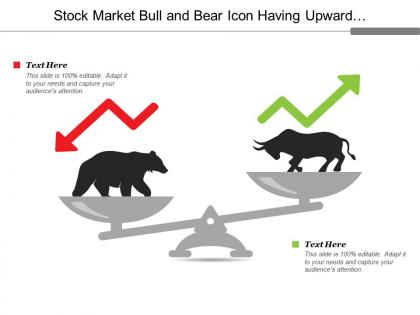
Stock market bull and bear icon having upward and downward arrow




Try Before you Buy Download Free Sample Product
 Impress Your
 Audience
 100%
100% Editable
 Save Hours
 of Time


Our Stock Market Bull And Bear Icon Having Upward And Downward Arrow act as an effective circular. Get everybody immediately aware of the facts.
People who downloaded this PowerPoint presentation also viewed the following :
Stock market bull and bear icon having upward and downward arrow with all 5 slides:
Crystallize your thoughts on our Stock Market Bull And Bear Icon Having Upward And Downward Arrow. They will evolve into a definite plan.



FAQs for Stock market bull and bear icon having upward
Key indicators include moving averages, trading volume, price momentum, support and resistance levels, and market sentiment metrics like the VIX. These technical and fundamental indicators streamline investment decision-making by revealing market direction, identifying entry and exit points, and assessing risk levels, with many financial institutions finding that combining multiple indicators delivers more accurate trend predictions and enhanced portfolio performance.
Macroeconomic factors influence stock market trends through interest rates, inflation levels, GDP growth, employment data, and monetary policy changes. These indicators shape investor sentiment by affecting corporate earnings potential, borrowing costs, and consumer spending power, with financial services, manufacturing, and retail sectors particularly sensitive to economic shifts, ultimately driving market volatility and long-term performance patterns.
Investor sentiment and psychology significantly influence stock price movements through emotional decision-making, herd behavior, fear-driven selling, and optimism-fueled buying that often override fundamental analysis. These psychological factors create market volatility and pricing inefficiencies, with many financial institutions increasingly leveraging sentiment analysis tools and behavioral data to anticipate market shifts, ultimately delivering more strategic investment approaches and competitive trading advantages.
Technical analysis identifies emerging stock market trends through chart patterns, moving averages, volume indicators, momentum oscillators, and trend lines. These analytical tools enable traders and investors to spot early market movements by examining price action, trading volume, and market sentiment, with many financial institutions finding that systematic technical analysis delivers enhanced timing for entries and exits, ultimately providing competitive advantage in volatile markets.
Geopolitical events significantly impact stock market performance through increased volatility, sector-specific disruptions, currency fluctuations, and shifts in investor sentiment and risk appetite. Events like trade wars, military conflicts, or diplomatic tensions can trigger immediate market reactions, with defense and energy sectors often benefiting while tourism and international trade stocks decline, ultimately creating both challenges and strategic opportunities for informed investors.
Interest rates significantly influence stock market trends by affecting borrowing costs, corporate earnings, and investment attractiveness compared to bonds. When rates rise, companies face higher financing costs while investors often shift toward fixed-income securities, creating downward pressure on stock prices, though sectors like banking may benefit from improved lending margins, ultimately reshaping portfolio allocation strategies.
Sector rotation creates shifting market dynamics as investors move capital between industries based on economic cycles, interest rates, and growth expectations. This strategic reallocation influences broader market volatility and performance patterns, with financial services, technology, and healthcare sectors often leading rotational movements, ultimately delivering diversified opportunities while requiring adaptive investment strategies.
Companies utilize stock trends to make strategic decisions by analyzing market volatility, sector performance, competitor valuations, and investor sentiment patterns. Through real-time market data, businesses can time acquisitions, optimize capital raising activities, and adjust operational strategies, with many corporations finding that aligning expansion plans with favorable market cycles ultimately delivers enhanced shareholder value and competitive positioning.
Stock market trends and corporate earnings reports share a direct, symbiotic relationship where quarterly earnings significantly influence stock prices, trading volumes, and sector performance. These reports drive market volatility by revealing revenue growth, profit margins, and future guidance, with investors in technology, healthcare, and financial services sectors closely analyzing results to make strategic portfolio decisions, ultimately determining whether broader market trends continue or reverse direction.
Dividend announcements significantly influence stock market trends by attracting income-focused investors, signaling financial stability, and creating price momentum through increased demand. These announcements often trigger sector-wide movements, with financial services and utility companies experiencing enhanced investor confidence, ultimately delivering improved market liquidity and strategic positioning advantages for dividend-paying corporations.
Common mistakes include overreacting to short-term volatility, ignoring fundamental analysis, following crowd psychology, misinterpreting technical indicators, and failing to diversify across sectors. These errors often stem from emotional decision-making rather than strategic analysis, with many investors finding that systematic approaches, comprehensive research, and long-term perspectives ultimately deliver more consistent returns and reduced portfolio risk.
Stock market trends vary significantly across geographical regions due to local economic conditions, regulatory environments, currency fluctuations, political stability, and sector compositions. While developed markets like North America and Europe often show correlation during global events, emerging markets in Asia and Latin America frequently exhibit independent patterns, with regional factors such as commodity cycles, trade relationships, and domestic policies ultimately driving distinct performance trajectories and investment opportunities.
AI and machine learning algorithms, real-time data analytics, natural language processing, blockchain technology, and cloud computing platforms are revolutionizing stock market analysis. These technologies streamline market predictions by processing vast datasets, analyzing sentiment from news sources, and identifying patterns, with many financial institutions finding that automated trading systems and predictive models deliver faster decision-making and enhanced portfolio performance.
Investors can leverage social media to gauge market trends by monitoring sentiment analysis across platforms, tracking trending hashtags and discussions, analyzing influencer opinions, and observing retail investor behavior patterns. These insights help identify emerging opportunities, assess public perception of specific stocks, and anticipate market movements, with many institutional investors finding that social media data enhances traditional analysis methods for more comprehensive market understanding.
ESG considerations are driving significant stock market trends including increased capital allocation toward sustainable companies, enhanced ESG disclosure requirements, green bond market expansion, and preference for firms with strong governance practices. These trends reflect growing investor demand for responsible investments, with financial institutions, energy companies, and technology firms increasingly integrating ESG metrics into valuations, ultimately delivering competitive advantages through improved risk management and stakeholder trust.
-
Design layout is very impressive.
-
Commendable slides with attractive designs. Extremely pleased with the fact that they are easy to modify. Great work!