

Strategic Action Plan Enhancing Customer Satisfaction For Business Growth Ppt Slide





Try Before you Buy Download Free Sample Product
 Impress Your
Audience
 100%
Editable
 Save Hours
of Time


This PPT introduces Strategic Action Plan Enhancing Customer Satisfaction for Business Growth. Achieving long-term success in todays ever-changing business environment requires placing a high priority on client pleasure. This carefully thought-out action plan is your road map to exceedingly high customer satisfaction levels and long-term, profitable business growth. We provide you with the tools and tactics required to improve your customer experience, from evaluating customer feedback to implementing strategic initiatives. Our action plan is intended to help your company create a customer-centric culture. It guarantees that every choice made and action taken is in line with the objective of exceeding client expectations. We place a strong emphasis on using data to inform decisions by utilizing market research, consumer input, and industry best practices. You will be able to provide outstanding experiences at every touchpoint by using our guide to obtain insights into customer journey mapping, service excellence frameworks, and employee training programs. Get access now.
People who downloaded this PowerPoint presentation also viewed the following :
Content of this Powerpoint Presentation
Slide 1: This slide introduces Strategic Action Plan Enhancing Customer Satisfaction for Business Growth. State your company name and begin.
Slide 2: This is an Agenda slide. State your agendas here.
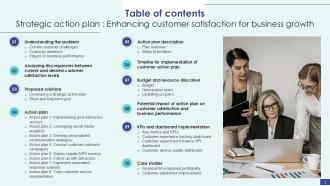
Slide 3: This slide shows Table of Content for the presentation.
Slide 4: This slide highlights the topics to be covered next.
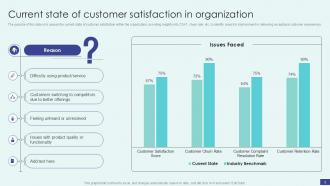
Slide 5: The purpose of this slide is to assess the current state of customer satisfaction within the organization, providing insights into CSAT, churn rate, etc.
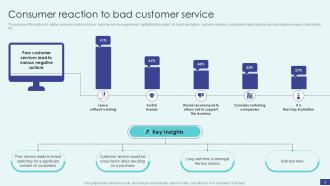
Slide 6: This slide outlines consumer reactions to poor customer service experiences.
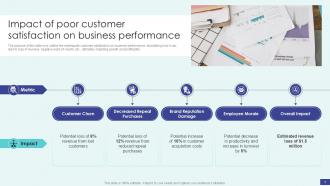
Slide 7: This slide showcases the inadequate customer satisfaction on business performance, elucidating how it can lead to loss of revenue, negative word-of-mouth, etc.
Slide 8: This is another slide highlighting the topics to be covered next.
Slide 9: The purpose of this slide is to pinpoint disparities between existing and desired levels of customer satisfaction.
Slide 10: This slide highlights the topics to be covered next.
Slide 11: This slide outlines a structured approach for enhancing customer service, including specific actions, timelines, and responsibilities.
Slide 12: This slide presents the short and long-term goals of the action plan, outlining objectives for rapid improvements in customer satisfaction.
Slide 13: This is another slide highlighting the topics to be covered next.
Slide 14: The purpose of this slide is to outline action plan i.e. implementing post-interaction surveys to gather immediate feedback from customers.
Slide 15: This slide provides action plan i.e. leveraging social media analytics to gain insights into customer sentiments and preferences.
Slide 16: This slide outlines action plan, i.e., developing personalized communication strategies to enhance customer engagement and improve overall satisfaction levels.
Slide 17: This slide introduces action plan, which involves conducting customer outreach campaigns to proactively reach out to customers, gather feedback, and address their needs and concerns.
Slide 18: This slide covers action plan, which focuses on deploying regular Net Promoter Score (NPS) surveys.
Slide 19: This slide provides action plan which involves following up with detractors identified through NPS surveys to turn negative experiences into positive ones.
Slide 20: This slide depicts action plan, which involves the implementation of automated response systems to address customer inquiries and issues efficiently.
Slide 21: The purpose of this slide is to outline action plan, which emphasizes the importance of training customer service representatives to deliver positive customer experiences.
Slide 22: This slide highlights the topics to be covered next.
Slide 23: This slide offers a comprehensive overview of the customer service action plan, outlining key strategies and initiatives.
Slide 24: This slide outline steps to streamline the customer service improvement plan, such as identifying touchpoints, evaluating underperforming touchpoints, etc.
Slide 25: This is another slide highlighting the topics to be covered next.
Slide 26: The purpose of this slide is to present a timeline for the implementation of the customer action plan.
Slide 27: This slide highlights the topics to be covered next.
Slide 28: This slide provides the budget allocation for the customer service improvement plan, detailing the financial resources allocated to each action item.
Slide 29: This slide introduces the customer service enhancement and optimization team who possesses expertise in driving improvements in customer satisfaction and operational efficiency.
Slide 30: The purpose of this slide is to outline a comprehensive upskilling program designed to enhance the capabilities and performance of the customer service team.
Slide 31: This is another slide highlighting the topics to be covered next.
Slide 32: This slide outlines the potential impact of the action plan on customer satisfaction and business performance.
Slide 33: This slide highlights the topics to be covered next.
Slide 34: The purpose of this slide is to outline the key performance indicators (KPIs) used to measure customer satisfaction.
Slide 35: This slide introduces the concept of setting up a customer experience tracking dashboard.
Slide 36: This slide highlights the benefits of enhancing customer support performance through the implementation of a KPI dashboard.
Slide 37: This slide emphasizes the importance of improving customer service quality through the implementation of a dashboard tracking system.
Slide 38: This is another slide highlighting the topics to be covered next.
Slide 39: The purpose of this slide is to showcase how a financial firm achieved improved profitability through the implementation of a strategic action plan.
Slide 40: This slide showcases a case study demonstrating the successful enhancement of customer satisfaction through targeted service improvements.
Slide 41: This slide shows all the icons included in the presentation.
Slide 42: This slide is titled as Additional Slides for moving forward.
Slide 43: This slide outlines various types of customer pain points within the organization, highlights key areas where customers experience dissatisfaction or frustration.
Slide 44: The purpose of this slide is to underscore the significance of implementing a customer service improvement plan.
Slide 45: This slide assesses the company's strengths, weaknesses, opportunities, and threats (SWOT) in order to identify potential ideas and strategies.
Slide 46: This slide explores various methods for measuring customer satisfaction scores, providing insights into effective metrics and tools.
Slide 47: This slide highlights the importance of strategic planning in driving customer success, emphasizing business outcomes, success criteria, progress, etc.
Slide 48: The purpose of this slide is to outline the strategies employed to enhance and improve customer service.
Slide 49: This slide presents Roadmap with additional textboxes.
Slide 50: This slide contains Puzzle with related icons and text.
Slide 51: This is a Thank You slide with address, contact numbers and email address.
Strategic Action Plan Enhancing Customer Satisfaction For Business Growth Ppt Slide with all 59 slides:
Use our Strategic Action Plan Enhancing Customer Satisfaction For Business Growth Ppt Slide to effectively help you save your valuable time. They are readymade to fit into any presentation structure.












FAQs for Strategic Action Plan Enhancing Customer Satisfaction For Business
Honestly, start with Net Promoter Score (NPS) - it's super straightforward and just asks if people would recommend you. Customer Satisfaction Score measures how happy they are with specific stuff, and Customer Effort Score tracks if you're making things too complicated for them. Retention rates are huge too because obviously happy customers don't leave. I always look at the actual survey comments though - sometimes a random complaint teaches you more than all the fancy metrics combined. Oh, and don't try to track everything at once or you'll go crazy analyzing data.
Honestly, templates are a game-changer for customer feedback stuff. Nobody wants to wade through raw survey data - it's brutal. With a good template, you can actually tell the story behind your numbers instead of just throwing charts at people. I usually do executive summary, key metrics, main themes, then action items. Pretty basic but it works. You'll save yourself hours every month not having to start from scratch, plus stakeholders can actually follow what you're saying. The consistency helps too - people know where to look for the insights they care about.
Oh man, presentation design makes such a difference! Your customers literally can't focus if they're squinting at tiny text or trying to decode messy slides. I've watched too many solid pitches tank because of awful PowerPoints - it's painful. Clean layouts with white space actually help people follow your logic. Stick to readable fonts and colors that don't clash. Honestly? Good design just shows you give a damn about their time. When everything flows nicely, customers can actually hear what you're saying instead of getting distracted by visual chaos.
Listen, figure out what your customers actually complain about first - not what you assume bothers them. I keep this little "concern bank" of slides ready to go because honestly? The same stuff comes up every single time. Pricing pushback, timeline questions, security worries - you know the drill. Build modular sections that tackle these head-on so you can swap them in based on your research or whatever pops up mid-conversation. Way better than scrambling to answer their specific concern with some generic fluff that doesn't really hit the mark.
Look, customer satisfaction data is pure gold for figuring out which templates actually work. Pull monthly scores and check the worst performers first - that's where you'll find the real problems. People will literally tell you what's confusing them or where they're getting stuck. I've watched teams totally redo their onboarding flow just because feedback kept pointing to the same messy sections. It beats playing guesswork, honestly. The data shows which ones drive results versus the ones that just look nice. Start there and work backwards from the complaints.
You know what actually works? Stories beat data dumps every single time. I learned this the hard way after watching way too many client presentations bomb with just charts and bullet points. People forget statistics, but they remember narratives - especially when they can picture themselves in the success story. It creates this emotional hook that plain facts just can't touch. Your customers start imagining how your solution fits into their world. Next presentation you're prepping, try swapping out at least one boring bullet point for a real customer win. Trust me, you'll see the difference in how engaged they get.
Don't just dump data on people - you'll lose them instantly. Executives can spot cherry-picked results from across the room, so include the messy stuff too. Those fancy charts that look cool but say nothing? Total waste of time. I learned this the hard way tbh. Connect your satisfaction scores to actual business impact, not just "92% positive feedback!" Focus on maybe 2-3 real insights max. Most importantly, wrap up with concrete next steps your team can actually do something with, not vague suggestions.
Honestly, ditch the spreadsheets - nobody wants to stare at rows of numbers. Line graphs are perfect for tracking satisfaction scores over time. Heat maps work great too, especially when you need to show which regions or products are struggling (the color coding makes it super obvious). Bar charts are solid for comparing different metrics side by side. I'm a huge fan of dashboards because you can spot trends instantly instead of digging through data. Oh, and don't forget simple icons - they help people quickly see what's good vs. what's broken. Trust me, your presentations will actually keep people awake when the story jumps off the screen.
Dude, satisfied customers are literally 5x more likely to buy again and tell their friends about you. It's wild how that works. Happy customers will stick around even when your competitors drop prices or come out with cooler stuff - they've got that emotional attachment thing going on. Plus retaining them costs way less than chasing new ones (which honestly makes so much sense when you think about it). My advice? Don't go crazy with huge gestures. Just consistently do little things that surprise them in good ways. Makes them feel heard, you know?
Check your customer feedback for patterns - like where people get confused or zone out during presentations. Those complaints are actually super useful for fixing your decks. When everyone says your slides are messy, try cleaner layouts or maybe throw in some interactive stuff. I've watched teams totally transform their pitches this way, it's pretty cool. Don't just look at satisfaction scores as grades. Pick your worst-performing sections and test out completely different approaches for those parts. Sometimes the feedback points to obvious fixes you just hadn't noticed before.
Mix hard numbers with actual customer quotes - the real words hit way harder than summaries. Don't cherry-pick though, that's sketchy. I split positive and negative feedback into separate slides so nobody thinks I'm hiding anything. Break down your data by customer segment or product so people can spot the patterns that actually affect their stuff. Oh and definitely mention your sample size upfront or someone will call you out on it later. Let the numbers do the talking instead of trying to spin everything into a story.
Oh totally scatter them throughout! Don't just slap testimonials at the end like an afterthought. When you're talking about a feature, boom - throw in what Sarah from accounting said about it. Way more believable than you just saying "this rocks." Video ones hit different too, honestly. Just make sure they're specific, not that generic "amazing service!" garbage. Real customer voices beat corporate speak every single time. Oh and definitely ask permission first - learned that one the hard way lol. Recent testimonials work best since nobody cares what someone said in 2019.
First thing - figure out who your customers actually are and what's bugging them. Then switch up your messaging for each group. Enterprise folks care about security, but small businesses? They just want cheap and easy. Your core message stays the same, but change the examples and case studies. Use photos that make sense for their industry too. I'd make maybe 2-3 different templates so you're not starting from scratch every single time - that gets exhausting fast. Oh, and don't overthink it. Most people do way too many variations.
So first figure out which satisfaction metrics actually matter to your audience - don't just dump everything. Then connect your survey tools (Zendesk, Salesforce, whatever you're using) to something like Tableau or Power BI through their APIs. The cool part is watching those charts update live during meetings, honestly makes you look way more prepared than you probably are. Set up automated pipelines so data flows directly without you having to manually upload stuff every time. Google Data Studio works too if you're going the free route. Focus on trends and weird outliers that'll actually help people make decisions.
Dude, following up after presentations is seriously underrated. It shows customers you're not just trying to close a deal and disappear. I always send something within a day or two - just a quick "hey, any questions come up since we talked?" Most people think of stuff later anyway. Plus you can catch issues early before they blow up into real problems. Honestly? It's such a simple thing but makes you look way more professional than your competition. The whole relationship thing matters more than people realize.
-
Their designing team is so expert in making tailored templates. They craft the exact thing I have in my mind…..really happy.
-
My team has been relying on SlideTeam’s professional PPT designs for a while now. It has greatly sped up quality work at my organization. So thanks!