

Strategic Information Systems Planning Framework





Try Before you Buy Download Free Sample Product
 Impress Your
 Audience
 100%
100% Editable
 Save Hours
 of Time


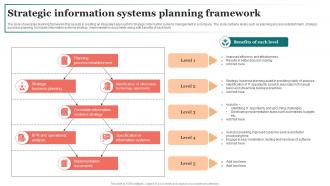
The slide showcases planning framework that assists in creating an integrated approach for strategic information systems management in a company. The slide contains levels such as planning process establishment, strategic business planning, formulate information systems strategy, implementation documents along with benefits of each level.
People who downloaded this PowerPoint presentation also viewed the following :
Strategic Information Systems Planning Framework with all 6 slides:
Use our Strategic Information Systems Planning Framework to effectively help you save your valuable time. They are readymade to fit into any presentation structure.





FAQs for Strategic Information
The SISP Framework comprises strategic alignment, information architecture, technology infrastructure, organizational capabilities, and governance structures. These components interrelate through continuous feedback loops, with strategic alignment driving architecture decisions, technology infrastructure enabling organizational capabilities, and governance structures ensuring coherent implementation, ultimately delivering integrated information systems that enhance operational efficiency and competitive advantage.
Organizations can effectively align IT strategy with business goals using SISP by conducting comprehensive strategic analysis, stakeholder engagement, resource assessment, and developing integrated roadmaps that connect technology investments directly to business objectives. Through systematic planning phases, companies in manufacturing, healthcare, and financial services streamline operations, enhance customer experiences, and accelerate digital transformation, ultimately delivering competitive advantage and measurable ROI.
Stakeholder engagement ensures SISP Framework alignment with diverse organizational needs, secures necessary resources, and facilitates change management throughout implementation phases. Active participation from executives, IT teams, department heads, and end-users creates shared ownership, reduces resistance, and enables comprehensive requirements gathering, ultimately delivering strategic consensus and smoother technology adoption across all business units.
The SISP Framework aids risk management by establishing systematic planning processes, comprehensive stakeholder alignment, and structured governance protocols that identify potential vulnerabilities early. Through strategic information systems planning, organizations streamline risk assessment workflows, enhance decision-making transparency, and implement proactive mitigation strategies, with many IT departments finding that this structured approach ultimately delivers reduced project failures and improved operational resilience.
Organizations should consider metrics like ROI on technology investments, business-IT alignment scores, project delivery timelines, user adoption rates, and strategic objective achievement. These measurements enable leaders to assess whether their SISP initiatives deliver operational efficiency, competitive advantage, and sustainable growth, with many finding that balanced scorecards combining financial and strategic indicators provide comprehensive success evaluation.
The SISP Framework accommodates rapid changes through flexible planning cycles, continuous environmental scanning, and adaptive strategy revision processes that enable real-time adjustments. Organizations using SISP maintain competitive advantage by regularly reassessing technology trends, market conditions, and business requirements, with many companies finding that this iterative approach delivers faster response times and more resilient strategic positioning.
SMEs can leverage the SISP Framework to achieve competitive advantage by aligning technology investments with strategic goals, optimizing resource allocation, and accelerating digital transformation initiatives. Through strategic information systems planning, smaller organizations streamline operations, enhance customer experiences, and compete more effectively against larger competitors, with many SMEs finding that systematic IT planning delivers cost efficiencies and market responsiveness.
Common pitfalls include inadequate stakeholder engagement, insufficient alignment between IT and business objectives, poor resource allocation, lack of executive commitment, and unrealistic timelines. These challenges often emerge when organizations rush implementation without proper change management, with many enterprises finding that successful SISP adoption requires sustained leadership support and comprehensive strategic planning processes.
The SISP Framework contributes to innovation by aligning strategic information systems planning with organizational goals, enabling systematic technology evaluation, and creating structured pathways for digital transformation initiatives. Through strategic IT roadmapping and resource optimization, organizations streamline innovation processes, reduce implementation risks, and accelerate time-to-market for new solutions, ultimately delivering competitive advantage and enhanced operational agility.
**INPUT**: What approaches can be taken to ensure continuous improvement in the SISP process? **OUTPUT**: Continuous improvement in SISP processes includes regular stakeholder feedback collection, performance metrics monitoring, iterative plan refinements, cross-departmental collaboration reviews, and technology trend assessments. These approaches streamline strategic alignment by identifying gaps early, enhancing resource allocation, and adapting to market changes, with many organizations finding that systematic review cycles ultimately deliver better IT-business integration and competitive advantage. **Word count: 56 words**
Cultural factors significantly influence SISP Framework effectiveness by affecting communication styles, decision-making processes, risk tolerance levels, and technology adoption rates across different regional operations. Multinational companies often find that adapting the framework to local business practices, leadership hierarchies, and regulatory environments enhances strategic alignment, while standardizing core processes delivers operational consistency and competitive advantage globally.
Tools and methodologies that complement the SISP Framework include SWOT analysis, balanced scorecards, enterprise architecture frameworks, business process modeling, and strategic roadmapping tools. These approaches enhance decision-making by providing comprehensive organizational assessment, performance measurement capabilities, and structured analysis methods, with many organizations finding that combining SISP with portfolio management tools delivers significantly improved strategic alignment and resource optimization.
Regulatory changes significantly impact SISP Framework elements by requiring updates to governance structures, compliance protocols, and risk management strategies throughout the strategic planning process. Organizations must realign their information systems priorities, modify security frameworks, and adjust resource allocation to meet new requirements, with many financial services and healthcare institutions finding that proactive regulatory monitoring enhances operational resilience and competitive positioning.
Organizations can implement cross-functional SISP teams, establish shared performance metrics, create standardized communication protocols, and utilize collaborative planning platforms to ensure effective departmental integration. Through regular interdepartmental workshops and strategic alignment sessions, companies in manufacturing, healthcare, and financial services streamline decision-making processes, enhance resource allocation, and ultimately deliver cohesive strategic outcomes with improved operational efficiency.
Businesses measure SISP Framework ROI by tracking operational efficiency improvements, cost reductions from streamlined processes, enhanced decision-making speed, and strategic alignment metrics between IT investments and business objectives. Through comprehensive performance dashboards, organizations quantify technology adoption rates, productivity gains, and competitive advantages, with many enterprises finding that systematic measurement of these interconnected outcomes demonstrates clear financial returns within 12-18 months.
-
Eye-catching PPT designs, outstanding team, and best customer service. I’m a super satisfied customer here!
-
Based on my personal experience, I would recommend other people to subscribe to SlideTeam. No one can be disappointed here!