

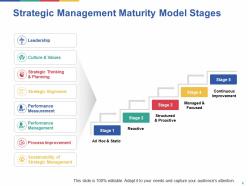
Strategic Management Maturity Model Powerpoint Presentation Slides





Try Before you Buy Download Free Sample Product
 Impress Your
Audience
 100%
Editable
 Save Hours
of Time


Bring her concerns to the forefront with our Strategic Management Maturity Model Powerpoint Presentation Slides. Fight for the female cause.
People who downloaded this PowerPoint presentation also viewed the following :
Strategic Management Maturity Model Powerpoint Presentation Slides with all 14 slides:
Fulfill your destiny with our Strategic Management Maturity Model Powerpoint Presentation Slides. They will make your dreams come true.




FAQs for Strategic Management Maturity Model
Key components of a Strategic Management Maturity Model include strategic planning processes, performance measurement systems, organizational alignment mechanisms, governance structures, and continuous improvement frameworks. These components work together by establishing clear strategic direction, enabling data-driven decision making, and fostering organizational capabilities, with many enterprises finding that higher maturity levels deliver enhanced competitive advantage and operational excellence.
Organizations can assess their strategic management maturity through comprehensive evaluations of planning processes, execution capabilities, performance measurement systems, stakeholder alignment, and adaptive capacity. Many companies utilize structured maturity frameworks, conduct cross-functional audits, and benchmark against industry standards, with financial services and manufacturing sectors increasingly finding that systematic assessments reveal gaps in strategic integration, ultimately enabling targeted improvements and competitive advantage.
Organizations at lower maturity levels typically face fragmented planning processes, reactive decision-making, limited stakeholder alignment, inconsistent performance measurement, and poor resource allocation coordination. These challenges manifest across sectors like manufacturing and retail, where companies struggle with siloed departments, unclear strategic priorities, and inadequate communication systems, ultimately hindering operational efficiency and competitive positioning in increasingly dynamic markets.
The maturity model facilitates strategic capability development by providing structured assessment frameworks, progressive skill-building pathways, and performance benchmarking systems that enable organizations to systematically enhance their planning competencies. Through standardized evaluation criteria, companies can identify capability gaps, implement targeted improvement initiatives, and track advancement across strategic domains, ultimately delivering enhanced decision-making processes and competitive advantage.
Leadership drives strategic management maturity by establishing clear vision, allocating resources effectively, fostering cross-functional collaboration, and championing continuous improvement initiatives throughout the organization. Strong leaders in manufacturing, healthcare, and financial services create cultures of strategic thinking, accountability, and adaptation, ultimately enabling their organizations to navigate complex business environments while delivering sustained competitive advantage and operational excellence.
Organizations use the maturity model to align strategic objectives by assessing current capabilities, identifying gaps between present and desired states, and creating structured roadmaps for advancement. Through systematic evaluation across planning, execution, and monitoring dimensions, companies can prioritize initiatives, allocate resources strategically, and establish clear milestones, ultimately delivering enhanced organizational coherence and competitive positioning.
**INPUT**: What metrics can be employed to measure progress within the Strategic Management Maturity Model? **OUTPUT**: Strategic management maturity metrics include strategic plan execution rates, goal achievement percentages, decision-making cycle times, stakeholder alignment scores, and resource allocation efficiency measures. These indicators enable organizations to track advancement through maturity levels by measuring planning consistency, implementation effectiveness, and strategic outcomes, with many companies finding that comprehensive metric frameworks ultimately deliver enhanced organizational performance and competitive positioning. **Word count: 60 words**
Strategic management maturity models differ across industries based on regulatory requirements, operational complexity, and competitive pressures, with healthcare and financial services typically requiring higher compliance maturity while manufacturing focuses on operational excellence frameworks. Industries like technology prioritize agile strategic planning and innovation maturity, whereas traditional sectors emphasize risk management and governance structures, ultimately reflecting each sector's unique strategic priorities and stakeholder expectations.
Best practices for advancing strategic management maturity levels include conducting comprehensive capability assessments, establishing clear governance frameworks, investing in leadership development, implementing robust performance measurement systems, and fostering cross-functional collaboration. Organizations successfully progressing through maturity stages focus on standardizing processes, enhancing data-driven decision making, and building strategic planning capabilities, with many finding that systematic approach development ultimately delivers improved organizational alignment and competitive advantage.
Technology enhances strategic management maturity through advanced analytics platforms, AI-powered forecasting tools, digital dashboards, cloud-based collaboration systems, and automated performance tracking solutions. These technologies streamline data collection, enable real-time decision-making, and facilitate cross-functional alignment, with many organizations finding that integrated digital platforms ultimately deliver faster strategic pivots and measurable competitive advantage.
Stakeholder engagement ensures comprehensive maturity assessment by incorporating diverse perspectives, identifying blind spots, and building organizational buy-in for strategic improvements. Through collaborative evaluation processes, organizations gain deeper insights into capability gaps, enhance change management effectiveness, and create shared ownership of transformation initiatives, with many enterprises finding that inclusive assessments deliver more accurate roadmaps and sustainable competitive advantage.
Organizations ensure sustainability while advancing through maturity levels by embedding environmental and social considerations into strategic planning processes, implementing circular economy principles, and establishing sustainability metrics at each development stage. This integrated approach enables companies to balance profitability with environmental responsibility, optimize resource utilization, and build resilient business models, with many finding that sustainability becomes a competitive differentiator rather than compliance burden.
Training and development initiatives that support higher strategic management maturity include executive leadership programs, scenario planning workshops, strategic thinking certification courses, cross-functional collaboration training, and data-driven decision-making seminars. These programs enhance organizational capability by developing analytical skills, fostering strategic mindset adoption, and building change management competencies, ultimately delivering improved strategic execution and competitive advantage across all management levels.
The maturity model addresses agility needs by incorporating flexible frameworks, adaptive planning cycles, and real-time feedback mechanisms that enable rapid strategic pivots. Higher maturity organizations implement scenario planning, cross-functional collaboration, and continuous monitoring systems, with many companies finding that these capabilities reduce response times to market changes while maintaining strategic coherence and competitive advantage.
Successful implementations include General Electric's digital transformation maturity framework, which streamlined operations across divisions, and IBM's strategic planning evolution model, enhancing portfolio management and resource allocation. These organizations leveraged maturity assessments to identify capability gaps, prioritize investments, and accelerate decision-making processes, ultimately delivering improved operational efficiency and competitive advantage in increasingly complex markets.
No Reviews